Cambridge International AS and A Level Chemistry 35: Polymerisation
Cambridge International AS and A Level Chemistry 35: Polymerisation
Study guide/
Cambridge International Chemistry 9701 notes on polyester and polyamide formation, repeat-unit and monomer deduction, polymerisation classification and polymer degradation.
Polymerisation is Cambridge International Chemistry 9701 Topic 35. The A Level boundary covers polyester and polyamide formation from paired or self-condensing monomers, repeat-unit and monomer deduction, classification of polymerisation and degradation by light or hydrolysis.
1. Condensation polymerisation
Condensation polymerisation joins bifunctional monomers and eliminates a small molecule at each new link. Water is lost when carboxylic acids react, while hydrogen chloride is lost when acyl chlorides react.
Monomers need two reactive ends to build long chains. A monofunctional molecule can terminate growth but cannot by itself form a linear high polymer.
The repeating link identifies the reaction family more reliably than the carbon skeleton alone.
2. Polyester from diol and dicarboxylic acid
Each hydroxyl group of a diol reacts with a carboxyl group of a dicarboxylic acid, forming ester links and eliminating water.
The repeat unit contains residues from both monomers. Remove hydroxyl from the acid group and hydrogen from the alcohol group at each joining site, but preserve all remaining atoms.
Polymer brackets cut through bonds continuing to neighbouring repeat units.
3. Polyester from diol and dioyl chloride
A diol reacts with a dioyl chloride to form a polyester and hydrogen chloride. The acyl chloride route is more reactive and proceeds through addition-elimination at each carbonyl.
The dioyl chloride supplies both carbonyl sides of ester links; the diol supplies oxygen-containing chain segments.
Account for two reactive acyl-chloride ends per dioyl-chloride molecule.
4. Polyester from a hydroxycarboxylic acid
A hydroxycarboxylic acid contains both required functions in one molecule. Its hydroxyl reacts with another molecule's carboxyl group, creating an ester link and water.
The repeat unit is derived from one monomer residue rather than alternating residues from two monomers.
Do not join hydroxyl to hydroxyl or carboxyl to carboxyl.
5. Polyamide from diamine and dicarboxylic acid
Each amino group of a diamine condenses with a carboxyl group of a dicarboxylic acid, forming amide links and water.
The repeat unit retains one diamine residue and one diacid residue. The amide nitrogen keeps one hydrogen when the starting amine group is primary.
Preserve carbon counts on both sides of every carbonyl.
6. Polyamide from diamine and dioyl chloride
A diamine reacts with a dioyl chloride to form a polyamide and hydrogen chloride. Nitrogen attacks the acyl carbon, followed by chloride elimination.
Check this topic from memory
Attempt the matching topic bank before reopening the notes. Use each missed idea to decide what to review next.
A base may neutralise hydrogen chloride in practical preparations, but the syllabus structural deduction centres on link and by-product ownership.
Do not draw ester oxygen where the link should contain nitrogen.
7. Polyamide from aminocarboxylic acid
An aminocarboxylic acid self-condenses because one molecule's amino group reacts with another's carboxyl group.
The repeat unit contains an amide link and one monomer residue. Water is eliminated at each link formed from acid and amine functions.
The amino and carboxyl groups must be placed at opposite continuation ends in a linear representation.
8. Polyamides from amino acids
Amino acids form peptide bonds, which are amide links. Repeated condensation can therefore produce polypeptides or polyamides.
Side chains remain attached to their alpha carbons and affect the repeat pattern. A single amino acid gives one residue type; mixtures or sequences can give more complex structures.
Do not remove side chains as part of water loss.
9. Deducing a repeat unit from monomers
Identify both functional ends, pair compatible groups and remove the correct small-molecule atoms. Draw enough linked residues to see the repeating pattern before choosing bracket boundaries.
The smallest repeat unit must reproduce the chain by translation. It may contain two different monomer residues.
Check continuation valencies at both bracket edges.
10. Deducing monomers from a polyester
Locate every ester link and conceptually hydrolyse its acyl-oxygen bond. Restore hydroxyl to the acyl fragment and hydrogen to the oxygen fragment.
This gives a dicarboxylic acid plus diol, or a hydroxycarboxylic acid if both functions belong to one repeating residue. A dioyl-chloride precursor is also possible when the route is specified.
Use link placement and symmetry to choose the smallest valid monomer set.
11. Deducing monomers from a polyamide
Locate each carbonyl-nitrogen link and conceptually hydrolyse it. Restore carboxyl to the carbonyl fragment and amino to the nitrogen fragment.
The products may be a dicarboxylic acid with a diamine, an aminocarboxylic acid, or amino acids. If a dioyl chloride was used, replace the reconstructed acid hydroxyl with chlorine for that precursor.
Retain all nitrogen substituents and side chains.
12. Addition versus condensation from monomers
A monomer containing a carbon-carbon double bond and no paired bifunctional condensation requirement usually undergoes addition polymerisation. The double bond opens and no small molecule is lost.
Bifunctional monomers with alcohol, acid, acyl chloride or amine groups can undergo condensation to form ester or amide links.
Classify from reactive functionality rather than the monomer's common name.
13. Addition versus condensation from a polymer
An addition-polymer backbone commonly contains carbon-carbon single bonds reflecting an alkene monomer. A condensation polymer contains identifiable ester or amide links in its main chain.
Look for atoms absent from a pure carbon backbone and for carbonyl-heteroatom linkages. Then reconstruct whether a small molecule was eliminated.
Do not call every polymer containing oxygen a condensation polymer if oxygen is only a side group.
14. Why polyalkenes persist
Polyalkenes have strong, largely non-polar carbon-carbon and carbon-hydrogen backbones. They lack readily hydrolysable main-chain functional groups.
Many enzymes and ordinary environmental reagents cannot attack them efficiently, so they can be difficult to biodegrade.
Persistence depends on structure and conditions, but chemical inertness explains the syllabus comparison.
15. Light degradation
Some polymers absorb light or contain additives that initiate radical processes. Chain scission lowers molecular mass and weakens the material.
Photodegradation is not automatically complete biodegradation or conversion to harmless products. It may create smaller fragments.
State light as the initiating action and chain breakdown as the structural outcome.
16. Polyester hydrolysis
Acidic or alkaline hydrolysis breaks ester links. Acid conditions give carboxylic acids and alcohols, while alkaline conditions give carboxylate salts and alcohols until acid work-up.
Breaking links lowers chain length and can make a polyester biodegradable under suitable environmental or biological conditions.
Product protonation states must match the hydrolysis medium.
17. Polyamide hydrolysis
Acidic hydrolysis breaks amide links to carboxylic acids and protonated amines. Alkaline hydrolysis gives carboxylate salts and amines.
Polyamides can therefore degrade through chemical or enzymatic cleavage where conditions allow. Their hydrolysis may be slower than polyester hydrolysis because amide resonance stabilises the link.
Do not write neutral amine as the only nitrogen product in strong acid.
Worked application: reconstructing a polymer and its degradation
A polymer segment alternates a four-carbon diol residue with a benzene dicarbonyl residue and contains ester links in the main chain. Cutting each ester link and restoring hydroxyl groups identifies butane-1,4-diol and benzene-1,4-dicarboxylic acid as one valid monomer pair; the corresponding dioyl chloride could replace the diacid in an alternative route. Because a small molecule is eliminated and ester links remain, this is condensation polymerisation rather than addition. Acid hydrolysis regenerates carboxylic-acid and alcohol ends, while alkaline hydrolysis produces carboxylate and alcohol ends. Each cleavage lowers chain length. A pure polyalkene would resist this route because its main chain lacks ester or amide links.
Common misconceptions and corrections
Calling any chain-forming reaction condensation. A small molecule must be eliminated.
Using monofunctional monomers for a long linear chain. Two reactive ends are needed.
Losing arbitrary atoms when forming an ester. Remove acid hydroxyl and alcohol hydrogen.
Giving water as the dioyl-chloride by-product. It produces hydrogen chloride.
Joining two hydroxyl groups directly. Pair alcohol with acid or acyl chloride.
Drawing an ester link in a polyamide. The link contains carbonyl-nitrogen.
Removing side chains from amino acids. They remain on alpha carbons.
Using brackets before finding the pattern. Draw several residues first.
Choosing a repeat unit that cannot tile the chain. Test translation.
Leaving broken valencies at bracket edges. Continuation bonds must be valid.
Cutting a polyester at the wrong bond. Restore acid and alcohol functions.
Forgetting nitrogen substituents in polyamide monomers. Preserve them.
Assuming every polyester needs two monomers. Hydroxy acids self-condense.
Assuming every polyamide needs two monomers. Amino acids can self-condense.
Calling alkene addition a condensation process. No small molecule is lost.
Classifying by oxygen anywhere in the molecule. Inspect the main-chain link.
Calling polyalkenes readily hydrolysable. Their backbone lacks hydrolysable groups.
Equating photofragmentation with full biodegradation. Smaller pieces may remain.
Writing carboxylic acid after alkaline ester hydrolysis. Carboxylate forms first.
Writing free amine after acid amide hydrolysis. It is protonated.
Claiming all polymers degrade at the same rate. Link chemistry and conditions matter.
Saying amide and ester links hydrolyse identically. Amide resonance can slow cleavage.
Assessment guidance
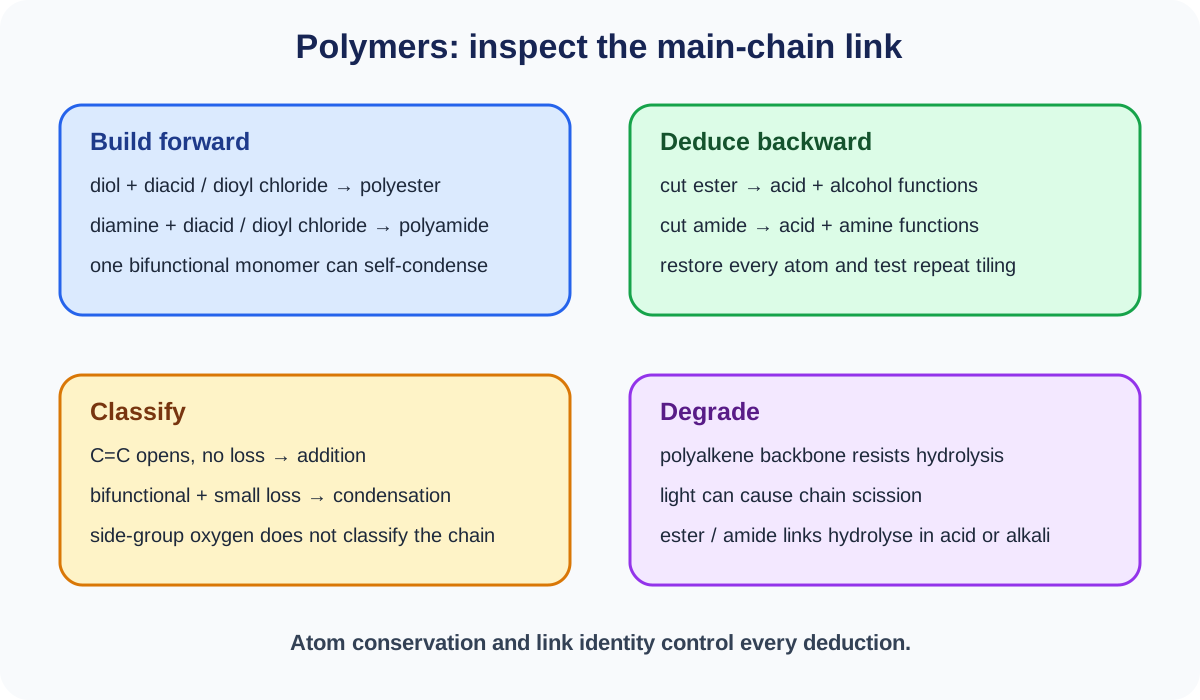
Start with a functional-end audit and identify whether the monomer set can grow in two directions. For construction, retain every skeleton atom, eliminate water or hydrogen chloride correctly and choose the smallest repeat unit that reproduces the chain. For reverse deduction, cut ester or amide links and restore acid, alcohol or amine functions with correct protonation. Classify addition by alkene opening without small-molecule loss and condensation by bifunctional monomers plus ester or amide links. Degradation answers should distinguish inert polyalkene backbones, light-induced chain scission and pH-dependent hydrolysis products.
Retrieval practice
Construct all six official polyester and polyamide route types, then deduce repeat units and reverse monomers from unfamiliar segments. Classify polymerisation from both monomer and product evidence. Compare a polyalkene, polyester and polyamide under light, acid and alkali, writing correct end groups after cleavage. Finish by auditing bracket boundaries, atom conservation, eliminated small molecules and whether each proposed repeat unit can tile the original chain.