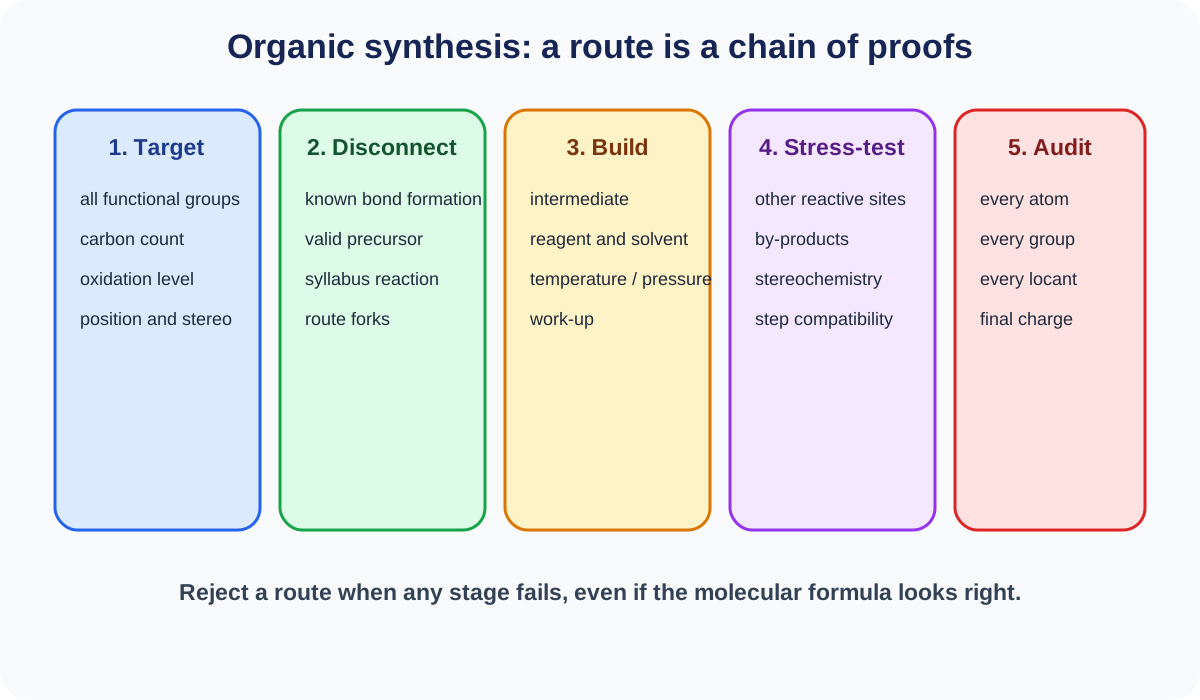
Organic Synthesis is Cambridge International Chemistry 9701 Topic 36. It integrates every organic reaction in the syllabus to identify functional groups, predict properties and reactions, devise multistep routes and analyse each step's reaction type, reagents and possible by-products.
1. Start with complete functional-group inventory
Mark every functional group in the starting material, intermediates and target. Include aromatic substituents, carbonyl derivatives, nitrogen groups and multiple reactive sites.
A reagent may react with more than the intended group. Multifunctional analysis is therefore a selectivity audit, not only a naming exercise.
Use exact connectivity because alcohol, phenol, amine and amide behaviour differs despite shared atoms.
2. Compare carbon skeletons
Count carbons in source and target before choosing reactions. Most transformations preserve carbon count; cyanide substitution or hydroxynitrile formation adds a carbon.
Carbon-carbon bond formation must be planned deliberately. If count changes without a known carbon source or loss, the route is incomplete.
Track aromatic-ring carbons separately from side-chain carbons when oxidation changes a side chain.
3. Compare oxidation levels
Identify whether each carbon becomes more or less bonded to electronegative atoms or hydrogen. Alcohol-to-carbonyl and side-chain-to-acid steps are oxidations; carbonyl-to-alcohol and amide-to-amine steps are reductions.
Select reagents and conditions that stop at the required level. Distillation versus reflux can control primary-alcohol oxidation products.
Do not use oxidation-state language as a substitute for the actual product structure.
4. Retrosynthetic disconnections
Work backwards from the target by replacing a bond with plausible precursor functional groups. An ester suggests alcohol or phenol plus acid or acyl chloride; an amide suggests ammonia or amine plus acyl chloride.
An amine may trace back to nitrile or amide reduction, while a longer-chain nitrile may trace back to halogenoalkane substitution.
Every backward step must correspond to a forward reaction in the syllabus.
5. Build the forward route
After retrosynthesis, write the route from actual starting material to target. Give the reagent, solvent, temperature, pressure, catalyst and work-up needed for each arrow.
Intermediates should be structurally explicit. Conditions such as acidification, excess ammonia or below-10-degree diazotisation can determine the isolated species.
Validate that each intermediate survives the next conditions.
Check this topic from memory
Attempt the matching topic bank before reopening the notes. Use each missed idea to decide what to review next.
Halogenoalkane substitution by cyanide adds one carbon and forms a nitrile. Nitrile hydrolysis gives a carboxylic acid or carboxylate, while reduction gives a primary amine.
Carbonyl addition of hydrogen cyanide also adds a carbon and creates a hydroxynitrile, but preserves an oxygen-containing group and may create chirality.
Choose the route from target connectivity, not merely the desire for one extra carbon.
7. Aromatic-route control
Electrophilic substitution requires appropriate catalysts or acid mixtures and existing groups direct new substitution. Ring and side-chain halogenation of methylbenzene use different conditions.
Strongly activating amino or hydroxyl groups may change rate and substitution count. Deactivating nitro, carboxyl and acyl groups alter position and conditions.
Plan substituent order when one group controls installation of the next.
8. Diazonium route forks
Phenylamine forms a diazonium salt with nitrite and dilute acid below 10 degrees Celsius. Warming with water gives phenol, while coupling with activated phenol in alkali gives an azo compound.
The same intermediate therefore supports different targets through condition choice. Treat it as a deliberate route fork.
Do not warm before choosing the desired outcome.
9. Acyl-transfer route forks
Acyl chlorides react at room temperature with water, alcohol, phenol, ammonia, primary amine or secondary amine. The nucleophile selects acid, ester or amide product.
Their high reactivity can shorten a route but also creates moisture sensitivity and unintended acylation. Account for hydrogen chloride or base neutralisation.
Track which reactant supplies the acyl fragment and which supplies the heteroatom fragment.
10. Reaction-type labels
Use precise labels: electrophilic substitution, nucleophilic substitution, addition, elimination, oxidation, reduction, hydrolysis, condensation, addition-elimination and polymerisation.
A single step can merit a more specific mechanistic description than a broad synthetic one. Acyl chloride plus amine is condensation overall and nucleophilic addition-elimination mechanistically.
Match the requested level of classification without giving contradictory labels.
11. Reagent and condition fidelity
Similar reagents can produce different outcomes through solvent or temperature. Aqueous hydroxide favours substitution while ethanolic hydroxide and heat favour elimination.
Acidic and alkaline hydrolysis produce different protonation states. Hot alkaline manganate followed by acid differs from acidified oxidant used directly.
Conditions are chemical information, not optional decoration.
12. Functional-group compatibility
Ask whether a reagent affects any group other than the intended site. A strong reducing agent may reduce several carbonyl derivatives, while an oxidant may attack multiple susceptible groups.
The syllabus does not require a broad protecting-group toolkit, so routes should use available selectivity, order of operations or supplied information.
If unavoidable competing reaction exists, the proposed route is not yet valid.
13. Stereochemical audit
Check whether addition or substitution creates or removes a chiral centre, and whether a planar intermediate gives a racemic mixture.
Drug or optical-isomer contexts may require resolution or a chiral catalyst. Geometrical isomerism can also constrain the structure of alkene intermediates.
State stereochemical outcomes when the target specifies one isomer.
14. By-product prediction
Possible by-products arise from over-oxidation, competing substitution or elimination, multiple aromatic substitution, further amine alkylation, incomplete selectivity or alternative positional attack.
Predict by-products from the actual mechanism and conditions. A generic statement that impurities form earns little explanatory value.
Then adjust excess reagent, temperature, solvent or order where syllabus chemistry allows.
15. Analyse a supplied route
For each arrow, compare structures, identify bonds made or broken, label the reaction, infer reagents and inspect small products or salts.
Use later intermediates as evidence for ambiguous earlier steps. A carbon-count change can distinguish cyanide from hydroxide substitution; a final amide identifies prior acyl activation.
Check the whole sequence after analysing individual arrows.
16. Route economy and evidence
Prefer fewer justified steps when routes have similar selectivity, but shortest is not automatically best. A longer route may control carbon count, position or oxidation state more reliably.
Each intermediate should have a purpose and a feasible isolation or direct continuation. Do not add steps solely because the reaction is familiar.
Use yield or purity data if supplied, but do not invent industrial superiority without evidence.
17. Whole-route audit
At the end, compare target and final product atom by atom. Verify carbon count, every functional group, substituent position, stereochemistry and charge state.
Read all arrows together for incompatible reagents, absent work-ups or intermediates used before formation. Confirm catalysts are regenerated and by-products accounted for where relevant.
A locally correct step does not rescue a globally incorrect route.
Worked application: a carbon-count and selectivity route
To prepare 3-aminopropanoic acid from bromoethane, first substitute bromide with cyanide in ethanol to form propanenitrile; this adds the required third carbon. Hydrolyse the nitrile under acidic conditions to propanoic acid only if the amino group is not yet needed. A better direct amino-acid plan requires introducing a leaving group at the correct carbon before ammonia substitution, so the original two-step idea is insufficient for the specified amino position. This failure is useful: carbon count is correct but connectivity is wrong. A valid answer must select a syllabus starting material or intermediate whose leaving group already occupies carbon 3, use excess ammonia under pressure to form the amine and preserve or generate the carboxyl group without oxidising the amine incompatibly. Whole-route auditing prevents a plausible reagent list from being accepted as the target.
Common misconceptions and corrections
Identifying only one functional group. Audit every reactive site.
Ignoring carbon count. Track every carbon source and loss.
Adding cyanide without recognising chain extension. Its carbon enters the product.
Treating all one-carbon additions as equivalent. Nitrile substitution and HCN addition give different connectivity.
Working backwards with reactions absent from the syllabus. Every disconnection needs a valid forward step.
Leaving intermediates unnamed or undrawn. Their structure is evidence.
Giving reagents without conditions. Solvent and temperature can change the product.
Forgetting acid or base work-up. Protonation state may be wrong.
Ignoring aromatic directing effects. Existing groups control position.
Using ultraviolet and Lewis-acid halogenation interchangeably. They target different sites.
Warming a diazonium salt before choosing the route fork. It can hydrolyse.
Reversing ester fragment ownership. Track the acyl and heteroatom sources.
Calling every acyl reaction direct substitution. It proceeds by addition-elimination.
Using vague reaction labels only. Give the most specific valid type.
Treating aqueous and ethanolic hydroxide as identical. They favour different paths.
Applying a reagent to one group while ignoring another susceptible group. Check compatibility.
Assuming protection chemistry outside the syllabus. Use permitted route ordering.
Ignoring racemic formation. Planar attack can create both enantiomers.
Listing generic impurities. Derive by-products from mechanisms.
Assuming shortest route is automatically best. Selectivity and feasibility matter.
Validating each arrow but not the final target. Perform a global audit.
Accepting correct carbon count with wrong connectivity. Both must match.
Assessment guidance
Start with functional-group, carbon-count, oxidation-level and stereochemical comparisons. Work backwards only through reactions available in the full syllabus, then present a forward route with explicit intermediates, reagents, solvents, temperatures, catalysts, pressure and work-ups. For each arrow, state a defensible reaction type and predict mechanism-based by-products or competing sites. Check functional-group compatibility before accepting the sequence. Finish with an atom-by-atom target audit, including aromatic locants, protonation state and stereochemical outcome; a plausible reagent list without correct connectivity is not a valid synthesis.
Retrieval practice
Build a reaction network organised by carbon-count change, oxidation level, aromatic substitution and acyl or diazonium forks. Retrosynthesise unfamiliar multifunctional targets, then rewrite each as a forward route with full conditions. Analyse supplied routes for reaction type and by-products, deliberately test competing groups and stereochemistry, and reject routes that reach the right formula but wrong connectivity. Finish every practice route with the same whole-target audit.