Cambridge International AS and A Level Chemistry Practical 1: Quantitative Measurement and Titration
Cambridge International AS and A Level Chemistry Practical 1: Quantitative Measurement and Titration
Study guide/
Cambridge International Chemistry 9701 practical notes on balances, volumetric apparatus, standard solutions, titration technique, concordance, calculations and uncertainty.
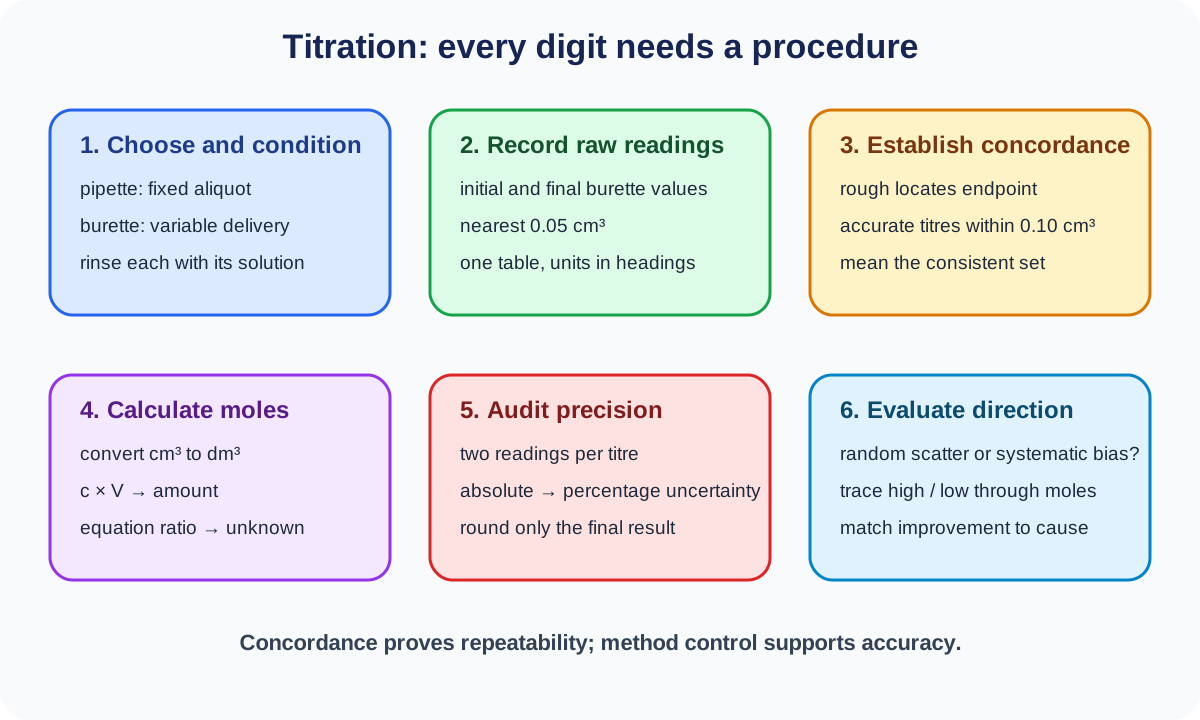
Quantitative Measurement and Titration is the first Cambridge Chemistry 9701 practical-skills note. It develops Paper 3 manipulation, measurement, data presentation, calculation and evaluation through balances, volumetric apparatus, standard solutions and titration. Paper 5 may test the same choices through planning and analysis without requiring apparatus assembly.
1. Match apparatus to measurement purpose
A volumetric pipette delivers one fixed volume accurately. A burette delivers a variable volume and records the difference between initial and final readings. A volumetric flask makes one precise total volume.
A measuring cylinder is suitable when moderate precision is enough. A beaker is primarily for containing or mixing, not for a high-precision volume.
Justify apparatus by required uncertainty and task, not by saying it is simply more accurate.
2. Balance measurements
Use a balance whose displayed resolution matches the mass precision required. Record all related masses to the same decimal places supported by the instrument.
Mass by difference is often more reliable than assuming every weighed solid transfers. Weigh container plus material, transfer, then reweigh the container and subtract.
Never invent extra digits beyond the balance display.
3. Preparing a standard solution
Accurately weigh a suitable pure solid, dissolve it in a small volume of deionised water and transfer quantitatively to a volumetric flask. Rinse the beaker, stirring rod and funnel into the flask.
Make up near the calibration mark, then add water dropwise until the bottom of the meniscus is at the mark at eye level. Stopper and invert repeatedly to mix.
Calculate concentration from transferred moles divided by final flask volume in cubic decimetres.
4. Quantitative transfer
Quantitative transfer means moving the measured amount without avoidable material loss. Rinsings carry residual solution into the receiving vessel.
Wash water does not change the number of solute moles transferred. It changes volume only until the final calibrated volume is set.
Do not rinse a volumetric flask with the solution being prepared, because that would add an unknown solute amount.
5. Conditioning a pipette
Rinse the pipette with deionised water, then with a small portion of the solution it will deliver. The solution rinse prevents residual water from diluting the aliquot.
Use a pipette filler, draw above the mark, then adjust the meniscus at eye level. Allow the pipette to drain under gravity into the flask.
Check this topic from memory
Attempt the matching topic bank before reopening the notes. Use each missed idea to decide what to review next.
Do not blow out the final liquid remaining in a volumetric pipette unless it is specifically designed for blow-out delivery.
6. Conditioning a burette
Rinse the burette with deionised water and then with the titrant. Run titrant through the tap and jet so no water or air bubble remains.
Remove the filling funnel before titration because drops from it could enter later and alter the reading. Check for leaks and read the meniscus at eye level.
The initial reading need not be zero; titre is final minus initial.
7. Conical flask preparation
Transfer the analyte aliquot with a pipette into a clean conical flask. Add only a few drops of a suitable indicator.
Rinsing the flask with deionised water is acceptable because it does not change analyte moles. Rinsing it with analyte would add an unknown amount.
Use a white tile beneath the flask to make a subtle endpoint colour change easier to judge.
8. Rough titration
The rough titration locates the approximate endpoint. Add titrant relatively quickly while swirling, then slow as the indicator begins to change.
Record the rough result but do not automatically include it in the mean. Its purpose is to guide accurate trials.
Subsequent titrations can add rapidly to a safe distance before the endpoint, then proceed dropwise.
9. Accurate endpoint technique
Swirl continuously so added titrant mixes throughout the flask. Near the endpoint, add one drop at a time and rinse flask walls with deionised water if splashes remain above the mixture.
The endpoint is the first permanent indicator colour change persisting after swirling, not the darkest possible colour.
Wash-bottle water changes concentration in the flask but not reacting moles, so it does not change the equivalence titre.
10. Burette readings and precision
Cambridge expects burette readings to the nearest 0.05 cubic centimetres. Record both initial and final readings consistently, normally with two decimal places and the final digit zero or five.
Read from the correct meniscus and avoid parallax by placing the eye level with it. A reading such as 21.3 cubic centimetres does not show the expected burette precision.
Titre inherits uncertainty from two burette readings.
11. Titration table
Prepare one table before taking readings. Include trial, initial burette reading, final burette reading and titre, with units in headings rather than every cell.
Keep raw readings, including the rough value and any anomalous accurate run. Do not erase inconvenient results or rewrite only selected titres.
Use a consistent number of decimal places throughout each measurement column.
12. Concordant titres
Cambridge defines concordant titres as two titres within 0.10 cubic centimetres of each other. Obtain at least two before calculating the accepted mean.
Select all concordant accurate titres that form a consistent set. Do not choose distant values merely because their mean seems convenient.
If an anomaly occurs, repeat the titration and use the consistent cluster.
13. Mean titre
Average the concordant accurate titres, normally excluding the rough result. State which values were used.
Keep sufficient digits through the calculation and report the mean at a precision consistent with the burette data.
A mean cannot improve systematic endpoint bias, but repeats reduce the effect of random variation and expose anomalies.
14. Indicator choice
An indicator must change colour within the steep pH region around the equivalence point. The best indicator depends on acid and base strengths.
Use only a small amount because indicator itself is a weak acid or base. Too much can consume titrant and blur the endpoint.
Endpoint is the observed indicator change; equivalence point is the stoichiometric condition. They should be close but are not identical definitions.
15. Mole calculation sequence
Convert mean titre to cubic decimetres and multiply by known concentration to find titrant moles. Use the balanced equation to convert through the stoichiometric mole ratio.
Those moles belong to the aliquot in the conical flask. Divide by aliquot volume in cubic decimetres to find analyte concentration, then apply any earlier dilution factor.
Do not use volume ratios as mole ratios unless concentrations and stoichiometry make that valid.
16. Back titration
In a back titration, add a known excess of reagent to the sample, then titrate the unreacted excess. Subtract remaining moles from initially added moles.
Convert the amount that reacted with the sample through the relevant equation. This method is useful for slow, insoluble or endpoint-inconvenient samples.
The final titre measures leftover reagent, not the sample directly.
17. Significant figures and working
Show every calculation stage so method credit remains visible. Cambridge accepts a final calculated quantity at the same or one more significant figures than the least precise supplied or measured input.
Avoid premature rounding. Carry guard digits until the final answer, then round once and include units.
Decimal places describe measurement recording; significant figures describe numerical precision. They are related but not interchangeable.
18. Absolute uncertainty
For one analogue reading, uncertainty is commonly related to half the smallest scale division. A delivered volume from a burette uses two readings, so their absolute reading uncertainties combine.
Use the convention specified by the question or instrument. State it rather than silently mixing assumptions.
Zeroing a balance does not remove its finite reading uncertainty.
19. Percentage uncertainty
Percentage uncertainty equals absolute uncertainty divided by measured quantity, multiplied by one hundred. For a fixed absolute uncertainty, a larger measured quantity has smaller percentage uncertainty.
This is why titres of reasonable size are preferable to very small titres. Increasing concentration blindly, however, may create safety or endpoint problems.
Combine uncertainties according to the requested calculation method rather than adding percentage values indiscriminately.
20. Accuracy, precision and concordance
Precision describes closeness of repeated values. Accuracy describes closeness to the accepted or true value. Concordant titres demonstrate repeatability, not necessarily absence of systematic error.
A consistent miscalibrated burette or unsuitable indicator can give precise but inaccurate results.
Evaluation must state whether an issue affects random scatter, systematic bias or both.
21. Direction of systematic effects
If the burette is rinsed only with water, titrant is diluted and a larger delivered volume is needed. If the pipette contains residual water, analyte aliquot concentration is diluted and a smaller titre may result.
Overshooting the endpoint makes the recorded titre too large. An air bubble initially in the burette tip can also make the apparent titre too large when some reading change fills the tip rather than entering the flask.
Trace the effect through moles and final calculated concentration instead of stating only high or low.
22. Safety and waste
Wear eye protection, use a pipette filler and clean spills promptly. Identify corrosive acids or alkalis and any toxic oxidants or reducing agents in the actual method.
Clamp the burette securely and fill below eye level where possible. Dispose of reaction mixtures according to their hazards rather than assuming sink disposal.
A strong plan links each specific hazard to a control, not a generic statement to be careful.
Worked application: standardising an alkali
A 25.00 cubic centimetre aliquot of sodium hydroxide is titrated with 0.1000 moles per cubic decimetre acid. Accurate titres are 24.80, 24.75 and 24.85 cubic centimetres; all are within 0.10 cubic centimetres of one another, so their mean is 24.80 cubic centimetres. The acid amount is concentration multiplied by 0.02480 cubic decimetres, giving 0.002480 moles. For a one-to-one equation, the aliquot contains the same alkali amount. Dividing by 0.02500 cubic decimetres gives 0.09920 moles per cubic decimetre. The result is precise because the titres are concordant, but accuracy still depends on indicator choice, conditioned glassware, absence of tip bubbles and correct standard concentration.
Common misconceptions and corrections
Choosing a beaker for precise volume. Use calibrated volumetric apparatus.
Recording digits the balance does not display. Match instrument resolution.
Assuming nominal mass was fully transferred. Use mass by difference or quantitative rinsing.
Rinsing the volumetric flask with solute solution. That adds unknown moles.
Forgetting to mix after making to volume. Invert the stoppered flask repeatedly.
Rinsing a pipette only with water. Condition it with the delivered solution.
Blowing out a volumetric pipette. Allow its calibrated drain unless specified otherwise.
Leaving water in the burette. It dilutes titrant.
Leaving an air bubble in the tip. Apparent delivered volume can be too large.
Keeping the burette funnel in place. Later drops can alter readings.
Rinsing the conical flask with analyte. That adds unknown moles.
Using many indicator drops. Indicator can consume reagent and blur endpoint.
Treating the rough titre as an accurate repeat. Use it to locate endpoint.
Stopping at a dark colour. Use the first permanent change.
Saying wash water changes equivalence moles. It only dilutes the flask mixture.
Recording burette readings to one decimal place. Cambridge expects nearest 0.05 cubic centimetres.
Starting every burette at zero. Any recorded initial value is acceptable.
Calling titres 0.20 apart concordant. The stated limit is 0.10 cubic centimetres.
Averaging every result. Use the concordant accurate set.
Using endpoint and equivalence as synonyms. One is observed; one is stoichiometric.
Using titre volume directly as moles. Multiply by concentration after unit conversion.
Skipping the balanced-equation ratio. Stoichiometry connects reactants.
Forgetting aliquot and dilution factors. Track solution ownership at every stage.
Using the back titre as sample amount. It measures excess remaining.
Rounding at each calculation step. Retain guard digits.
Confusing decimal places with significant figures. They answer different precision questions.
Using one burette reading uncertainty for a titre. A titre is a difference of two readings.
Saying concordance proves accuracy. It proves repeatability.
Naming repeats as a cure for systematic bias. Repeats mainly address random variation.
Giving an error direction without tracing the calculation. Follow reagent concentration and moles.
Assessment guidance
Paper 3 rewards correct setup, conditioned apparatus, readings at the specified precision, a single pre-planned raw-data table and a concordant titre set. Calculations should show volume conversion, concentration-times-volume moles, balanced-equation ratio, aliquot concentration and dilution factors before final significant figures. Evaluation must distinguish resolution, absolute and percentage uncertainty, precision and accuracy. For each limitation, state the physical cause, whether it makes a reading or result high, low or more scattered, and a specific procedural improvement. Paper 5 plans should also justify apparatus range, repeat strategy, hazard controls and how data will answer the stated question.
Retrieval practice
Design a standard-solution preparation from mass to mixed volumetric flask, then annotate the correct rinsing for every vessel. Produce a complete burette table from raw readings, select concordant titres within 0.10 cubic centimetres and calculate an unknown concentration including dilution. Repeat for a back titration. Finish by calculating measurement uncertainties and tracing the direction of residual water, endpoint overshoot, air bubbles and transfer loss through the final result.
Cambridge International, Chemistry 9701 syllabus for examinations in 2025, 2026 and 2027, Practical Assessment section for Paper 3 manipulation, measurement, observation, quantitative titration, data presentation, analysis and evaluation, and Paper 5 planning, analysis and evaluation.