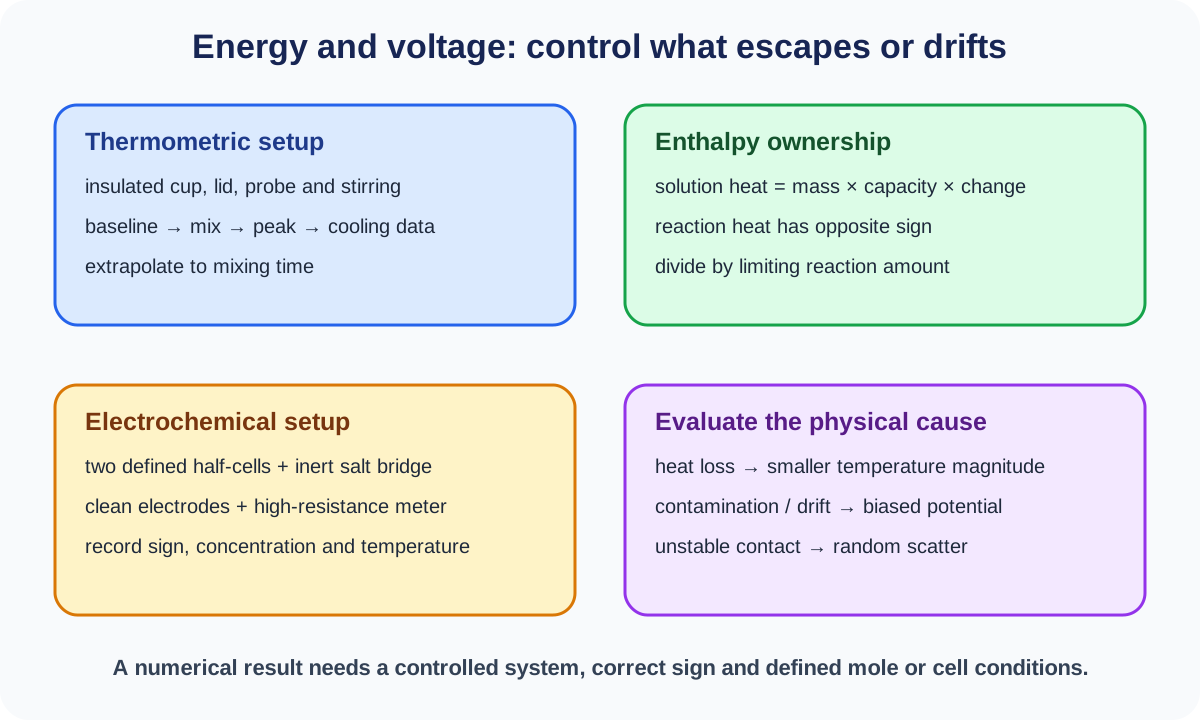
Energetics and Electrochemistry Investigations is the third Cambridge Chemistry 9701 practical-skills note. It develops the official thermometric measurement, presentation, calculation and evaluation skills through calorimetry and Hess cycles, then applies the same Paper 3 and Paper 5 evidence standards to cell-potential measurements. Energetics and electrode theory remain in the theory hub.
1. Define the thermometric aim
State the process whose enthalpy change will be determined and the amount basis, such as per mole of limiting reagent or per mole of water formed.
The dependent measurement is temperature against time or maximum temperature change. Volumes, concentrations, initial temperatures, insulation and mixing are controlled.
The sign and mole basis must be decided from the chemical process, not from the temperature reading alone.
2. Simple solution calorimeter
Use an insulated polystyrene cup supported in a beaker, with a lid, thermometer or temperature probe and a way to stir. The cup reduces heat transfer and has lower heat capacity than glass.
The lid reduces evaporation and exchange with air. A probe hole should be close fitting but must not create an unsafe sealed pressure system.
Use the same calorimeter construction across comparative runs.
3. Measuring initial temperature
Allow reacting solutions to reach the same starting temperature where possible. Measure stable initial temperatures before mixing.
If separate solutions differ, a mass- or volume-weighted initial temperature may be needed, but equal starting temperatures are experimentally cleaner.
Do not assume room temperature without measurement.
4. Mixing and timed readings
Record baseline temperature for several intervals, mix rapidly at a recorded time and stir consistently. Continue readings through the peak and into the cooling region.
A temperature probe with data logging gives more frequent, objective readings, but its calibration and response time still matter.
The mixing time must be known so an extrapolated corrected temperature can be read at the reaction time.
5. Maximum-temperature method
For a rapid exothermic reaction, subtract initial temperature from the highest observed temperature. For an endothermic process, the temperature change is negative because final temperature is lower.
This simple method underestimates the magnitude when heat exchange occurs before the observed extreme.
Report temperatures to precision compatible with the instrument, including Cambridge's nearest 0.5 degrees Celsius expectation for a thermometer graduated at 1 degree intervals.
Check this topic from memory
Attempt the matching topic bank before reopening the notes. Use each missed idea to decide what to review next.
Plot temperature against time. Fit the approximately linear cooling region after reaction and extrapolate it back to the mixing time.
The extrapolated value estimates the temperature that would have occurred without post-mixing cooling over that interval. Subtract the initial baseline at mixing time.
Use enough post-reaction points for a defensible line; do not extrapolate from only two adjacent readings.
7. Heat calculation
Calculate heat gained or lost by the solution as mass multiplied by specific heat capacity multiplied by temperature change. If solution density is assumed to be one gram per cubic centimetre, total volume in cubic centimetres estimates mass in grams.
The reaction heat has opposite sign to the solution heat. An exothermic reaction warms solution, so reaction enthalpy is negative.
Include calorimeter heat capacity if supplied rather than silently ignoring it.
8. Molar enthalpy
Calculate moles of the limiting reagent or the explicitly requested reaction amount. Divide reaction heat by that amount.
Convert joules to kilojoules and state kilojoules per mole. Balanced-equation stoichiometry defines what one mole of reaction means.
Do not divide by total moles of every substance in the cup.
9. Neutralisation experiments
Mix known acid and alkali quantities, determine corrected temperature change and calculate heat per mole of water formed.
Identify the limiting hydrogen or hydroxide amount. Excess reagent may remain but does not increase water moles beyond the limiting amount.
Use the same total volume and starting temperature when comparing acid or base strengths.
10. Enthalpy of displacement or solution
Metal-displacement calorimetry may use excess metal powder added to a measured metal-ion solution. Control metal mass, surface area, solution concentration and mixing.
For solution enthalpy, dissolve a known solute mass in measured water and calculate moles dissolved. Incomplete dissolution or material on cup walls makes the assumed reacted amount too large.
Choose the correct final solution mass rather than water mass alone when instructed by the model.
11. Hess-law experimental cycle
Measure two accessible enthalpy changes whose equations combine to give a difficult target. Write each chemical equation and reverse or multiply it before combining numerical values.
The experimental cycle does not remove systematic calorimetry errors; it organises measured state changes.
Use common initial or final states explicitly so the algebraic path is auditable.
12. Heat-loss bias
In an exothermic experiment, heat lost to surroundings reduces observed temperature rise and makes calculated enthalpy less negative than the true value.
In an endothermic experiment, heat enters from surroundings and reduces the observed temperature fall, making the calculated positive enthalpy too small.
Insulation, a lid, rapid mixing and extrapolation target this systematic underestimation of magnitude.
13. Apparatus heat capacity
The cup, lid, thermometer and stirrer absorb or release heat. Ignoring them assigns too little total heat transfer to the reaction.
Use a calorimeter constant if supplied or calibrate the apparatus. Merely switching to thicker glass may reduce external loss but increases apparatus heat capacity.
An improvement must address the dominant physical effect without creating a larger one.
14. Thermometer uncertainty
For a thermometer graduated every 1 degree Celsius, Cambridge uses maximum reading uncertainty of plus or minus 0.5 degrees Celsius. A temperature change uses two readings, so the maximum absolute uncertainty can be 1.0 degree Celsius.
Percentage uncertainty is that combined uncertainty divided by measured temperature change, multiplied by one hundred.
A larger safe temperature change reduces percentage uncertainty, but excessive concentrations may increase hazards.
15. Reaction-completion limitations
Incomplete reaction, slow dissolution, side reactions or reagent loss invalidates the assumed mole amount. Observe residual solid, delayed temperature change or unexpected colour.
Use an appropriate excess only when its heat contribution and amount basis remain controlled. Confirm reaction completion where possible.
Repeating an incomplete method produces precise but biased results.
16. Electrochemical investigation aim
A cell-potential investigation measures potential difference while changing one controlled factor, such as ion concentration, electrode identity or temperature.
The dependent variable is voltage with sign or electrode polarity. Control solution volumes, concentration of other ions, electrode area, immersion depth, salt bridge and equilibration time.
State whether the aim is comparison, concentration trend or identification of the positive electrode.
17. Constructing two half-cells
Place each electrode in a solution containing its relevant ions and connect the half-cells with a salt bridge. Connect electrodes to a high-resistance voltmeter.
The salt bridge completes the circuit and maintains charge balance without bulk mixing. A suitable inert electrolyte should not react or precipitate with cell ions.
Label electrode materials, ion concentrations and polarity.
18. Inert electrodes
When a redox couple contains only ions or gases, use an inert conductor such as platinum or graphite to transfer electrons.
Clean the surface consistently. An inert electrode provides electrical contact but does not appear in the net redox equation.
Do not use an arbitrary reactive metal that introduces another half-cell reaction.
19. Measuring cell potential
Allow the reading to stabilise, record voltage to meter precision and note which lead is connected to each electrode. Reversing leads reverses the sign, not the chemical cell.
Avoid drawing significant current because that changes concentrations and creates polarisation. A high-resistance voltmeter approximates open-circuit potential.
Repeat after cleaning and rebuilding to assess reproducibility.
20. Concentration-series cells
Prepare a measured concentration series by volumetric dilution while keeping the comparison half-cell constant. Rinse electrode and vessel between solutions to avoid carry-over.
Use concentration after mixing or dilution, not stock concentration. Hold temperature constant because potential varies with temperature.
Plot voltage against the transformed concentration variable requested or justified by theory; do not assume voltage is linearly proportional to concentration.
21. Electrode surface effects
Oxide films, grease or deposited material can slow electron transfer and destabilise readings. Polish or clean electrodes by a consistent safe method and rinse with deionised water.
Keep immersion depth and exposed area constant. Although ideal equilibrium potential is not set by area, inconsistent surfaces affect how reliably equilibrium is approached.
Do not claim a larger electrode automatically creates a larger standard potential.
22. Salt-bridge and junction effects
A dry, poorly contacting or chemically unsuitable salt bridge can give unstable voltage or introduce junction potential. Ensure both ends contact solution and use the same bridge composition.
Prevent direct solution mixing, which changes local concentrations. Replace contaminated bridges between incompatible runs.
Evaluate drift direction only when the chemical consequence is known; otherwise state increased instability rather than inventing high or low.
23. Electrochemical systematic errors
Incorrect concentrations, temperature drift and contaminated electrodes can bias potential. Voltmeter resolution adds reading uncertainty, while unstable contact produces random scatter.
Standard electrode potentials cannot be claimed unless standard conditions are actually established. An observed cell potential under other conditions is still valid experimental evidence but is not standard.
Classify each limitation before suggesting calibration, temperature control, fresh solutions or better contact.
24. Safety and disposal
Corrosive acids or alkalis, oxidising metal-ion solutions and toxic heavy-metal salts require specific controls. Wear eye protection and gloves where risk assessment requires them.
Avoid skin contact with electrodes contaminated by metal salts. Collect heavy-metal waste separately rather than disposing to the sink.
For calorimetry, control splash and heat hazards; for electrical work, use low-voltage cells and dry external connections.
Worked application: corrected neutralisation enthalpy
Equal 25.0 cubic centimetre portions of 1.00 moles per cubic decimetre strong acid and alkali begin at 21.0 degrees Celsius. Cooling-curve extrapolation gives 27.7 degrees Celsius at the mixing time, so the corrected rise is 6.7 degrees Celsius. Assuming density one gram per cubic centimetre and specific heat capacity 4.18 joules per gram per degree Celsius, the 50.0-gram solution gains 1400 joules to three significant figures. The reaction therefore releases 1.400 kilojoules. Water amount is 0.0250 moles from the limiting one-to-one neutralisation, giving negative 56.0 kilojoules per mole. Using the observed later peak instead would give a smaller rise and a value that is insufficiently negative because heat had already escaped.
Common misconceptions and corrections
Using a glass beaker as the best simple calorimeter. An insulated low-heat-capacity cup is preferable.
Assuming both solutions start at room temperature. Measure and equilibrate them.
Taking one initial reading. A baseline supports extrapolation.
Recording only the final temperature. Keep a time series through the peak.
Calling the observed peak fully corrected. Heat exchange has already occurred.
Extrapolating from two nearby points. Fit a defensible cooling region.
Using water volume as mass after adding substantial solute. Apply the stated mass model.
Giving solution heat the reaction sign. Reaction heat is opposite.
Omitting limiting-reagent moles. Molar enthalpy needs a reaction amount.
Dividing by total solution moles. Use the specified stoichiometric amount.
Ignoring calorimeter heat capacity when provided. Include it.
Combining Hess values without equations. Reverse and multiply state changes explicitly.
Saying heat loss makes exothermic enthalpy more negative. It makes it insufficiently negative.
Saying heat gain makes endothermic change too large. It reduces the observed magnitude.
Proposing thicker glass without considering its heat capacity. Improvements have tradeoffs.
Using one thermometer uncertainty for a temperature change. Two readings contribute.
Claiming repeats fix incomplete reaction. That is systematic.
Using excess reagent without defining mole basis. State the limiting amount.
Omitting the salt bridge. The circuit and charge balance fail.
Choosing a salt that precipitates cell ions. The bridge electrolyte must be inert.
Using a reactive electrode for an ion-only couple. Use an inert conductor.
Ignoring voltmeter lead orientation. It determines recorded sign.
Drawing current during equilibrium measurement. It changes cell conditions.
Plotting voltage directly against concentration without justification. The relation need not be linear.
Calling electrode area the cause of standard potential. Potential is thermodynamic.
Reusing contaminated electrodes without cleaning. Carry-over destabilises readings.
Calling every measured potential standard. Standard conditions are required.
Inventing the direction of an unstable junction error. State uncertainty when direction is unsupported.
Sending heavy-metal solutions to the sink. Use designated waste.
Assessment guidance
Thermometric answers should specify an insulated lidded calorimeter, starting-temperature control, mixing time, frequent readings, extrapolation and correct temperature precision. Show solution heat, opposite reaction sign, limiting moles and kilojoules-per-mole conversion. Evaluation must trace heat exchange, apparatus heat capacity, incomplete reaction and temperature uncertainty to magnitude and direction. Electrochemical plans need explicit half-cells, an inert salt bridge, suitable electrodes, high-resistance voltmeter, lead orientation, concentration and temperature control, cleaning and repeats. Distinguish equilibrium potential from current, and measured non-standard voltage from standard potential.
Retrieval practice
Design and process one neutralisation, one solution-enthalpy and one Hess-cycle experiment, including extrapolation, limiting reagent and uncertainty. Trace heat loss for both exothermic and endothermic cases. Then draw a complete two-half-cell apparatus, choose an inert salt bridge, plan a concentration series and predict which controls affect voltage stability rather than ideal potential. Finish by classifying limitations as random or systematic and pairing each with a realistic improvement and waste control.
Cambridge International, Chemistry 9701 syllabus for examinations in 2025, 2026 and 2027, Practical Assessment section for Paper 3 thermometric experiments, temperature measurement, presentation, calculation and evaluation, and Paper 5 planning and data analysis; electrochemical contexts apply those assessed skills using syllabus electrode chemistry.