Cambridge International AS and A Level Chemistry Practical 4: Qualitative Analysis
Cambridge International AS and A Level Chemistry Practical 4: Qualitative Analysis
Study guide/
Cambridge International Chemistry 9701 practical notes on safe small-scale tests, complete observations, cation and anion logic, gas identification, organic tests and defensible...
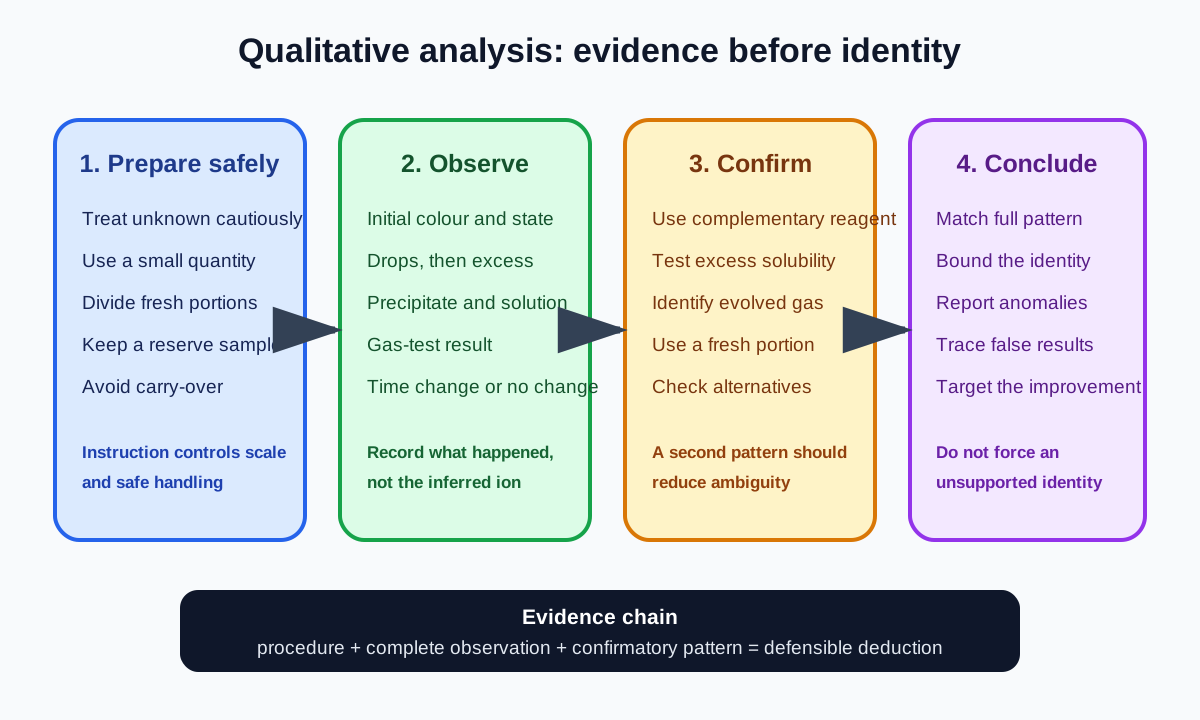
Qualitative Analysis is the fourth Cambridge Chemistry 9701 practical-skills note. It develops the official Paper 3 requirements to handle unknowns cautiously, use specified quantities, record every observation and use the supplied qualitative-analysis notes to reach bounded conclusions. Paper 5 planning and evaluation principles are included, while the underlying inorganic and organic reaction theory remains in the theory hub.
1. Start with the evidence question
The aim is to distinguish possible ions, gases, elements or functional groups using observable chemical changes. It is not simply to perform every remembered test.
Read the sequence before starting. Identify which portions need heating, excess reagent or a gas test, and preserve enough unknown for every branch.
Treat a named identification as a conclusion supported by specified observations. If the supplied evidence distinguishes only a class, report that class rather than inventing a precise identity.
2. Treat every unknown cautiously
Assume an unknown may be corrosive, oxidising, toxic, flammable or harmful until the instructions and hazard information establish otherwise. Wear eye protection and avoid direct contact or deliberate smelling.
Use a clean test tube and the instructed small quantity. Small-scale work reduces exposure, waste and the consequences of an unexpected vigorous reaction.
When heating a solid in a hard-glass test tube, use a holder and point the open end away from people.
3. Divide samples before testing
Use a fresh portion for each independent test unless the procedure explicitly continues in the same tube. A reagent added in one test changes the sample and may create false results in the next.
Label tubes or arrange them in a fixed order. Use separate droppers to avoid transferring one unknown or reagent into another bottle.
Keep an untouched reserve until the identification is secure.
4. Record observations before deductions
An observation is what is directly seen: colour, precipitate, effervescence, gas-test result, solution remaining colourless, solid dissolving or no change.
A deduction names what the observation supports. Keep the two in separate table columns so the evidence trail can be marked.
Record all results, including no precipitate, no effervescence or a solution remaining colourless. Negative evidence can eliminate alternatives.
5. Use precise observation language
State the initial state and the change. Write that a pale blue precipitate forms and remains insoluble in excess ammonia, not merely that the mixture is blue.
Check this topic from memory
Attempt the matching topic bank before reopening the notes. Use each missed idea to decide what to review next.
Distinguish a precipitate from cloudiness, a solution colour from a solid colour, and immediate change from change on standing in air.
Do not write the ion name in the observation column. That is an inference.
6. Add only the specified amount
Many cation tests require reagent added dropwise first, followed by excess only after a precipitate appears. Adding excess immediately can dissolve an amphoteric precipitate before its formation is recorded.
Use approximate quantities only where instructed. Too much reagent dilutes colours, obscures stages and consumes the reserve sample.
The sequence few drops, observe, then excess, observe again is part of the evidence.
7. Sodium hydroxide cation screen
Aqueous sodium hydroxide distinguishes cations by precipitate colour, solubility in excess and, for ammonium, gas released on warming.
White precipitates require further discrimination. Aluminium and zinc precipitates dissolve in excess sodium hydroxide; magnesium remains insoluble. Calcium normally gives a white precipitate, and barium can give a faint white precipitate unless its concentration is very low.
Warm an ammonium sample with hydroxide and test any gas as ammonia. Do not infer ammonium from smell.
8. Ammonia cation screen
Aqueous ammonia supplies a complementary solubility pattern. Aluminium gives a white precipitate insoluble in excess, while zinc gives a white precipitate soluble in excess.
Copper(II) first gives a pale blue precipitate, then a dark blue solution in excess ammonia. Magnesium remains a white insoluble precipitate. Calcium and barium give no precipitate under the syllabus table conditions.
Use both the initial and excess observations when the distinction depends on them.
9. Coloured transition-metal precipitates
Chromium(III) gives a grey-green precipitate. It dissolves in excess sodium hydroxide to form a dark green solution but remains insoluble in excess ammonia.
Iron(II) gives a green precipitate that turns brown on contact with air. Iron(III) gives a red-brown precipitate. Manganese(II) gives an off-white precipitate that rapidly turns brown in air.
Timing and colour qualify the observation. A later brown solid does not by itself distinguish all three routes.
10. Carbonate and gas evidence
Add dilute acid cautiously to a fresh portion. Effervescence suggests gas formation, but Cambridge requires the gas to be identified.
Pass the gas into limewater. A white precipitate identifies carbon dioxide and supports carbonate in the original sample.
Do not stop at bubbles formed, because boiling, trapped air or another gas can also produce bubbles.
11. Halide sequence
Add the specified silver-ion reagent to the prepared sample. Chloride gives a white precipitate, bromide a cream or off-white precipitate and iodide a pale yellow precipitate.
Their ammonia behaviour supports the distinction: the chloride precipitate dissolves, the bromide precipitate is partially soluble and the iodide precipitate is insoluble under the syllabus notes.
Judge colour in good light against a white background and keep sample depth comparable.
12. Sulfate and sulfite distinction
Barium ions give a white precipitate with sulfate and sulfite. The acid response distinguishes them: sulfate precipitate is insoluble in excess dilute strong acid, while sulfite precipitate dissolves.
Sulfite also decolourises acidified aqueous potassium manganate(VII). Use a fresh portion so earlier barium or acid additions do not corrupt the redox test.
Record whether disappearance is dissolution, decolourisation or both; these are different observations.
13. Nitrate and nitrite distinction
Both nitrate and nitrite can release ammonia when heated with aqueous hydroxide and aluminium foil. Confirm the evolved ammonia with damp red litmus paper.
Nitrite additionally decolourises acidified aqueous potassium manganate(VII), allowing it to be distinguished from nitrate in the prescribed scheme.
Heating, aluminium and alkaline conditions are all part of the test. Omitting one invalidates the inference.
14. Thiosulfate evidence
Thiosulfate produces an off-white or pale yellow precipitate slowly with hydrogen ions. Record the time dependence instead of reporting only the final cloudy appearance.
A delayed precipitate must not be described as immediate. Compare it with any instruction-provided control under the same timing.
Use a fresh sample and avoid assuming every sulfur-containing anion behaves identically.
15. Gas tests
Test a gas near the mouth of the tube or through the instructed delivery setup. Ammonia turns damp red litmus blue. Carbon dioxide gives a white precipitate with limewater.
Hydrogen gives a pop with a lighted splint. Oxygen relights a glowing splint. A flame test and a glowing-splint test are not interchangeable.
Collect enough gas to displace initial air where the method requires it, but never seal a gas-generating system.
16. Iodine test
Iodine gives a blue-black colour when starch solution is added. Record both the starting colour and the new colour.
Use freshly prepared starch where specified and avoid confusing iodine's own brown colour with the blue-black complex.
This is an element test in the official qualitative-analysis notes, not a universal test for iodide ions.
17. Aldehyde tests
Fehling's reagent gives an orange-red precipitate with an aldehyde under the stated conditions. Tollens' reagent gives a silver mirror or black silver precipitate.
Use a clean tube for Tollens' reagent because poor glass cleanliness can obscure the mirror. Prepare and dispose of the reagent according to centre instructions; do not store residues.
A positive result supports an aldehyde functional group in the syllabus context. It is not an observation of the group itself.
18. Iodoform test
Alkaline aqueous iodine gives a yellow precipitate with compounds containing the methyl carbonyl group or the corresponding secondary-alcohol arrangement stated by Cambridge.
Record disappearance of iodine colour and formation of a yellow precipitate separately if both occur.
A positive result identifies the structural feature, not necessarily one unique compound.
19. Acidified manganate(VII) oxidation test
Acidified aqueous potassium manganate(VII) changes from purple to colourless when the tested compound can be oxidised under the conditions.
This broad positive result does not by itself distinguish every oxidisable functional group. Combine it with other tests and the information supplied.
Do not report a brown manganese dioxide precipitate as the expected acidic result without examining whether the conditions were actually acidic.
20. Build a minimal decision sequence
Choose tests that divide the remaining possibilities. A hydroxide test followed by ammonia solubility can distinguish several cations more efficiently than unrelated repeated tests.
Use fresh portions for confirmatory branches. A good sequence avoids incompatible carry-over and reserves hazardous heating for when it is informative.
Stop when the evidence supports the requested conclusion. Extra tests create extra opportunities for contamination and contradiction.
21. Handle ambiguous results
If a precipitate colour lies between descriptions, repeat with clean apparatus, equal sample depth and a known comparison if provided. Do not force the result to match an expected identity.
If unknown ions fall outside the supplied notes, record the observations and make only general conclusions where possible. Cambridge explicitly does not require an unsupported identity.
Report anomalies and say how they limit confidence.
22. Evaluate contamination and carry-over
A contaminated dropper can create a false positive in every later tube. Residual detergent, tap-water ions or reagents in a test tube can also alter precipitation.
Rinse apparatus with deionised water, use dedicated droppers and take reagent from clean working portions where the centre procedure permits.
Repeating with the same contaminated equipment does not make the conclusion reliable.
23. Evaluate weak or missing observations
A very low ion concentration may produce a faint or absent precipitate. Excessive dilution, insufficient reagent or poor mixing can also weaken the change.
Do not simply add unlimited reagent. Repeat at the instructed scale and compare the full pattern of independent tests.
Explain whether a limitation risks a false negative, false positive or uncertain colour before proposing an improvement.
24. Safety and waste ownership
Keep silver, barium, transition-metal and oxidising wastes in the designated streams. Do not return unused reagent to stock bottles.
Use a water bath rather than a naked flame when flammable organic material may be present. Point heated tubes away, use holders and avoid sealing them.
Follow the centre's risk assessment for Tollens' reagent, corrosive alkalis, strong acids and oxidisers. Safety controls must name the actual hazard and exposure route.
Worked application: identifying two unknown ions
An unknown solution gives a pale blue precipitate when aqueous ammonia is added dropwise. The precipitate dissolves in excess ammonia to form a dark blue solution. This complete pattern supports copper(II), whereas stating only blue would omit the decisive excess result. A fresh portion gives a white precipitate with barium ions. The precipitate remains in excess dilute strong acid, supporting sulfate rather than sulfite. Because the first test introduced ammonia and copper chemistry, it cannot be reused for the anion test. The bounded conclusion is that the evidence supports copper(II) and sulfate ions; clean repeats would test reproducibility but cannot replace the named observations.
Common misconceptions and corrections
Using the whole unknown in the first test. Divide it and keep a reserve.
Treating an unknown as harmless. Apply cautious handling until hazards are known.
Adding excess reagent immediately. Record the dropwise stage first.
Writing an ion name as an observation. Put it in the deduction column.
Omitting no change. Negative evidence is still evidence.
Writing only precipitate. Include colour and excess solubility.
Calling cloudiness a solution colour. Identify the phase observed.
Inferring carbonate from bubbles alone. Confirm carbon dioxide with limewater.
Smelling ammonia directly. Use damp red litmus.
Using dry litmus for ammonia. The indicator must be damp.
Calling every white cation precipitate magnesium. Use both reagents and excess behaviour.
Missing aluminium-zinc separation. Their ammonia solubilities differ.
Missing copper's excess-ammonia result. The dark blue solution is diagnostic.
Calling every later brown precipitate iron(III). Record initial colour and air change.
Using one portion for silver and barium tests. Reagent carry-over can interfere.
Identifying halides by colour alone when solubility is requested. Use the full sequence.
Calling partially soluble bromide fully soluble. Preserve the official distinction.
Treating sulfate and sulfite barium results as identical conclusions. Test acid solubility.
Using the manganate result after contaminating the sample. Use a fresh portion.
Distinguishing nitrate from nitrite using ammonia release alone. Both can give it.
Omitting aluminium foil from the nitrate test. The prescribed reduction conditions matter.
Calling a slow thiosulfate precipitate immediate. Record time behaviour.
Using a lighted splint for oxygen. Oxygen relights a glowing splint.
Sealing a gas-generating tube. Keep a safe outlet.
Calling the starch test an iodide test. It detects iodine in the supplied table.
Equating a positive aldehyde test with a unique compound. It identifies a functional-group class.
Storing Tollens' reagent after use. Follow immediate safe disposal procedures.
Treating iodoform as unique to one molecule. It detects either listed structural feature.
Using manganate decolourisation as a unique functional-group identity. It is broad oxidation evidence.
Forcing an unlisted ion into the supplied table. Give only supported general conclusions.
Repeating with contaminated apparatus. Remove the contamination source first.
Naming more repeats as the whole improvement. Explain preparation, consistency and use of results.
Assessment guidance
High-scoring qualitative answers preserve the chain from instruction to observation to deduction. State fresh portions, small quantities, dropwise addition, excess where required, heating method and gas-test procedure. Tables should include initial state, precipitate colour, solution colour, effervescence, excess solubility, time-dependent change and explicit no-change results. Use the official cation, anion, gas, element and organic-test patterns exactly, then limit the conclusion to what those patterns distinguish. Evaluation should identify contamination, dilution, ambiguous colour or procedural deviation, say whether it risks a false positive or false negative, and give a targeted safe improvement.
Retrieval practice
Reconstruct the sodium-hydroxide and ammonia decision patterns for aluminium, zinc, magnesium, copper(II), chromium(III), iron ions and manganese(II). Then design fresh-portion sequences for carbonate, the three halides, sulfate versus sulfite, and nitrate versus nitrite. Practise all four gas tests and the iodine, aldehyde, iodoform and manganate tests. For each result, write one observation, one bounded deduction, one plausible interference and one safety or waste control.
Cambridge International, Chemistry 9701 syllabus for examinations in 2025, 2026 and 2027, Practical Assessment section for Paper 3 qualitative-analysis methods and organic tests, the supplied cation, anion, gas and element notes, and Paper 5 planning, conclusion and evaluation expectations.