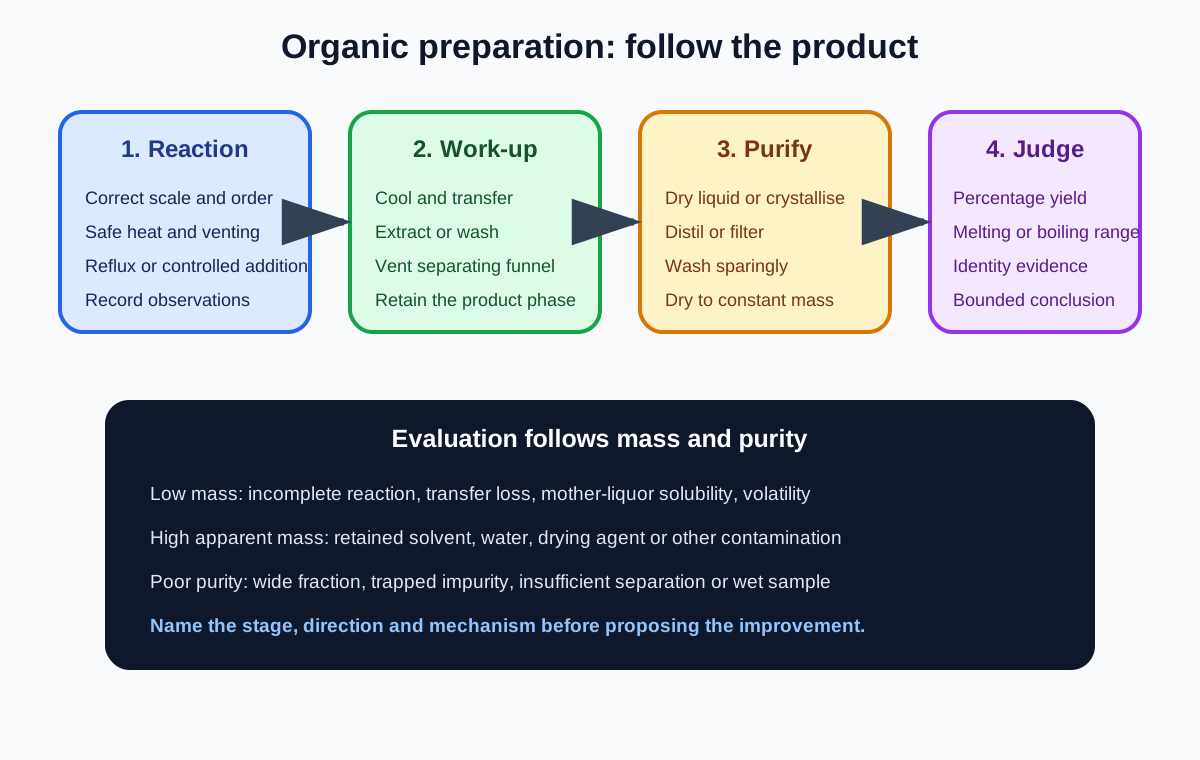
Organic Preparation and Purification is the fifth Cambridge Chemistry 9701 practical-skills note. Organic preparation is not a separately guaranteed Paper 3 procedure in the official list. This note instead applies Cambridge's assessed manipulation, observation, measurement, calculation, planning, safety and evaluation standards to organic laboratory contexts that may be instructed or supplied. Reaction mechanisms and synthetic-route knowledge remain in the theory hub.
1. Define the practical outcome
State the product to be prepared, its physical form and the evidence used to judge success. A useful outcome may include isolated mass, percentage yield, boiling range, melting range or a specified chemical test.
Separate reaction success from isolation success. Product may form but be lost during transfer or purification.
Identify the limiting reagent before deciding the theoretical yield.
2. Read the complete route first
Mark each stage as reaction, work-up, separation, purification, drying or characterisation. Note every transfer and the phase in which product should reside.
Identify when heating, cooling, venting, extraction or reduced pressure is required. Check whether later steps depend on a reagent being removed earlier.
Prepare a labelled apparatus diagram when the arrangement is not obvious.
3. Choose a suitable scale
Use the specified masses, volumes and concentrations. Scaling one reagent alone changes stoichiometry, heat release and mixing.
Small-scale work reduces solvent use and hazard but must still give enough product for isolation and measurement. Apparatus capacity should leave headspace for boiling and additions.
Record masses and volumes to instrument-compatible precision.
4. Control the heat source
Select a water bath, electric heater, heating mantle or other instructed source according to solvent flammability and required temperature. Avoid a naked flame with flammable organic vapours.
Increase heat gradually. Violent boiling causes loss, bumping and contamination of condensers or receivers.
Secure glassware without applying strain to joints.
5. Reflux without material loss
Reflux heats a reaction at its boiling temperature while vapour condenses and returns to the flask. Water enters the condenser at the lower connection and leaves at the upper connection so the jacket remains full.
Keep the condenser open to the atmosphere unless the supplied apparatus includes a safe pressure-control system. A sealed heated vessel can rupture.
Adjust heat so the condensation line remains within the condenser rather than vapour escaping from the top.
Check this topic from memory
Attempt the matching topic bank before reopening the notes. Use each missed idea to decide what to review next.
Add anti-bumping granules before heating a liquid. They provide nucleation sites for smooth boiling.
Do not add granules to a liquid already near boiling because sudden vigorous boiling may occur. If heating has stopped and the liquid must be reheated, follow the supplied instruction on adding fresh granules only after cooling.
Stirring can also improve temperature and concentration uniformity.
7. Add reagents safely
For exothermic or gas-producing additions, add slowly with stirring and external cooling where instructed. A dropping funnel controls rate better than pouring.
Keep the addition system vented. If moisture-sensitive reagents are used, follow the provided dry-apparatus and guard-tube requirements rather than improvising.
Observe temperature, effervescence, colour and phase changes without leaning over the vessel.
8. Distil the required fraction
Distillation separates a volatile liquid from less volatile components. Position the thermometer bulb at the side-arm entrance so it measures vapour entering the condenser.
Use a receiver suited to the product hazard and volatility. Record the temperature range over which the fraction is collected.
Do not distil a flask to dryness, especially where unstable residues may remain.
9. Distillation versus reflux
In reflux, condensed liquid returns to the reaction flask. In distillation, condensate travels into a separate receiver.
Choose reflux to heat while retaining volatile reagents or solvent. Choose distillation to remove or collect a volatile component.
Changing the condenser orientation without changing the take-off arrangement does not by itself produce the intended separation.
10. Use a separating funnel correctly
Transfer cooled immiscible layers into the funnel, insert the stopper, invert gently and vent frequently away from people. Pressure may arise from volatile solvent or gas-producing neutralisation.
Allow a clear boundary to form. Remove the stopper before draining the lower layer so air can enter smoothly.
Identify layers using supplied densities or a small water-drop test when safe, rather than assuming the organic layer is always on top.
11. Extract rather than merely wash
Extraction transfers the desired solute into the phase in which it is more soluble. Several smaller solvent portions are often more effective than one equal total volume, subject to the instructed method.
A wash removes unwanted soluble material from the phase containing product. State which substance moves and which phase is retained.
Keep all potentially product-containing layers until the recovery is confirmed.
12. Neutralise residual reagents carefully
An acid or alkali wash may remove residual reactant or by-product. Add slowly because carbonates release carbon dioxide and neutralisation may heat the mixture.
Vent the separating funnel repeatedly. Test the appropriate phase only when the method requires it.
Excessive washing can dissolve or hydrolyse product and reduce yield.
13. Dry an organic liquid
Add a compatible anhydrous drying agent in small portions and swirl. Continue until fresh solid remains free-flowing or the instructed endpoint is reached.
Decant or filter the dry liquid without carrying drying agent into the distillation flask. Drying removes traces of water, not dissolved organic impurities.
Do not count drying-agent mass as product.
14. Filter a solid product
Use gravity filtration when hot solution must pass through without crystallising in the funnel. Use reduced-pressure filtration to collect and partly dry a solid rapidly after crystallisation.
Seat filter paper correctly, wet it with a suitable solvent and maintain a secure vacuum connection. Break the vacuum before switching off the pump or disconnecting tubing.
Wash the collected crystals with a small volume of cold solvent to remove surface impurities while limiting dissolution.
15. Recrystallise a solid
Choose a solvent in which product is much more soluble hot than cold and impurities are either always soluble or removable while hot.
Use the minimum volume of hot solvent needed to dissolve the crude solid. Too much solvent leaves more product dissolved after cooling.
Cool slowly to room temperature for orderly crystal growth, then use an ice bath to improve recovery. Rapid immediate chilling may trap impurities.
16. Hot filtration
If insoluble impurities remain in the hot solution, filter through warmed apparatus so product does not crystallise prematurely.
Use a fluted filter paper or suitable setup to speed gravity filtration where instructed. Rinse with a minimal amount of hot solvent.
Product crystallised in the funnel is an isolation loss, not evidence of high purity.
17. Dry a solid to constant mass
Remove surface solvent by suction, then dry by the instructed method. Cool before weighing, because warm objects create unstable balance readings.
Weigh, dry again, cool and reweigh until successive values satisfy the stated constant-mass criterion. Constant mass supports solvent removal.
It does not prove chemical purity if a non-volatile impurity is present.
18. Calculate theoretical yield
Convert starting amounts to moles and use the balanced equation to find the limiting reagent. Apply the stoichiometric ratio to obtain theoretical product moles, then convert to mass.
Use reagent purity or solution concentration if supplied. An excess reagent does not set the theoretical yield.
Show each stage so a correct method can be credited even if arithmetic slips.
19. Calculate percentage yield
Percentage yield is isolated dry product mass divided by theoretical product mass, multiplied by one hundred.
A low yield can result from incomplete reaction, equilibrium, side reaction, solubility in mother liquor, transfer loss or volatilisation. These causes require different improvements.
A yield above one hundred percent usually indicates residual solvent, water or other contamination, or a measurement error.
20. Assess melting behaviour
Compare the measured melting range with supplied reference data. A pure crystalline solid normally melts over a narrow range; soluble impurities commonly broaden and lower it.
Use a dry, finely powdered sample packed consistently and heat slowly near the expected point. Record the range from first melting to complete liquid.
Agreement with one temperature is supporting evidence, not absolute structural proof.
21. Assess boiling behaviour
For a liquid, record the stable vapour-temperature range of the collected fraction. A narrow range near the reference value supports purity.
Thermometer position, calibration, atmospheric pressure and mixed fractions affect the result. Do not call the heater setting the boiling point.
Retain beginning and ending fractions separately when the instructed method requires a central pure fraction.
22. Use chemical or instrumental evidence
A named functional-group test, chromatography or spectrum may support product identity and reveal starting material. Follow only the evidence method provided or within the syllabus context.
No single test establishes every aspect of identity and purity. Combine mass, physical constant and chemical evidence where available.
Keep observations separate from the final structural interpretation.
23. Trace product losses by stage
Map whether product remains in reaction flask, aqueous layer, mother liquor, filter paper, transfer vessel or volatile fraction. This makes evaluation specific.
Rinsing transfers with a small amount of compatible solvent can improve recovery, but excessive rinse volume may worsen later separation.
Quantify recovery from separate stages if the investigation provides masses or concentrations.
24. Separate yield from purity tradeoffs
More washing and recrystallisation may increase purity while lowering recovered mass. Collecting a wider distillation fraction may raise yield while including impurities.
Evaluate the goal stated in the question. The best method balances sufficient purity, safe operation, time and material recovery.
Do not describe maximum mass as automatically best.
25. Evaluate systematic and random effects
Product dissolved in mother liquor causes a systematic low yield. Wet crystals cause a systematic high apparent yield. Material lost during inconsistent transfers may vary between trials.
Balance resolution affects mass uncertainty, especially for small products. Repeating the same biased purification does not correct systematic loss.
Pair every limitation with its direction, mechanism and realistic modification.
26. Manage organic hazards and waste
Use a fume hood for harmful or volatile vapours when required. Avoid ignition sources, minimise exposure and wear chemically resistant gloves for irritant materials according to risk assessment.
Label organic, aqueous, halogenated and heavy-metal waste streams correctly. Do not mix incompatible wastes or pour organic solvent into the sink.
Inspect glassware and tubing before heating, and let hot apparatus cool before dismantling.
Worked application: yield and purity diagnosis
A preparation starts from 0.0500 moles of limiting reagent and forms product in a one-to-one ratio. The product molar mass is 122.0 grams per mole, so the theoretical mass is 6.10 grams. After recrystallisation, the student weighs 5.25 grams of crystals, giving a yield of 86.1 percent. The crystals melt from 73 to 80 degrees Celsius, while the supplied pure value is 82 to 84 degrees Celsius. The substantial mass recovery does not establish success: the broad depressed range suggests impurity or retained solvent. Drying to constant mass and repeating the melting measurement should precede any claim about yield or purity; another recrystallisation may improve purity but reduce recovery.
Common misconceptions and corrections
Treating organic preparation as a guaranteed named Paper 3 procedure. It is an application of assessed practical skills.
Starting before reading the work-up. Map every phase and transfer first.
Scaling only one reagent. Preserve the complete stoichiometry and safe scale.
Using a naked flame with flammable solvent. Select a safe controlled heat source.
Sealing a reflux apparatus. Maintain a safe pressure outlet.
Connecting condenser water at the top. Feed from the lower connection.
Heating until vapour escapes the condenser. Control the reflux rate.
Adding anti-bumping granules to hot liquid. Add them before heating.
Calling reflux and distillation identical. Condensate returns in one and is collected in the other.
Placing the distillation thermometer in the liquid. Measure vapour entering the condenser.
Distilling to dryness. Leave a safe residue.
Assuming the organic layer is always uppermost. Use density evidence.
Draining a stoppered separating funnel. Remove the stopper first.
Shaking without venting. Release pressure safely and frequently.
Using extraction and washing as synonyms. State what transfers and what is retained.
Discarding a layer before confirming product location. Retain uncertain phases.
Using unlimited wash solution. Product may dissolve or react.
Calling drying agent a purification of all impurities. It removes water.
Using suction filtration for a hot recrystallisation solution. Product may crystallise prematurely.
Washing crystals with warm solvent. Use a small cold portion.
Using excess recrystallisation solvent. More product remains in mother liquor.
Putting the hot solution directly in ice. Slow cooling usually improves crystal quality.
Calling constant mass proof of purity. Non-volatile impurities can remain.
Using excess reagent to calculate theoretical yield. Use the limiting reagent.
Calculating yield from wet mass without qualification. Dry the product first.
Accepting yield above one hundred percent. Investigate solvent, water or contamination.
Reporting one melting temperature rather than a range. Record onset to complete melting.
Calling the heater setting a boiling point. Read the vapour thermometer.
Treating a reference match as absolute identity proof. Combine independent evidence.
Calling low yield one generic human error. Trace the physical loss mechanism.
Assuming the highest yield is the purest sample. Yield and purity can trade off.
Proposing repeats to fix mother-liquor solubility. Change the separation conditions.
Pouring organic waste into the sink. Use the designated stream.
Assessment guidance
Planning answers should specify scale, apparatus, heat source, addition order, reflux or distillation arrangement, separation sequence, drying, purification, product measurement and named safety controls. Draw condensers with lower water inlet, open pressure path and correct vapour or receiver ownership. Calculations must identify limiting reagent, theoretical yield, dry isolated mass and percentage yield. Use melting or boiling range and any supplied test as evidence rather than proof. In evaluation, locate the product at each loss point, distinguish wet-mass inflation from incomplete-reaction or transfer loss, explain yield-purity tradeoffs and propose a modification that targets the stated mechanism.
Retrieval practice
Draw and label reflux, simple distillation, separating-funnel and suction-filtration setups. For one solid and one liquid product, design the complete reaction, work-up, purification and characterisation sequence. Calculate limiting reagent, theoretical mass and percentage yield, then diagnose one low yield, one yield above one hundred percent and one broad melting range. Finish by assigning every solvent and reagent to a heat control, exposure control and waste stream.
Cambridge International, Chemistry 9701 syllabus for examinations in 2025, 2026 and 2027, Practical Assessment section for Paper 3 manipulation, measurement, observation, calculation and evaluation and Paper 5 safe and efficient planning, apparatus choice, risk control, standard laboratory practice, analysis and evaluation. Organic preparation is used here as a context for those assessed skills, not claimed as a separately guaranteed Paper 3 procedure.