

Cambridge International AS and A Level Further Mathematics 1: Further Pure Mathematics 1
Cambridge International Further Mathematics 9231 Paper 1 notes on polynomial roots, rational graphs, series, matrices, polar coordinates, vectors and induction.
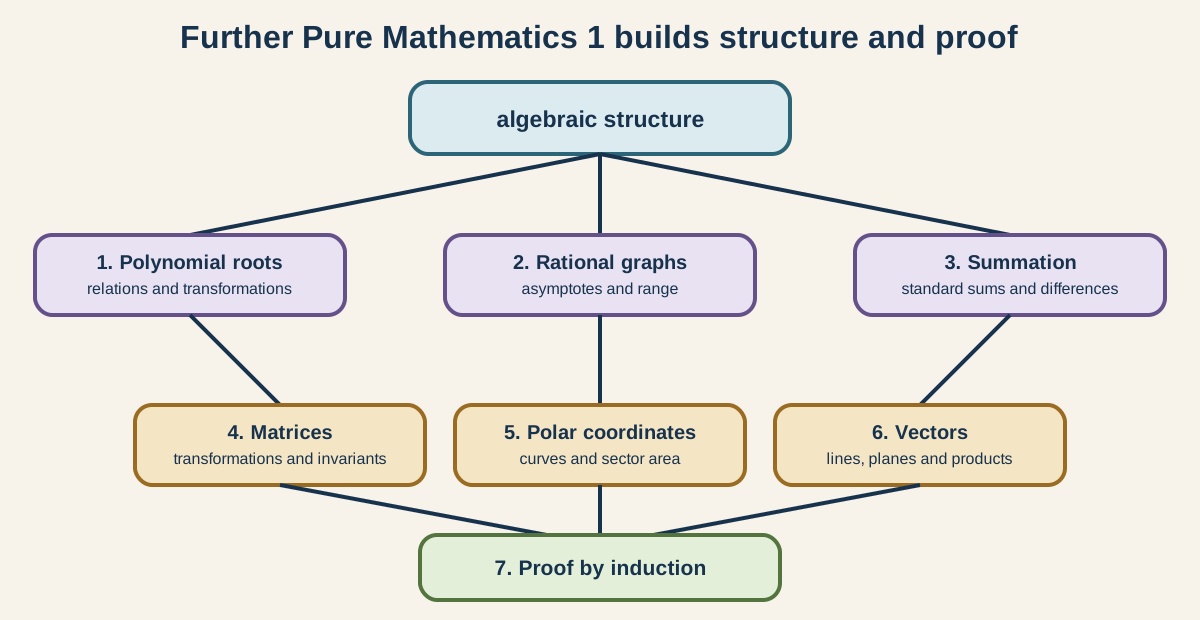
Further Pure Mathematics 1 is the compulsory Cambridge International AS and A Level Further Mathematics 9231 Paper 1. Its seven official sections cover roots of polynomial equations, rational functions and graphs, summation of series, matrices, polar coordinates, vectors and proof by induction.
1. Roots of polynomial equations
For a monic polynomial, relations between roots and coefficients provide symmetric sums without solving for every root. For a quadratic with roots alpha and beta, their sum and product come from the x coefficient and constant term. Cubic and quartic relations alternate signs through sums of single roots, pairwise products, triple products and the product of all roots. Paper 1 restricts this work to degrees 2, 3 and 4.
Use these relations to evaluate symmetric expressions such as sums of reciprocal roots or squared roots. Rewrite the target in terms of known elementary symmetric sums. For example, the sum of squares equals the square of the sum minus twice the sum of pairwise products.
To construct an equation whose roots are related to old roots, introduce the transformation, express the old variable in terms of the new one where possible, substitute into the original equation and clear denominators. For simple reciprocal, square or linear transformations, Cambridge may not supply the substitution. Check whether the transformation combines distinct old roots into the same new root.
2. Rational functions and graphs
Sketch simple rational functions whose numerator and denominator degrees are at most 2. Find domain exclusions, intercepts and vertical asymptotes first. Polynomial division exposes any horizontal or oblique asymptote. Turning points may require differentiation.
To find the range, set y equal to the rational function, rearrange as a polynomial equation in x and require a real solution. A discriminant condition often gives the permitted y-values. A sketch should show significant features, not a dense plot.
Relate y = f(x) to y^2 = f(x), y = 1/f(x), y = f(sqrt x) and the other syllabus-listed graph relations. Apply domain and sign restrictions before drawing branches. Use the sketches to solve equations or inequalities by identifying intersections or signed regions.
3. Summation of series
Recall the standard finite sums of r, r^2 and r^3. Shift indices or expand algebraically to convert a related polynomial sum into these forms. State the limits after any index change.
The method of differences writes a general term as a difference such as f(r + 1) - f(r), so most intermediate terms cancel. Partial fractions may reveal the telescoping structure. Write several initial and final terms to prove which survive instead of claiming cancellation from pattern alone.
Check this topic from memory
Attempt the matching topic bank before reopening the notes. Use each missed idea to decide what to review next.
Start the topic quiz