

Cambridge International AS and A Level Further Mathematics 2: Further Pure Mathematics 2
Cambridge International Further Mathematics 9231 Paper 2 notes on hyperbolic functions, matrices, advanced calculus, complex numbers and differential equations.
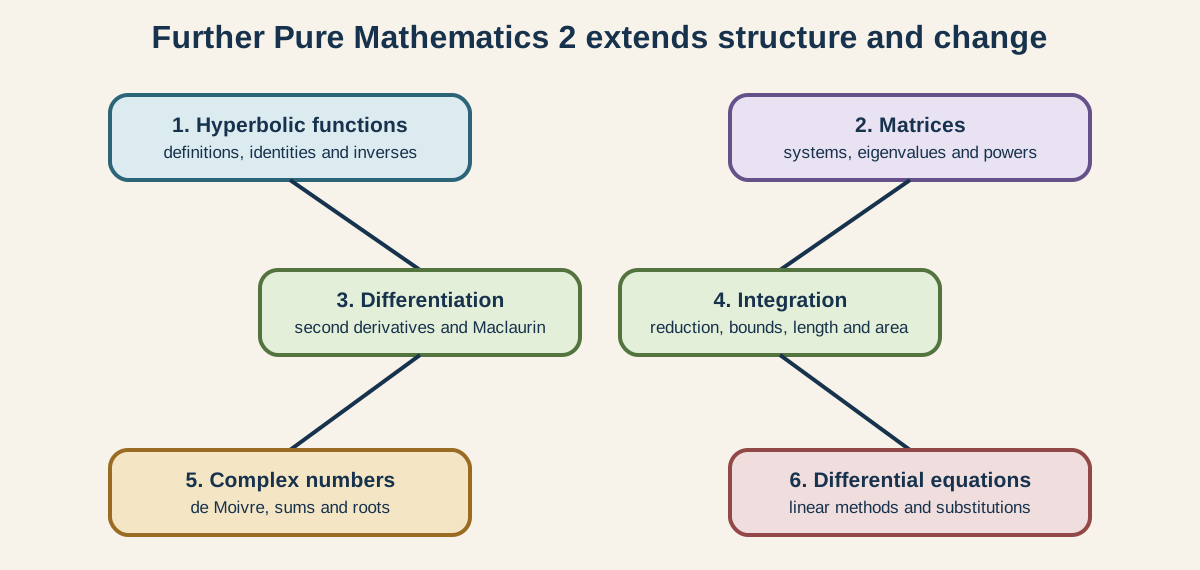
Further Pure Mathematics 2 is Cambridge International Further Mathematics 9231 Paper 2. Paper 1 Further Pure Mathematics knowledge is assumed. The six official sections cover hyperbolic functions, matrices, advanced differentiation, advanced integration, complex numbers and differential equations.
1. Hyperbolic functions
Define sinh x, cosh x and tanh x from e^x and e^(-x), with sech, cosech and coth as reciprocals. These definitions explain domains, ranges, symmetry and asymptotic behaviour. Sketch all six functions with intercepts and asymptotes.
Prove and use identities such as cosh^2 x - sinh^2 x = 1 and sinh 2x = 2 sinh x cosh x. Hyperbolic identities resemble trigonometric identities but important signs differ, so derive rather than guess.
Inverse hyperbolic functions undo suitable restricted hyperbolic functions. Derive logarithmic forms by setting y equal to the hyperbolic function, substituting u = e^x and solving the resulting quadratic. State domain restrictions and select the logarithmic branch consistent with e^x positive.
2. Matrices
Translate three simultaneous linear equations in three unknowns into AX = B, and translate a matrix equation back into its system. A non-singular coefficient matrix gives one solution. A singular matrix can describe consistent equations with infinitely many solutions or an inconsistent system with none. Interpret these cases as planes meeting at one point, in a common line or with no common point.
An eigenvector e is non-zero and satisfies Ae = lambda e. Eigenvalues solve det(A - lambda I) = 0. Paper 2 finds real, distinct eigenvalues and corresponding eigenvectors for 2 by 2 and 3 by 3 matrices.
If Q has eigenvectors as columns and D holds matching eigenvalues on its diagonal, A = QDQ^-1. Then A^n = QD^nQ^-1, making powers manageable. Keep column order aligned with the diagonal entries.
The Cayley-Hamilton result says a square matrix satisfies its own characteristic equation. Use it for powers or an inverse of a 2 by 2 or 3 by 3 matrix, provided any inverse step is justified.
3. Differentiation
Differentiate hyperbolic functions and the inverse functions sin^-1 x, cos^-1 x, sinh^-1 x, cosh^-1 x and tanh^-1 x. Preserve their domains and use implicit differentiation if deriving a formula.
For a parametric curve, calculate the second derivative by differentiating dy/dx with respect to the parameter and dividing by dx/dt again. For an implicit curve, differentiate the first derivative relation, applying product and chain rules to every y-dependent term, then solve for d^2y/dx^2.
Maclaurin's series uses successive derivatives at zero. Derive and use the first few terms, including cases needing repeated implicit differentiation. A general-term derivation is not included. State the order of the omitted remainder when using a truncated approximation if useful.
Check this topic from memory
Attempt the matching topic bank before reopening the notes. Use each missed idea to decide what to review next.
Start the topic quiz