

Cambridge International AS and A Level Further Mathematics 3: Further Mechanics
Cambridge International Further Mathematics 9231 Paper 3 notes on projectiles, rigid bodies, circular motion, elasticity, variable forces and impacts.
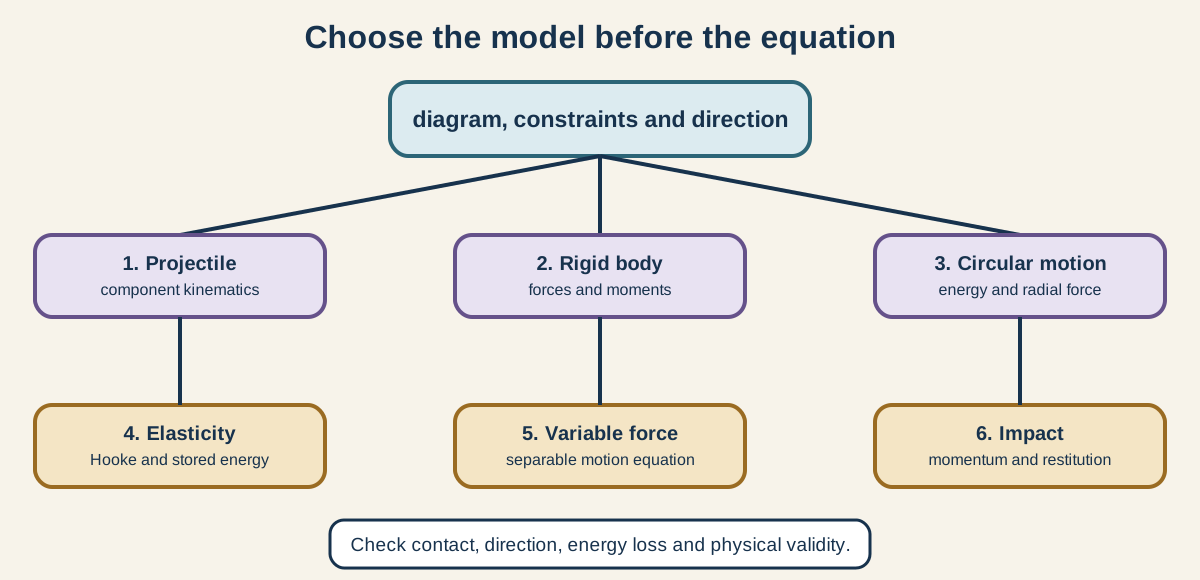
Further Mechanics is Cambridge International Further Mathematics 9231 Paper 3 and assumes Mathematics 9709 Paper 4 Mechanics. The six official sections cover projectile motion, rigid-body equilibrium, circular motion, Hooke's law, variable-force linear motion and momentum with coefficient of restitution.
1. Motion of a projectile
Model a projectile as a particle moving under constant gravitational acceleration, with air resistance neglected. Resolve initial velocity into horizontal and vertical components. Horizontal acceleration is zero and vertical acceleration is downward, so use separate constant-acceleration equations with a common time.
Find speed from perpendicular velocity components and direction from their ratio with the correct quadrant. At greatest height, vertical velocity is zero but horizontal velocity generally is not. Range on a horizontal plane comes from the later time at the launch height.
Eliminate time to derive the Cartesian trajectory, a downward-opening parabola. Use it when the launch speed or angle is unknown. Vector methods are not required, and the bounding parabola for all accessible points is excluded.
2. Equilibrium of a rigid body
The moment of a force about a point is force times perpendicular distance from that point to its line of action. Use a consistent clockwise-positive or anticlockwise-positive convention. Only coplanar forces are assessed, and the vector nature of moments is not required.
Gravity on a rigid body acts as a single weight through its centre of mass. Locate the centre of mass of a uniform symmetric body by symmetry. Use supplied formula results for a triangular lamina and other simple shapes without proving them.
For a composite body, replace each part by a particle at its own centre of mass. The combined coordinate is the mass-weighted mean. Treat a removed region as negative mass when convenient.
A rigid body in equilibrium has zero resultant force and zero resultant moment. Choose a moment centre that eliminates unknown forces. In toppling, the resultant contact reaches an edge of the base. In limiting sliding, friction reaches its limiting value. Compare the conditions to determine which event occurs first.
3. Circular motion
Angular speed omega and linear speed satisfy v = r omega. At constant speed, acceleration points towards the centre and has magnitude v^2/r or r omega^2. Proof of these formulas is not required.
In a horizontal circle, resolve all force components radially and vertically. Conical-pendulum and banked configurations connect geometry to the centripetal resultant.
In a vertical circle without energy loss, use energy to connect speed at different heights, then a radial Newton equation to find tension or normal contact. The radial direction changes around the circle, so derive each force equation from a local diagram. A string requires non-negative tension; contact requires non-negative normal reaction. Complete circular motion is controlled by the weakest-contact point, often the top.
Check this topic from memory
Attempt the matching topic bank before reopening the notes. Use each missed idea to decide what to review next.
Start the topic quiz