

Cambridge International AS and A Level Further Mathematics 4: Further Probability and Statistics
Cambridge International Further Mathematics 9231 Paper 4 notes on continuous variables, inference, chi-squared and non-parametric tests, and PGFs.
Further Probability and Statistics is Cambridge International Further Mathematics 9231 Paper 4 and assumes Mathematics 9709 Papers 5 and 6. Its five official sections cover continuous random variables, normal and t inference, chi-squared tests, non-parametric tests and probability generating functions.
1. Continuous random variables
A probability density function may be piecewise. Check that each piece is non-negative on its interval and that the total integral is 1. Probability is area, so integrate only the pieces overlapping the requested region.
For a function g(X), E[g(X)] is the integral of g(x)f(x) across the support. This avoids first finding the distribution of g(X) when only an expectation is needed. It also gives moments and transformed costs or payoffs directly.
The cumulative distribution function F(x) = P(X is at most x) integrates the density up to x. It is non-decreasing, right-continuous, tends from 0 to 1 and has derivative f(x) where differentiable. Use inverse CDF reasoning for percentiles.
For a related variable Y = h(X), derive its CDF by rewriting the event that h(X) is at most y as an event involving X. Monotonicity controls the inequality direction and whether one or several x intervals contribute. Differentiate the resulting CDF to obtain the PDF where required.
2. Inference using normal and t-distributions
For a small sample from a normal population with unknown variance, test a population mean using a t statistic with n - 1 degrees of freedom. The sample standard deviation estimates the unknown population standard deviation. State normal-population and random-sample assumptions.
For two independent samples assumed to share a population variance, calculate the pooled variance by combining their sums of squared deviations and dividing by the total degrees of freedom. A two-sample pooled t-test compares means using that common estimate.
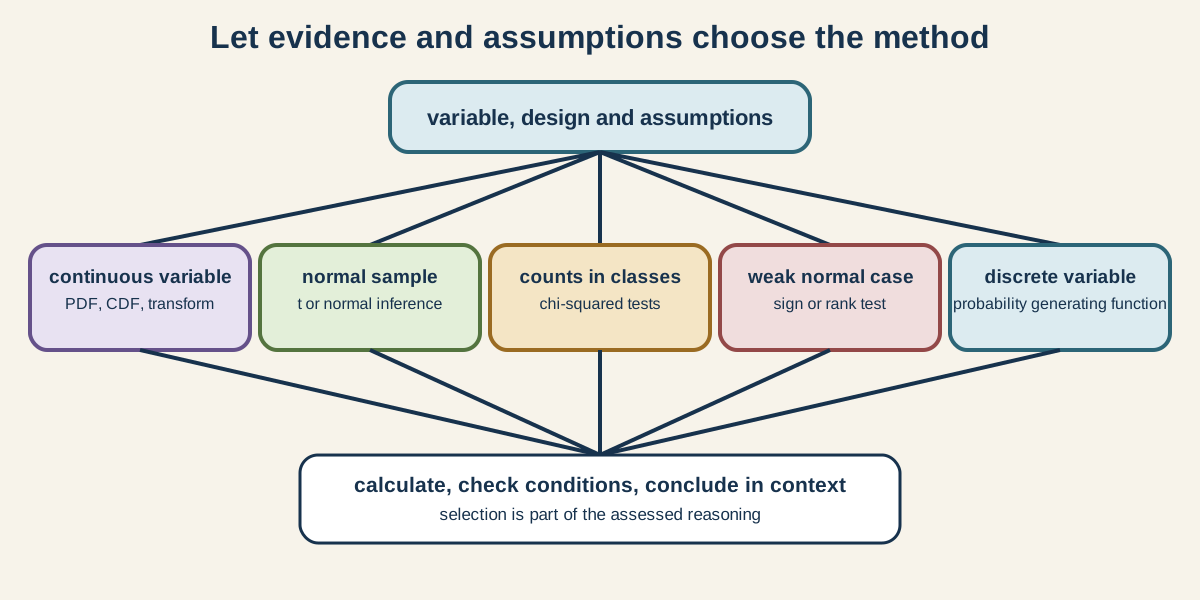
Paired data must be converted into one sample of within-pair differences. Apply a one-sample t-test to the difference mean. Independent samples instead require a two-sample method. When variances are known or large-sample normal conditions apply, use the appropriate normal test. Selecting the test from the design and assumptions is part of the assessment.
Confidence intervals follow estimate plus or minus critical value times standard error. Use t for a small normal sample with unknown variance, and the corresponding t or normal method for a difference of means. Degrees of freedom and pooled or paired structure must match the calculation.
3. Chi-squared tests
A goodness-of-fit test compares observed counts O with expected counts E under a prescribed theoretical distribution. Estimate or use parameters as directed, compute expected counts and sum (O - E)^2/E. Combine classes until every expected frequency is at least 5. Degrees of freedom equal the number of final classes minus 1 minus the number of parameters estimated from the data.
Check this topic from memory
Attempt the matching topic bank before reopening the notes. Use each missed idea to decide what to review next.
Start the topic quiz