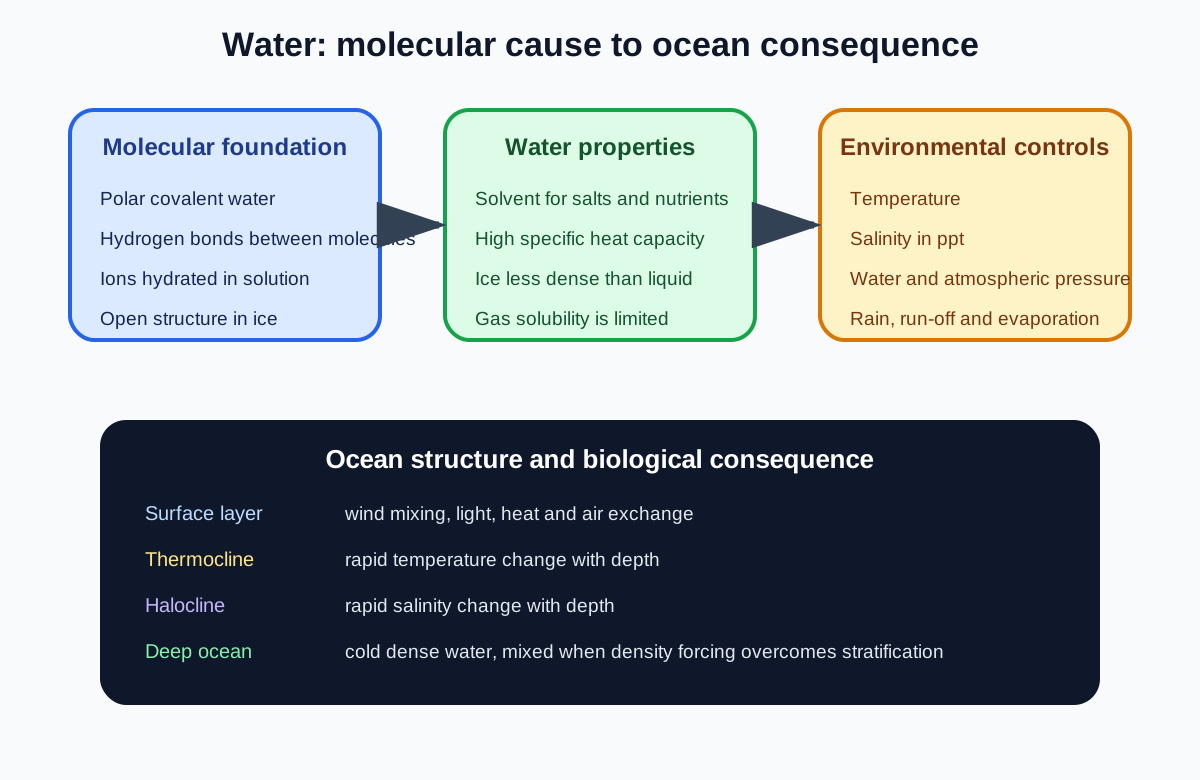
Water is Topic 1 of the Cambridge International AS and A Level Marine Science 9693 AS syllabus. These notes follow official sections 1.1 Particle theory and bonding, 1.2 Solubility in water and 1.3 Density and pressure. The emphasis is on explaining how molecular properties create marine conditions, then connecting those conditions to organisms and ocean structure.
1.1 Particle theory and bonding
Changes of state in water
In ice, water molecules occupy a fixed arrangement and vibrate about positions. Heating increases their kinetic energy until some hydrogen-bonded organisation is overcome and the solid melts.
In liquid water, molecules remain close but move past one another. Further energy allows the fastest molecules to escape as gas. Cooling reverses these changes as kinetic energy decreases.
The molecules remain water molecules during melting, boiling, condensation and freezing. A change of state is physical, not a decomposition into hydrogen and oxygen.
Atomic structure
An atom has a central nucleus containing protons and neutrons, surrounded by electrons arranged in shells. Protons are positively charged, electrons negatively charged and neutrons uncharged.
The number and arrangement of outer-shell electrons govern the simple bonding models required here. An ion forms when an atom or group has a net charge after electron loss or gain.
Do not describe electrons as being inside the nucleus.
Seawater is a mixture
Seawater contains water, dissolved ions, gases and many other substances. The components are not present in one fixed chemical ratio, so seawater is a mixture rather than one pure compound.
Its composition varies with evaporation, precipitation, river input, freezing, melting, biological activity and local geology. A sample can therefore have a different salinity or dissolved-oxygen concentration from another while both remain seawater.
Mixture components retain their chemical identity and can be separated by physical or chemical methods.
Covalent bonding in water
An oxygen atom shares one pair of electrons with each of two hydrogen atoms. Each shared pair is a covalent bond within a water molecule.
The syllabus model is limited to shared electron pairs between atoms. A diagram should show two oxygen-hydrogen shared pairs and distinguish these strong intramolecular bonds from attractions between different water molecules.
Water, carbon dioxide, oxygen, sulfur dioxide and glucose are examples that candidates should identify as covalent molecules from names, formulae or diagrams.
Ionic bonding in sodium chloride
Check this topic from memory
Attempt the matching topic bank before reopening the notes. Use each missed idea to decide what to review next.
Sodium loses an electron to form a positive sodium ion, while chlorine gains an electron to form a negative chloride ion. Electrostatic attraction between oppositely charged ions is ionic bonding.
An ionic substance contains an extended arrangement of ions, not separate sodium chloride molecules. When sodium chloride dissolves, the ions separate and become surrounded by water molecules.
Sodium chloride and calcium carbonate must be recognisable as ionic substances from diagrams or formulae.
Major named seawater salts
The required names and formulae are sodium chloride, NaCl; magnesium sulfate, MgSO4; and calcium carbonate, CaCO3.
Learn name, formula and ion charges together so subscripts can be explained by overall electrical neutrality. The formula does not state the concentration in seawater.
Calcium carbonate is especially important in shells and skeletons, but this biological context does not make its bonding covalent overall in the required classification.
Hydrogen bonding
Oxygen attracts the shared electrons in each oxygen-hydrogen bond more strongly than hydrogen. This creates partial negative character at oxygen and partial positive character at hydrogen.
The partially positive hydrogen of one water molecule is attracted to the partially negative oxygen of another. This intermolecular attraction is a hydrogen bond.
Hydrogen bonds are between molecules; covalent bonds hold atoms together within each molecule.
Solvent action
Water's uneven charge distribution allows its molecules to surround ions. The oxygen end is oriented towards positive ions, while the hydrogen ends are oriented towards negative ions.
These attractions can separate ions from an ionic structure and keep them dispersed in solution. This explains why seawater can carry many dissolved salts and nutrients.
Water does not dissolve every substance equally, and universal solvent is an overstatement.
Density anomaly of ice
When water freezes, hydrogen bonding stabilises an open structure in which molecules are farther apart on average than in liquid water. The same mass occupies a larger volume, so ice has lower density.
This is why ice floats on seawater. The floating layer can insulate liquid beneath and provide habitat for marine organisms.
Do not explain floating by saying ice has less mass than the surrounding water sample without comparing equal volumes or density.
High specific heat capacity
Energy supplied to liquid water is used partly to disrupt hydrogen-bond interactions before molecular motion rises substantially. Water therefore requires considerable energy for a given temperature increase.
The ocean warms and cools more slowly than many land surfaces. This moderates temperature variation and creates a relatively stable thermal environment for marine organisms.
High specific heat capacity does not mean water cannot change temperature; it means more energy is required per unit mass per degree.
1.2 Solubility in water
Solute, solvent, solution and solubility
A solute is dissolved. A solvent is the liquid doing the dissolving. The uniform mixture produced is a solution.
Solubility is the maximum amount of solute that dissolves in a given amount of solvent under specified conditions. A solution below that limit is unsaturated; at the limit it is saturated.
Concentration describes how much solute is present, while solubility describes the condition-dependent maximum.
Dissolution of soluble salts
When sodium chloride dissolves, its sodium and chloride ions separate from the ionic structure. Water molecules surround and stabilise the ions through attraction to their charges.
The ions remain present in the solution and can move independently. Dissolving is not the same as sodium chloride atoms disappearing or turning into water.
If water evaporates, the separated ions can become concentrated and may crystallise when the solubility limit is exceeded.
Temperature and salt solubility
The solubility of many solid salts changes with water temperature. The direction and magnitude depend on the salt, so use supplied data rather than claiming every salt becomes much more soluble when warmed.
A solubility curve shows the maximum dissolved amount at each temperature. Points below the curve are unsaturated, while excess above the limit remains or precipitates as solid at equilibrium.
Temperature effects on solid salts must not be copied automatically to gases.
Salinity
For this syllabus, salinity is the concentration of dissolved salts in seawater and is expressed in parts per thousand, abbreviated ppt.
Thirty-five ppt means about thirty-five parts of dissolved salt per thousand parts of seawater under the convention used. It is not thirty-five percent.
Salinity affects freezing point, density, gas solubility and the water-balance challenges faced by organisms.
Salinity and freezing point practical
The marked practical activity investigates how salinity affects water's freezing point. Prepare a range of known salt concentrations, keep sample volume and cooling conditions constant and measure the temperature at which freezing behaviour is observed.
Use repeats and a consistent operational definition of freezing. A cooling curve can help distinguish temporary supercooling from the temperature plateau associated with freezing.
The expected pattern is that dissolved salt lowers the freezing point, but the conclusion must follow the measured range.
Evaporation, precipitation and run-off
Evaporation removes water but leaves most dissolved salts, so salinity increases. Precipitation adds freshwater, so salinity decreases through dilution.
Surface run-off usually supplies freshwater and lowers coastal salinity, although it may also carry dissolved material. State the dominant water-balance effect in the context given.
Restricted basins with high evaporation tend to become more saline; river mouths and rainy surface waters tend to be less saline.
pH and hydrogen ions
The pH scale indicates hydrogen-ion concentration. Acidic water has a higher hydrogen-ion concentration and a pH below neutral; alkaline water has a lower hydrogen-ion concentration and a pH above neutral.
Cambridge does not require hydrogen-ion concentration calculations for this section. Candidates should interpret acidic, neutral and alkaline conditions and measured pH values.
A one-unit numerical change represents a substantial chemical change, but detailed logarithmic calculation is outside this stated boundary.
Measuring acidity and pH
Litmus identifies whether a substance is acidic or alkaline. Universal Indicator gives an approximate pH from colour, while a calibrated pH probe gives a numerical measurement.
For water samples, rinse the probe between measurements, control temperature where relevant and allow a stable reading. Calibrate with suitable buffer solutions according to the method.
Colour or turbidity can make indicator judgement difficult, which is a limitation rather than a reason to invent precision.
Dissolved oxygen
Oxygen has low solubility in water compared with its availability in air. Marine organisms relying on dissolved oxygen therefore respond strongly to environmental changes that alter its concentration.
As water temperature rises, gas solubility generally falls. Warm water can hold less dissolved oxygen, while organism respiration may simultaneously increase.
This combination can intensify oxygen stress.
Pressure, salinity and gas solubility
Higher atmospheric pressure above water increases gas solubility. Greater water pressure with depth also favours more gas remaining dissolved, subject to the actual marine system.
Increasing salinity generally reduces gas solubility because dissolved ions compete for interaction with water. Cold, less saline water can therefore hold more oxygen than warm, saline water under comparable pressure.
The gas laws themselves are not required here. Explain the qualitative relationships and biological implications.
1.3 Density and pressure
Density calculation
Density is mass divided by volume. In the required SI form, density is measured in kilograms per cubic metre, mass in kilograms and volume in cubic metres.
Rearrange consistently: mass equals density multiplied by volume, and volume equals mass divided by density. Convert units before substitution.
Density compares how much mass occupies a given volume; it is not another word for mass.
Temperature, salinity and seawater density
Warming normally expands seawater, so the same mass occupies more volume and density decreases. Cooling generally increases density until freezing behaviour becomes relevant.
Adding dissolved salt increases mass more than it increases volume, so salinity increases density. Greater water pressure compresses water slightly, increasing density with depth.
Ocean density therefore reflects the combined effects of temperature, salinity and pressure, not one factor alone.
Why floating ice matters
Ice is less dense than seawater and remains at the surface. A surface ice layer reduces heat exchange between the ocean and cold air, helping liquid water persist below.
Sea ice also provides habitat and a platform for organisms. Its formation and melting change local light, salinity and access to air-water interfaces.
The syllabus boundary here is floating, insulation and habitat; wider climate feedbacks require additional evidence if discussed.
Surface layer and thermocline
Sunlight and wind affect the upper ocean, creating a relatively mixed surface layer. Below it, a thermocline is a depth interval where temperature changes rapidly.
Warmer surface water is usually less dense than colder water below, producing stable layering. Strong density differences resist vertical mixing.
Do not call the whole deep ocean a thermocline; it is the gradient zone.
Halocline and deep ocean
A halocline is a depth interval where salinity changes rapidly. Its direction varies with regional freshwater input, evaporation and water-mass history.
Temperature and salinity effects combine to create density stratification. The deep ocean is generally cold and comparatively uniform but is not chemically or physically identical everywhere.
Describe the actual profiles supplied rather than assuming every halocline has increasing salinity with depth.
Mixing of ocean layers
Wind transfers energy to surface water. Cooling, evaporation or sea-ice formation can make surface water denser, encouraging sinking and vertical mixing.
Freshwater input or strong surface warming can strengthen stratification and suppress mixing. Storms, tides and currents can also disrupt layers.
Mixing redistributes heat, dissolved gases, nutrients and organisms, so physical water structure has ecological consequences.
Worked application: comparing two water masses
Water mass A has a mass of 1.026 kilograms in a volume of 0.00100 cubic metres, giving a density of 1026 kilograms per cubic metre. Water mass B has the same volume but a mass of 1.022 kilograms, giving 1022 kilograms per cubic metre. A is therefore denser and tends to lie below B if the water masses meet without strong mixing. A higher salinity, lower temperature or greater pressure could contribute to that difference. The calculation alone cannot identify which factor caused it, so temperature, salinity and depth evidence must be examined before explaining the density contrast.
Common misconceptions and corrections
Saying state changes break water into elements. Water molecules remain chemically intact.
Placing electrons in the nucleus. Electrons occupy shells around it.
Calling seawater one compound. Its variable composition makes it a mixture.
Calling a shared pair a hydrogen bond. The shared pair is a covalent bond.
Putting hydrogen bonds inside one water molecule. They act between molecules.
Calling sodium chloride a covalent molecule. It is an ionic substance.
Forgetting magnesium sulfate and calcium carbonate formulae. Learn all three named salts.
Saying water dissolves everything. Solvent action depends on substance and conditions.
Explaining floating ice only by mass. Compare density.
Saying high heat capacity prevents temperature change. It increases the required energy.
Using concentration and solubility as synonyms. One is actual amount; one is the maximum.
Saying dissolved ions disappear. They become separated and hydrated.
Assuming every solid salt has the same temperature trend. Use substance-specific data.
Reading thirty-five ppt as thirty-five percent. Parts per thousand is a different scale.
Changing sample volume in a freezing investigation. Keep cooling conditions comparable.
Treating supercooling as the equilibrium freezing point. Use the curve and plateau carefully.
Saying evaporation removes salt and water equally. Most salt remains.
Saying rainfall raises salinity. Freshwater normally dilutes it.
Performing logarithmic pH calculations for this outcome. They are explicitly not required.
Giving Universal Indicator excessive precision. It provides an approximate value.
Saying warm water holds more oxygen. Gas solubility generally falls with temperature.
Ignoring salinity in gas solubility. More dissolved salt generally reduces it.
Using mass as density. Density relates mass to volume.
Substituting grams and cubic centimetres into required SI units without conversion. Convert first.
Saying pressure makes seawater less dense. Compression slightly increases density.
Attributing density to salinity alone. Temperature and pressure also contribute.
Calling all subsurface water the thermocline. It is the rapid temperature-gradient zone.
Assuming every halocline has the same direction. Interpret the regional profile.
Saying stratification always prevents mixing. Sufficient wind or density change can disrupt it.
Describing a graph without connecting it to organisms. Explain the marine consequence.
Assessment guidance
Organise answers by the stated learning outcome. For bonding, distinguish covalent electron sharing, ionic electron transfer and intermolecular hydrogen bonding, then link hydrogen bonds only to solvent action, density and specific heat capacity. For solubility, keep salts and gases separate, use ppt correctly, explain evaporation, precipitation and run-off, and apply temperature, pressure and salinity to dissolved gases and organisms. For density, show unit conversions and working, then interpret combined temperature, salinity and pressure effects. Profile questions should name surface layer, thermocline, halocline and deep ocean and explain when stratification strengthens or mixing occurs.
Retrieval practice
Draw a water molecule with covalent bonds and two neighbouring molecules with hydrogen bonding. Classify the named covalent and ionic substances and recall all three seawater salts. Explain one salinity-freezing investigation, interpret pH and dissolved-oxygen measurements, calculate density in SI units and sketch labelled temperature and salinity profiles. Finish by predicting how warming, rainfall, evaporation and surface cooling alter stratification, gas availability and organism distribution.