Cambridge International AS and A Level Marine Science 3: Interactions in marine ecosystems
Cambridge International AS and A Level Marine Science 3: Interactions in marine ecosystems
Study guide/
Cambridge Marine Science 9693 AS notes on symbiosis, food webs, photosynthetic and chemosynthetic producers, productivity, energy losses, ecological pyramids, nutrients and the...
Interactions in Marine Ecosystems is Topic 3 of the Cambridge International AS and A Level Marine Science 9693 AS syllabus. These notes follow official sections 3.1 Interactions, 3.2 Feeding relationships and 3.3 Nutrient cycles. They connect relationships between organisms to energy transfer, biomass production and the recycling or removal of matter.
3.1 Interactions
Symbiosis
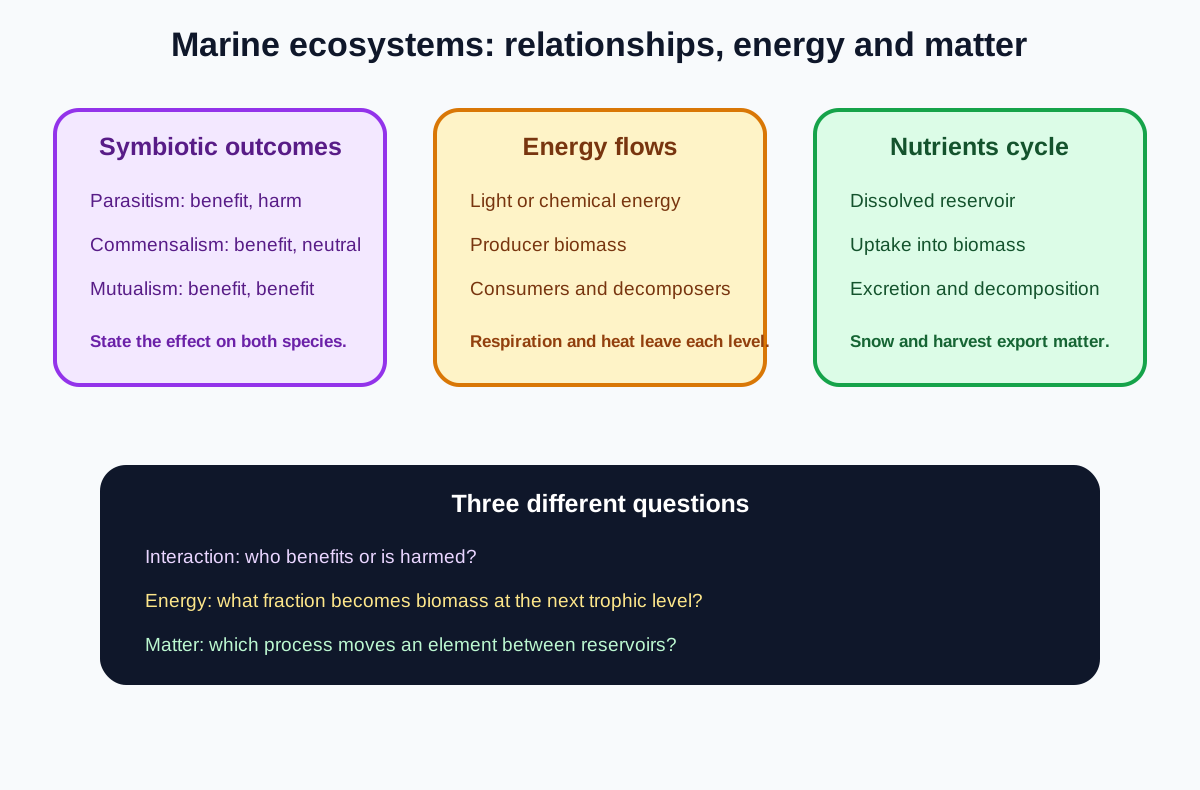
Symbiosis is a close relationship between organisms of different species. The outcome for each partner distinguishes parasitism, commensalism and mutualism.
Use a sign framework: benefit, harm or no significant effect. The relationship must be assessed for both partners, not only the more visible organism.
Predation is an interaction but is not automatically called symbiosis because the required relationships are close associations.
Parasitism
In parasitism, the parasite benefits while the host is harmed. The parasite gains food, shelter or transport, and the host loses resources or suffers tissue damage, stress or disease.
The named example is a parasitic copepod attached to a marine fish. It may feed on tissue, mucus or blood, reducing host condition and increasing vulnerability.
A parasite usually depends on keeping its host alive long enough to reproduce or transfer, unlike a predator that kills and consumes prey directly.
Commensalism
In commensalism, one species benefits while the other is not significantly helped or harmed.
Barnacles attached to a whale gain a firm surface, transport through feeding waters and exposure to currents carrying particles. The whale is treated as unaffected in the syllabus model.
Do not claim the whale benefits merely because both organisms remain together.
Mutualism
In mutualism, both species benefit. The named example is a boxer crab carrying anemones.
The crab gains defence from the anemones' stinging cells, while the anemones gain transport and access to food particles from the crab's feeding.
State a benefit for each partner. They help each other is too vague for a developed response.
Context and evidence
The same pair of species can have effects that vary with conditions or life stage, but examination answers should apply the relationship described by the evidence.
Look for changes in growth, survival, feeding, reproduction or transport. Absence of an obvious effect is not proof of commensalism without suitable comparison.
Use the syllabus cases accurately before adding unfamiliar examples.
3.2 Feeding relationships
Check this topic from memory
Attempt the matching topic bank before reopening the notes. Use each missed idea to decide what to review next.
Producers build organic substances from inorganic materials using an external energy source. Photosynthetic producers capture light; chemosynthetic producers capture energy from chemical reactions.
Consumers obtain organic material by feeding. Primary consumers feed on producers, secondary consumers feed on primary consumers, followed by tertiary and quaternary consumers where the chain continues.
An organism's level can differ between feeding pathways in a food web.
Herbivores, carnivores and omnivores
Herbivores feed on producers. Carnivores feed on animals. Omnivores consume material from both producers and animals.
These dietary labels do not always specify one trophic level. An omnivore may act as a primary consumer in one meal and a secondary consumer in another.
Classify from the arrows and stated diet, not from body size.
Predators and prey
A predator captures and consumes prey. This interaction transfers energy and can alter prey abundance, behaviour and distribution.
One species can be predator and prey in the same web. Removing a predator may indirectly increase pressure on producers by releasing herbivores from control.
Do not describe arrows as showing which organism chases another; they show transfer of energy or material from food to feeder.
Decomposers
Decomposers break down dead organisms and waste, using some organic material for respiration and releasing soluble nutrients.
They return matter to the dissolved nutrient reservoir, making elements available for producers again. Energy is not recycled in the same way because much is dissipated as heat.
Detrital pathways are essential even when a simple grazing food chain is shown.
Food chains and food webs
A food chain is one linear feeding pathway. A food web combines interconnected pathways in an ecosystem.
Draw arrows from the organism being eaten to the consumer because the arrow represents energy and matter transfer. Label producers and trophic levels where requested.
Food webs better represent alternative food sources and indirect effects but can still simplify seasonal and size-dependent diets.
Photosynthetic producers
Photosynthesis captures light energy and makes some energy available to the food chain. At AS Level, use the word equation: carbon dioxide plus water produces glucose plus oxygen in the presence of light and chlorophyll.
Further mechanistic detail and balanced chemical equations are not required here. Some glucose is built into biomass, while some is used in respiration.
Phytoplankton, macroalgae and seagrasses are important marine photosynthetic producers.
Light-intensity practical
The marked practical activity investigates how light intensity affects photosynthesis rate; freshwater plants are acceptable. Vary measured light intensity or controlled lamp distance and measure oxygen output or another defined response.
Control temperature, plant amount, carbon-dioxide availability, wavelength and measurement period. Lamp distance can also alter temperature, so a heat shield or water bath may be needed.
Use several values and repeats, then identify any plateau caused by another limiting factor.
Chemosynthetic producers
Chemosynthetic microorganisms use energy released from oxidation of inorganic substances to build organic matter. They do not require sunlight.
At hydrothermal vents, chemical energy can support producers that form the base of food webs in permanent darkness. Consumers may graze microorganisms or host symbiotic bacteria.
Chemosynthesis is not photosynthesis occurring with a different colour of light.
Respiration and usable energy
Respiration transfers energy from glucose into forms cells can use. At this boundary, the word equation is glucose plus oxygen produces carbon dioxide plus water.
Respiration occurs in producers as well as consumers, during day and night. Glucose used in respiration is not available to become new biomass.
The syllabus does not require further biochemical detail at AS Level.
Productivity
Productivity is the rate of biomass production per unit area or volume per unit time. It is a rate, so both spatial and temporal units matter.
Primary productivity concerns producers. High primary productivity can support more consumer biomass, longer food chains or larger populations if other factors are suitable.
Standing biomass is the amount present at one time and must not be confused with its rate of production.
Energy loss between trophic levels
Not all biomass is consumed. Some ingested material is not digested and leaves as waste. Organisms respire, move, maintain tissues and lose heat, so only part of the energy becomes new biomass available to the next level.
Percentage transfer equals energy at the higher trophic level divided by energy at the lower trophic level, multiplied by one hundred. Percentage loss is one hundred minus percentage transfer.
Keep units comparable and specify which two levels are being compared.
Pyramid of energy
A pyramid of energy shows energy flow per unit area per unit time at each trophic level. It is always upright because usable energy decreases along the chain.
Bar width represents the stated energy quantity; bars should be labelled and arranged producer first.
Do not use organism counts to construct an energy pyramid.
Pyramid of biomass
A pyramid of biomass shows the mass of living material at each trophic level at a stated time, often per unit area or volume.
In marine plankton systems, producer standing biomass can be smaller than consumer biomass because phytoplankton reproduce and are consumed rapidly. High turnover supports consumers despite a small snapshot biomass.
An inverted biomass pyramid does not violate energy loss.
Pyramid of numbers
A pyramid of numbers shows organism counts at each trophic level. It can be inverted or irregular.
One large host can support many parasites, which may support still more hyperparasites. A single large producer can also support many small herbivores.
Numbers ignore organism size, so use the correct pyramid for the question.
Algal blooms and pyramid interpretation
During a plankton or algal bloom, producer numbers and biomass may rise rapidly. Consumer populations may respond later because growth and reproduction take time.
A pyramid is a time-specific snapshot. Its shape can change before, during and after a bloom.
Interpret the stated period rather than assuming one permanent ecosystem structure.
3.3 Nutrient cycles
Meaning and forms of nutrients
A nutrient is a substance required for growth, repair, energy supply or normal metabolism. Nutrients include gases, ions and organic compounds.
Required examples include carbon dioxide gas; magnesium, carbonate, phosphate and nitrate ions; and carbohydrates, lipids and proteins.
Nutrient does not mean only food eaten by animals.
Elements in biological molecules
Carbohydrates and lipids contain carbon, hydrogen and oxygen. Proteins contain carbon, hydrogen, oxygen and nitrogen and may also contain other elements.
Starch and cellulose are built from glucose units. Proteins are built from amino acids. Lipids are built from fatty acids and glycerol within the required model.
Large biological molecules are assembled from smaller building units, not created directly from one mineral ion.
Essential-element roles
Nitrogen is required for proteins, chlorophyll and DNA. Carbon forms all organic compounds. Magnesium is part of chlorophyll.
Calcium is used in bones, shells and coral skeletons. Phosphorus is used in DNA and bones.
State the specific biological product rather than saying only that an element is for growth.
Dissolved nutrient reservoir
Soluble nutrients form a reservoir in ocean water available for uptake. Producers absorb inorganic nutrients, and consumers obtain many nutrients by feeding.
Availability varies with depth, mixing, run-off, biological demand and chemical conditions. Total nutrient in an ocean region is not the same as the immediately available dissolved amount in the illuminated surface.
Uptake transfers matter into biomass and depletes the dissolved reservoir locally.
Replenishing dissolved nutrients
Upwelling brings deeper nutrient-rich water towards the surface. Run-off supplies weathered and human-derived material from land. Tectonic and hydrothermal activity adds dissolved substances.
Atmospheric gases dissolve at the surface. Excretion releases soluble waste, and decomposition mineralises organic material.
Name the source, transfer process and receiving reservoir in a complete explanation.
Marine snow
Marine snow is sinking organic material including dead cells, fragments, faecal material and mucus aggregates. It transfers energy-containing organic matter from surface waters to the deep ocean.
Much is consumed or decomposed during descent, releasing nutrients at depth. A fraction reaches seabed sediments and contributes to longer-term storage.
The downward transfer helps explain why deep water can be nutrient-rich while surface water becomes depleted.
Harvesting removes nutrients
When fish, shellfish or seaweed are harvested and taken from the ecosystem, the elements contained in their biomass are removed from the local food web.
This differs from natural death and decomposition within the system, which return many nutrients to local reservoirs.
The effect depends on harvest scale, replenishment and movement of organisms and water.
Nutrient limitation
Productivity becomes limited when an essential dissolved nutrient is scarce relative to biological demand. Adding other abundant nutrients does not remove that specific constraint.
Upwelling or run-off may raise productivity by replenishing the limiting nutrient, but excessive enrichment can lead to blooms and later oxygen depletion.
Use data to identify the likely limiting factor rather than assuming nitrogen in every location.
Carbon-cycle transfers
Photosynthesis moves carbon from carbon dioxide into organic compounds. Respiration and decomposition return carbon dioxide. Combustion oxidises organic or fossil carbon and releases carbon dioxide.
Some organic material is buried and, over long timescales, contributes to fossil-fuel formation. Carbonate ions are incorporated into rocks and biological hard parts, while weathering transfers carbonate-related material back through the system.
The cycle tracks carbon matter among reservoirs; energy enters and leaves rather than cycling identically.
Worked application: energy transfer through a food chain
Marine producers store 48,000 kilojoules per square metre per year, herbivore biomass stores 6,000 and primary-carnivore biomass stores 720. Transfer from producers to herbivores is 6,000 divided by 48,000, or 12.5 percent. Transfer to primary carnivores is 720 divided by 6,000, or 12.0 percent. The missing energy was not destroyed: much was never eaten or assimilated, and much was transferred through respiration and heat rather than new biomass. These values support an upright energy pyramid, but they do not predict a necessarily upright pyramid of numbers or a snapshot biomass pyramid in a rapidly turning-over plankton community.
Common misconceptions and corrections
Calling every close relationship mutualism. Determine the outcome for each species.
Saying a parasite benefits its host. The host is harmed.
Claiming whale barnacles clearly benefit the whale. The required model treats it as unaffected.
Giving only the crab's benefit in boxer-crab mutualism. State both partners' gains.
Drawing food-web arrows from consumer to food. Arrows follow energy transfer to the feeder.
Assigning one permanent trophic level to an omnivore. It depends on the pathway.
Calling decomposers energy recyclers. Matter cycles; energy dissipates.
Saying every producer photosynthesises. Some use chemosynthesis.
Adding balanced photosynthesis detail beyond the AS boundary. The word equation is sufficient.
Letting lamp distance change temperature uncontrolled. Control the thermal effect.
Calling a photosynthesis plateau evidence that light has no effect anywhere. Another factor may limit the tested range.
Saying chemosynthesis uses dim light. It uses chemical energy.
Saying producers do not respire. They respire continuously.
Using biomass as a synonym for productivity. Productivity is a rate.
Omitting area or volume and time from productivity units. Both are required.
Saying energy loss means energy vanishes. Trace waste, respiration and heat.
Dividing the lower level by the higher level for transfer efficiency. Higher divided by lower gives the transferred fraction.
Drawing an inverted energy pyramid. Energy transfer always decreases upward.
Assuming biomass pyramids must be upright. Rapid producer turnover can invert a snapshot.
Using organism size in a pyramid of numbers. It shows counts.
Ignoring parasites in number pyramids. One host can support many parasites.
Treating an algal-bloom pyramid as permanent. It represents a period or snapshot.
Calling nutrients only edible organic food. Gases and ions also qualify.
Putting nitrogen in every carbohydrate and lipid. The required basic elements are carbon, hydrogen and oxygen.
Saying magnesium builds bones. It is required for chlorophyll.
Saying calcium's only role is in fish bone. Shells and coral skeletons are included.
Equating total nutrients with surface availability. Location and chemical form matter.
Saying uptake replenishes the dissolved reservoir. Uptake depletes it.
Describing marine snow as inorganic salt crystals. It is sinking organic material.
Assuming the same nutrient limits every ocean. Infer limitation from evidence.
Saying energy and carbon cycle in the same way. Carbon cycles while energy flows.
Assessment guidance
For symbiosis, state benefit, harm or no significant effect for both named partners. In feeding questions, define the term, follow arrows as energy transfer and allow trophic position to vary across a web. Keep AS photosynthesis and respiration to the required word equations, but explain glucose allocation to biomass or respiration. Productivity needs rate, area or volume and time. Calculate transfer efficiency explicitly and choose the correct energy, biomass or numbers pyramid, including parasite and bloom exceptions. Nutrient answers should identify chemical form, essential-element role, reservoir transfer and whether uptake, replenishment, sinking or harvest changes availability. Carbon-cycle responses should name processes and reservoirs.
Retrieval practice
Classify the three named symbioses by outcomes for both partners. Build a marine food web with photosynthetic and chemosynthetic producers, decomposers and an omnivore, then label alternative trophic levels. Calculate two energy-transfer efficiencies and draw energy, biomass and numbers pyramids for parasite and algal-bloom cases. Finally, map all dissolved-reservoir inputs and outputs, explain marine snow and harvest, recall the five element roles and reconstruct the limited carbon cycle from process cards.