Cambridge International AS and A Level Marine Science 4: Classification and biodiversity
Cambridge International AS and A Level Marine Science 4: Classification and biodiversity
Study guide/
Cambridge Marine Science 9693 AS notes on taxonomy, marine groups, biodiversity, populations, ecological factors, field sampling, Lincoln and Simpson indices and Spearman correl...
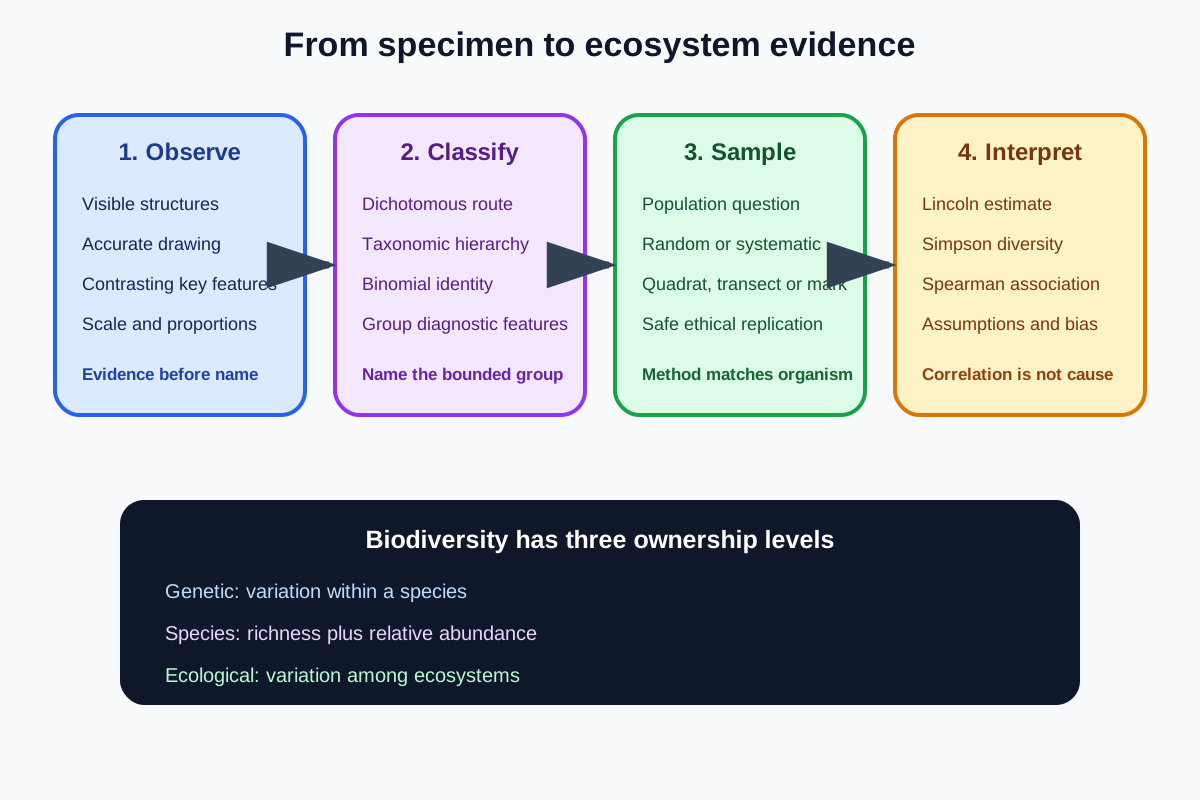
Classification and Biodiversity is Topic 4 of the Cambridge International AS and A Level Marine Science 9693 AS syllabus. These notes follow official sections 4.1 Classification, 4.2 Key groups, 4.3 Biodiversity and 4.4 Populations and sampling. The topic moves from naming an individual specimen to estimating patterns across habitats and judging what the data can support.
4.1 Classification of marine organisms
Taxonomic hierarchy
The required hierarchy is domain, kingdom, phylum, class, order, family, genus and species. Each level contains one or more groups from the level below.
Moving down the hierarchy produces smaller groups whose members share more features and are more closely related. Species is the most specific required rank.
Do not omit domain or reverse genus and species.
Species and binomial nomenclature
A species is a group of organisms identified as one distinct biological kind within the classification system. Each species receives a universally recognised two-part scientific name.
The first word is the genus and begins with a capital letter. The second is the species name and begins with a lower-case letter. Both are italicised when typed or underlined separately when handwritten.
After first use, the genus may be abbreviated if unambiguous, but the species word is not used alone as the full binomial.
Why universal names matter
Common names vary between languages and regions and may refer to several species. A binomial provides one internationally shared label.
The name also places the organism in a genus, communicating a classification relationship. It does not by itself describe every ecological trait.
Use the spelling and formatting supplied by the question.
Dichotomous keys
A dichotomous key uses a sequence of paired contrasting statements. At each numbered choice, select the statement matching the specimen and follow its instruction until a name is reached.
Good statements use observable, mutually exclusive features such as five arms present versus five arms absent. Avoid vague size terms unless a threshold is defined.
Each pair should compare the same kind of feature and route every specimen onward.
Constructing a key
List reliable differences, choose a broad first split and progressively separate the remaining organisms. Test the key from every starting specimen.
Use features visible in the material provided. Do not require internal anatomy when only photographs of external structures are available.
Check this topic from memory
Attempt the matching topic bank before reopening the notes. Use each missed idea to decide what to review next.
A key identifies according to its designed set; it does not prove evolutionary relationships.
Biological observations and drawings
The marked practical activity requires observations and drawings of unfamiliar structures or specimens from the Topic 4.2 groups and Cnidaria from Topic 5.2.
Use a sharp pencil, clear single lines, no shading and accurate proportions. Make the drawing large enough for features to be distinguished and label only structures actually visible.
Include a title and scale or magnification information when provided. Do not draw an idealised textbook specimen instead of the observed one.
4.2 Key groups of marine organisms
Plankton
Plankton are a diverse collection of generally microscopic organisms with limited motility that drift in water currents. The term describes an ecological mode of life, not one taxonomic group.
Some plankton can swim, but not strongly enough to determine their movement against currents at ecosystem scale. Larval and adult forms may differ in whether they are planktonic.
Size alone does not define plankton.
Phytoplankton
Phytoplankton are photosynthetic producers that absorb dissolved nutrients and use light to build organic material. Required examples include diatoms and dinoflagellates.
They support many marine food webs and contribute to gas and carbon cycling. Their abundance responds to light, nutrients, mixing and grazing.
Not all dinoflagellates have identical nutrition, but apply the producer context stated in the syllabus outcome.
Zooplankton
Zooplankton are consumers. Examples include copepods, the larvae of many animals and larger drifting animals such as jellyfish.
Temporary zooplankton spend only part of the life cycle in plankton, while others remain planktonic throughout life. Feeding roles range from herbivore to predator.
Do not classify every microscopic organism as phytoplankton.
Adult echinoderms
A typical adult echinoderm has pentaradial symmetry and tube feet. Starfish, sea urchins and sea cucumbers belong to this group despite different body shapes.
Tube feet contribute to locomotion, attachment, feeding or gas exchange depending on the organism. Adults show five-part organisation even though larval symmetry differs.
The named ecological and economic case is the crown-of-thorns starfish, which consumes coral and can damage reefs when abundant.
Crown-of-thorns importance
At natural densities, crown-of-thorns starfish are part of reef food webs. Population outbreaks can remove living coral over large areas, reducing habitat complexity and affecting tourism and fisheries.
Management may include monitoring and targeted removal, but causes can include multiple ecological conditions. Avoid presenting one untested cause as certain.
Economic importance can be harmful, beneficial or both depending on context.
Adult crustaceans
A typical adult crustacean has a carapace, segmented abdomen, jointed legs and two pairs of antennae. Crabs, shrimps, lobsters, copepods and krill show modifications of this basic plan.
The external skeleton provides protection and attachment for muscles but must be shed for growth.
Count antenna pairs carefully because two pairs are part of the required distinction.
Antarctic krill
Antarctic krill transfer energy from phytoplankton and ice-associated production to fish, penguins, seals and whales. Their vast populations make them a central Southern Ocean food-web component.
They are also harvested for feed, oil and other products. Ecological importance means harvest decisions must account for predator demand and environmental variability.
Krill are crustaceans, not fish or generic planktonic algae.
Adult bony fish
Required external and internal features are a bony skeleton, operculum covering the gills, gills, swim bladder, scales, a visible lateral line and pectoral, caudal, pelvic, anal and dorsal fins.
The swim bladder helps control buoyancy. The lateral line detects water movement. Fins provide thrust, steering and stability in different combinations.
Use position and structure together when labelling an unfamiliar specimen.
Peruvian anchoveta
The Peruvian anchoveta is a bony fish supported by productive eastern-Pacific upwelling. It feeds low in the food web and supports a major fishery and marine predators.
El Niño can weaken upwelling and reduce productivity or change distribution, affecting catches. Fishing pressure and environmental variability must both be considered.
Its economic importance does not remove its ecological role as prey.
Adult cartilaginous fish
A typical adult cartilaginous fish has a cartilaginous skeleton, exposed gill slits, gills, denticles, a lateral line and pectoral, caudal, pelvic, anal and dorsal fins.
Unlike a typical bony fish, it lacks a bony skeleton and operculum. Buoyancy relies on mechanisms other than a typical bony-fish swim bladder.
Denticles are tooth-like skin structures, not ordinary overlapping bony-fish scales.
Blue shark
The blue shark is a mobile cartilaginous predator with ecological importance in pelagic food webs. It can influence prey populations and indicate wider ecosystem conditions.
It also has economic importance through fisheries and bycatch. Slow growth or reproduction in many sharks can increase vulnerability to mortality.
Evaluation should distinguish targeted catch from incidental capture where data allow.
Shared chordate features
Bony and cartilaginous fish are both in phylum Chordata. Chordates share, at some point in development, a notochord, dorsal neural tube, pharyngeal slits and post-anal tail.
The phrase at some point in development matters because adult structures may be modified or replaced. A vertebral column in adults does not erase the chordate developmental plan.
Do not use bone as a defining feature of all chordates.
Macroalgae
A typical kelp-like macroalga has a holdfast, stipe, blades and often gas bladders. The holdfast anchors rather than absorbing water like a plant root. Blades provide a large photosynthetic surface.
Gas bladders raise blades towards light, and the flexible stipe tolerates water movement. Kelp creates three-dimensional habitat, supports food webs and may be harvested for food or useful compounds.
Macroalgae are not true flowering plants.
Seagrass
Seagrass is a marine flowering plant with rhizomes, roots, flowers and leaves. Roots and rhizomes anchor it in sediment and allow vegetative spread.
Meadows provide nursery habitat, food, sediment stabilisation and carbon storage. They also support fisheries and protect water quality through particle trapping.
Unlike a kelp holdfast, seagrass roots participate in plant uptake and are linked to true vascular-plant organisation.
4.3 Biodiversity
Genetic diversity
Genetic diversity is variation in genes within a species. It supplies different traits on which natural selection can act.
Populations with greater genetic variation may have a wider range of responses to disease or environmental change. Small isolated populations can lose variation through chance and inbreeding.
Genetic diversity is not measured simply by counting species.
Species diversity
Species diversity includes both the number of species and their relative abundance. Species richness alone counts how many species occur, while evenness describes how similar their abundances are.
Two sites can have the same richness but different diversity if one is dominated by a single species. Simpson's index incorporates abundance distribution.
Sampling effort must be comparable before sites are contrasted.
Ecological diversity
Ecological diversity is variation among ecosystems at regional or global scale. Reefs, mangroves, seagrass meadows, estuaries, rocky shores and open-ocean systems contribute different conditions and communities.
Losing one ecosystem type can remove functions not replaced by preserving the same area elsewhere.
This level differs from habitat variation measured within one small sample site.
Stability and complex interactions
Diverse communities contain multiple feeding and ecological pathways. If one species declines, alternative pathways may sometimes maintain a process.
This can support ecosystem stability, but high diversity does not make an ecosystem immune to severe disturbance. The type and functional roles of species matter.
Explain the mechanism rather than stating only that diversity is good.
Physical protection and climate control
Coral reefs reduce wave energy and help protect coastlines. Mangroves and seagrasses also stabilise sediment and reduce erosion in suitable settings.
Phytoplankton absorb carbon dioxide and release oxygen during photosynthesis. Marine ecosystems store and move carbon, contributing to climate regulation.
Do not imply one local phytoplankton bloom solves global climate change.
Food and medicines
Marine biodiversity provides algae, crustaceans and fish as food and supports the ecological processes sustaining harvests.
Marine organisms also provide biochemical compounds and research leads. The syllabus example is keyhole limpet hemocyanin, KLH, in anticancer-related medical use.
Potential benefit does not justify uncontrolled collection; sustainable access and ecosystem effects remain relevant.
4.4 Populations and sampling techniques
Ecosystem, habitat and niche
An ecosystem includes a community and its abiotic environment with their interactions. A habitat is the place where an organism lives.
A niche is the organism's functional role and requirements, including resource use, conditions and interactions. It is not simply another word for habitat.
Use a named marine example to distinguish location from role.
Species, population and community
A species is one classified kind of organism. A population contains members of one species in a defined place and time.
A community consists of populations of different species living and interacting in an area. Adding the abiotic environment and its interactions gives an ecosystem.
State spatial and temporal boundaries where population estimates are interpreted.
Biotic factors
Biotic factors arise from living organisms. Required categories include competition within a species, competition between species, symbioses, predation and disease.
They influence distribution and abundance through survival, growth, reproduction and access to resources. One observation may result from several interacting biotic effects.
Do not classify food availability as automatically abiotic.
Abiotic factors
Required abiotic factors include salinity, temperature, pH, oxygen and carbon-dioxide concentration, light, turbidity, wave or tide action, nutrient availability and exposure to air.
Their importance depends on ecosystem and organism. Exposure to air is critical across a shore height gradient, while light declines with water depth and turbidity.
Measure the factor alongside organism abundance before testing a relationship.
Mark-release-recapture
Capture a first sample, mark individuals harmlessly, record the number and release them to remix. Later capture a second sample and record total caught and marked recaptures.
The Lincoln estimate multiplies the first-sample count by the second-sample count and divides by the number of marked individuals recaptured.
The method suits mobile organisms in a definable population and must minimise stress and behavioural change.
Lincoln assumptions and limitations
The population should be closed between samples, with no substantial birth, death, immigration or emigration. Marks should remain visible and not affect survival or catchability.
Marked organisms must mix fully, and every individual should have a similar chance of capture. Trap attraction, avoidance or clustered distribution violates this.
Very few recaptures make the estimate unstable because the small denominator greatly increases the result.
Random sampling
Random sampling gives positions an equal chance of selection, reducing deliberate site bias. Coordinates can be generated within a mapped area.
It estimates overall abundance or compares sites when the habitat is reasonably accessible. Chance may still undersample rare patches unless sample number is sufficient.
Random does not mean casually choosing convenient locations.
Systematic sampling
Systematic sampling places observations at regular intervals, often along an environmental gradient. A line or belt transect from low to high shore can reveal zonation.
It represents the chosen gradient efficiently but may miss patterns elsewhere or align accidentally with periodic habitat features.
Use multiple transects or a random starting position to improve representativeness where appropriate.
Frame quadrats
A frame quadrat defines an area for counting organisms, estimating percentage cover or recording frequency. It suits sessile or slow-moving organisms.
Choose quadrat size and number to match organism scale and patchiness. Apply consistent boundary rules for organisms touching an edge.
Percentage cover can exceed a visual estimate's precision, so use a grid or point method when required.
Line and belt transects
A line transect records organisms touching the line or at set points. A belt transect samples a strip, often using contiguous or interval quadrats.
Belts provide abundance across an area but require more time. Lines are quicker but capture less spatial information.
The orientation must follow the question, such as perpendicular to the shoreline across an exposure gradient.
Ethical and safe littoral work
Check tides and weather, define access and exit routes, work in groups and avoid unstable rocks or dangerous surf. Use suitable footwear and sun or cold protection.
Handle organisms briefly, keep them moist, return them to their original location and minimise habitat disturbance. Marks must be non-toxic and non-injurious.
Safety and ethics are design requirements, not an afterthought.
Simpson's index of diversity
The provided formula calculates an index from each species count and the total count. Under the syllabus form, values closer to one indicate higher diversity and values closer to zero lower diversity.
High values arise when many species have relatively even abundances. Dominance by one species lowers the result.
Compare samples only when methods and effort are compatible, and show each species term before summing.
Spearman's rank correlation
Spearman's coefficient tests the strength and direction of a monotonic association between paired variables. Rank each variable consistently, find the difference between paired ranks, square those differences and use the supplied formula.
Values range from negative one for perfect negative correlation through zero for no correlation to positive one for perfect positive correlation.
Tied ranks need the method specified in the question or teaching procedure.
Correlation is not causation
A strong correlation shows that two variables change together in the sampled data. It does not establish that one causes the other.
Shore height may correlate with limpet abundance while exposure time, temperature, predators and food also vary. A causal claim needs controlled evidence or elimination of alternatives.
State direction, strength, sample context and plausible confounders.
Worked application: Lincoln population estimate
Researchers capture and harmlessly mark 48 shore crabs, release them and later catch 60 crabs, of which 12 are marked. The Lincoln estimate is 48 multiplied by 60 divided by 12, giving 240 crabs. This is an estimate, not a count. If marked crabs avoid traps after the first capture, fewer marked individuals appear in the second sample and the denominator becomes too small, so population size is overestimated. If marked animals cluster near the release site and are recaptured too often, the estimate is too low. More well-spaced traps and adequate mixing target those mechanisms, while safe marking preserves equal survival.
Common misconceptions and corrections
Starting the hierarchy at kingdom. Domain is the largest required rank.
Capitalising both binomial words. Only the genus begins with a capital.
Leaving a typed binomial unitalicised. Format both words consistently.
Using vague choices in a dichotomous key. Use observable contrasting features.
Building a key from unavailable internal anatomy. Use the specimen evidence provided.
Shading a biological drawing. Use clean single lines.
Drawing an ideal specimen from memory. Preserve observed proportions and features.
Calling plankton one phylum. It is an ecological collection.
Defining plankton only by small size. Limited motility and drift are central.
Calling all microscopic plankton producers. Zooplankton are consumers.
Giving adult echinoderms bilateral symmetry. The required adult pattern is pentaradial.
Ignoring the ecological role of crown-of-thorns starfish. Context changes the evaluation.
Giving crustaceans one antenna pair. Two pairs are required.
Calling Antarctic krill fish. They are crustaceans.
Putting exposed gill slits on a typical bony fish. Its gills are covered by an operculum.
Putting a swim bladder in the required cartilaginous-fish plan. It is a bony-fish feature here.
Calling denticles ordinary scales. They are tooth-like skin structures.
Saying all chordates have adult bone. Shared features occur at some developmental stage.
Calling a kelp holdfast a nutrient-absorbing root. Its main role is anchorage.
Calling seagrass macroalgae. It is a flowering marine plant.
Measuring genetic diversity by species count. It is variation within a species.
Equating species richness with complete species diversity. Relative abundance also matters.
Claiming high biodiversity prevents every disturbance. It can support, not guarantee, stability.
Reducing biodiversity value to food. Protection, climate and medicine are also required.
Using habitat and niche as synonyms. Place and functional role differ.
Calling one species across an ocean a community. A community contains multiple populations.
Classifying competition as abiotic. It is biotic.
Ignoring exposure to air on a rocky shore. It is a key abiotic gradient.
Marking organisms in a way that changes survival. The method must be harmless.
Using Lincoln estimation for a freely migrating open population without qualification. Closure is assumed.
Assuming marked animals need not remix. Representative recapture requires mixing.
Calling convenient quadrats random. Use random coordinates.
Using systematic sampling to estimate every part of a heterogeneous site. It represents the selected gradient.
Using tiny quadrats for large sparse organisms. Match scale and patchiness.
Changing boundary rules between quadrats. Apply one consistent convention.
Choosing a line transect when area abundance is required without justification. A belt may be more suitable.
Ignoring tide timing during shore sampling. It is a major safety and access control.
Interpreting a high Simpson value as low diversity. Under this form, closer to one is higher.
Calculating Spearman from unpaired ranks. Preserve each sampling pair.
Calling strong correlation proof of cause. Confounding variables may explain it.
Assessment guidance
Classification answers should preserve hierarchy order, binomial formatting and observable key choices. For unfamiliar specimens, label only defensible group features and connect each named organism to both ecological and economic importance. Biodiversity questions must distinguish genetic, species and ecological levels, then explain the required services through mechanisms. In fieldwork, match quadrat, transect or capture method to organism mobility and spatial question; include randomisation, replication, tide safety and ethical handling. Show Lincoln and Simpson substitutions clearly and interpret the estimate or index. For Spearman, preserve paired ranks and state direction and strength while explicitly separating correlation from causation.
Retrieval practice
Write the hierarchy from domain to species and construct a key for six unfamiliar marine specimens. Draw and label one echinoderm, crustacean, bony fish, cartilaginous fish, kelp and seagrass, then attach the named case and importance to each group. Compare all three biodiversity levels and five service categories. Finally, design random quadrat and shore-transect studies, calculate one Lincoln and Simpson example, rank a Spearman dataset and list the assumption or confounder that limits each conclusion.
Cambridge International, AS and A Level Marine Science 9693 syllabus for examinations in 2028, 2029 and 2030, AS Level Topic 4 sections 4.1 Classification of marine organisms, 4.2 Key groups of marine organisms, 4.3 Biodiversity and 4.4 Populations and sampling techniques, including the marked drawing and littoral-sampling practical activities.