Cambridge International AS and A Level Marine Science 5: Examples of marine ecosystems
Cambridge International AS and A Level Marine Science 5: Examples of marine ecosystems
Study guide/
Cambridge Marine Science 9693 AS notes on open-ocean zones, tropical coral reefs, rocky and sandy shores and mangrove forests, including adaptations, services and threats.
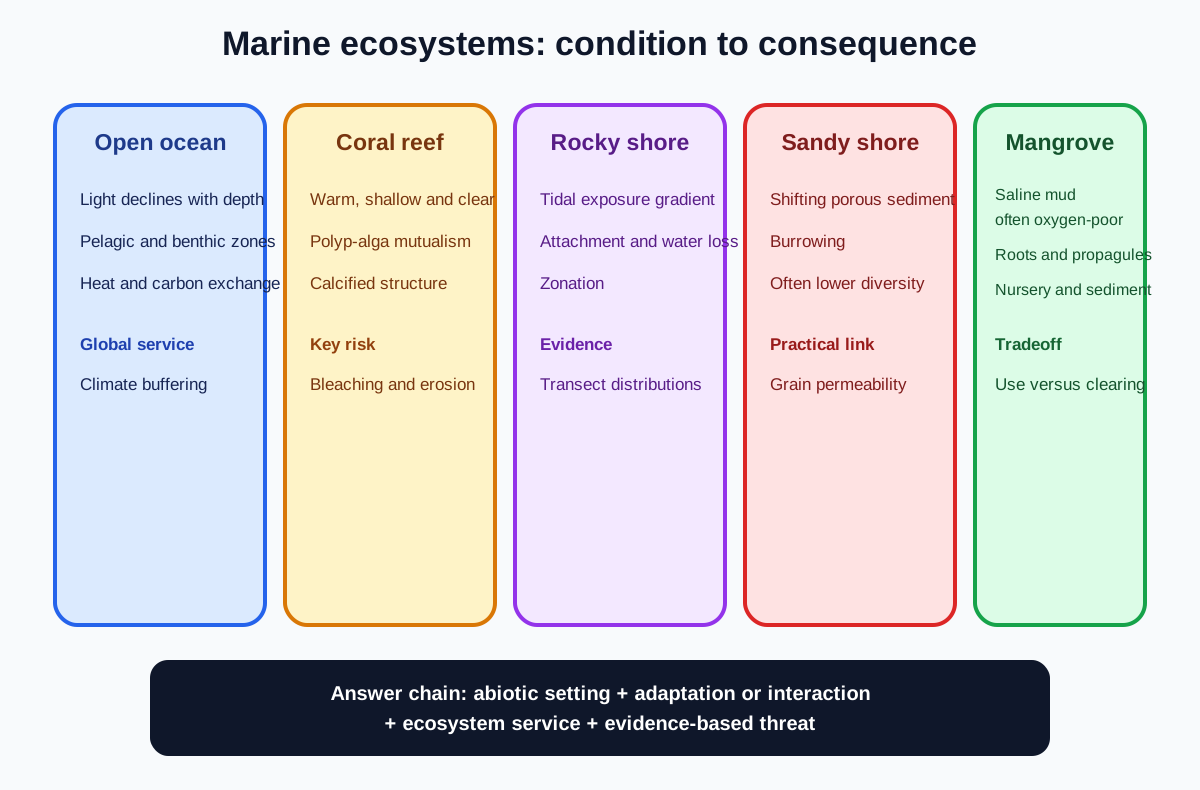
Examples of Marine Ecosystems is Topic 5 of the Cambridge International AS and A Level Marine Science 9693 AS syllabus. These notes follow official sections 5.1 Open ocean, 5.2 Tropical coral reef, 5.3 Rocky shore, 5.4 Sandy shore and 5.5 Mangrove forest. Each ecosystem is organised by physical conditions, organism responses, ecological functions and human value.
5.1 The open ocean
One connected World Ocean
The five named oceans are Arctic, Atlantic, Pacific, Indian and Southern. Their conventional names describe regions, but they are interconnected and encircle Earth as one World Ocean.
Water, heat, dissolved substances and organisms move among them through currents. Boundaries on maps are not physical walls.
Regions are also described as polar, temperate or tropical according to latitude and climatic conditions.
Open-ocean zones
The epipelagic zone is the sunlit surface layer where light supports most photosynthesis. Below it, the mesopelagic receives dim light but generally insufficient light for substantial photosynthesis.
The bathypelagic and abyssopelagic zones are dark. The abyssopelagic is deeper than the bathypelagic. The benthic zone is the seabed at any depth rather than one fixed layer in the water column.
Depth boundaries may be supplied in a question; the required emphasis is light penetration.
Ocean-atmosphere interaction
Oceans absorb carbon dioxide and store carbon in dissolved forms, organisms and sediments, so they act as carbon sinks. Photosynthetic marine producers release oxygen.
Water's high specific heat capacity buffers temperature change. Currents redistribute heat, and evaporation, condensation and gas exchange connect ocean and atmosphere.
These processes influence global climate, but a sink can also release some carbon under changing conditions.
Suitable salinity, oxygen, hard substrate and water movement also support growth. Nutrient-poor clear water can still support productive reefs because nutrients are recycled efficiently.
Conditions must persist long enough for calcification to exceed erosion.
Four reef types
A fringing reef lies close to the coast with little or no broad lagoon. A barrier reef is separated from land by a substantial lagoon.
A patch reef is a smaller isolated reef, often within a lagoon or shelf area. An atoll is a ring or partial ring around a central lagoon, commonly without a central high island.
Check this topic from memory
Attempt the matching topic bank before reopening the notes. Use each missed idea to decide what to review next.
Identify type from both coastal proximity and lagoon structure.
Coral identity and structure
Corals are animals in phylum Cnidaria. They form sessile colonies of polyps and often live in mutualism with photosynthetic zooxanthellae.
A typical hard-coral polyp has tentacles bearing nematocysts for prey capture and defence, a mouth leading to a stomach, and a surrounding skeletal cup. The calyx holds the polyp, the theca forms the cup wall and the basal plate lies beneath it.
Hard corals such as staghorn are more heavily calcified. Soft corals such as sea fans have less extensive calcification and can differ in zooxanthellae abundance.
Coral nutrition and mutualism
Polyps capture small organisms and particles with tentacles and nematocysts. Zooxanthellae photosynthesise and transfer organic products to the coral.
The coral supplies shelter, carbon dioxide and recycled nutrients to the algae. This mutualism explains the light dependence of many reef-building corals.
Corals remain consumers even when symbionts supply much of their energy.
Reef importance
Reefs support high biodiversity and fisheries, supply food, attract tourism and reduce wave energy reaching coastlines. Marine compounds may provide leads for medicines.
These benefits depend on living reef structure and surrounding water quality. A damaged reef can retain some physical protection while losing biodiversity and productivity.
Evaluation should include ecological and socioeconomic effects.
Reef erosion and damage
Higher temperature can disrupt coral-zooxanthellae mutualism and cause bleaching. Persistent or severe bleaching can reduce growth and survival.
Lower pH reduces carbonate availability and can make calcification more difficult. Predation by crown-of-thorns starfish removes tissue; storms, anchors and trampling cause physical damage; sediment blocks light and smothers polyps.
Reef state reflects the balance between growth, bioerosion, dissolution and physical breakage.
Artificial reefs
Artificial structures provide hard substrate, shelter and surface complexity on which reef communities may develop. They may support fisheries, tourism or restoration goals.
Success requires suitable material, placement, water quality and monitoring. A structure can merely aggregate existing fish rather than increase production, and poorly chosen materials can pollute or move in storms.
Artificial reefs do not replace the full ecological history of a natural reef automatically.
5.3 The rocky shore
Shore zones and tidal change
From highest to lowest, the required zones are splash zone, upper shore, middle shore, lower shore and subtidal zone. Exposure to air decreases downshore, while time submerged increases.
The upper shore experiences greater drying, temperature fluctuation and salinity change. The lower shore has more stable aquatic conditions but often stronger competition and predation.
During one tidal cycle, water coverage, wave force, oxygen route and feeding opportunity change through time.
Distribution and abundance
High-shore limits are often set by abiotic stress such as desiccation and heat. Lower limits can be strongly influenced by competition, grazing and predation.
Named examples should be matched to local evidence. Barnacles close shell plates to retain water; limpets clamp to rock and return to home scars; mussels attach with byssus threads; seaweeds use holdfasts and flexible bodies.
One species' realised distribution reflects interacting tolerances and biological relationships.
Adaptations
Shells, plates, mucus and tight attachment reduce water loss and resist waves. Burrowing or occupying crevices provides shade and moisture.
Flexible seaweed fronds bend with waves, while holdfasts anchor without functioning as roots. Behaviour such as feeding when submerged reduces exposure.
State the feature, its mechanism and the zone-specific challenge.
5.4 The sandy shore
Shifting porous substrate
Sand is unstable and repeatedly moved by waves. Water drains through connected pore spaces, so upper sediment can dry rapidly and conditions change with the tide.
Large particles generally create larger pore spaces and higher permeability than tightly packed fine particles. Oxygen penetrates differently according to water movement and grain packing.
Few organisms can attach permanently to the moving surface.
Low biodiversity
Instability, abrasion, drainage, temperature and salinity change limit exposed surface life. The substrate offers less fixed three-dimensional structure than a rocky shore or reef.
Burrowing organisms can escape waves and drying, but must tolerate low oxygen or shifting sediment. Food availability and predation further shape abundance.
Low visible diversity does not mean the sand contains no organisms.
Particle-size practical
The marked practical activity investigates particle size and substrate permeability. Put equal depths or masses of sorted substrate in identical columns, add the same water volume and measure drainage volume over fixed time or time for a fixed volume.
Control packing, column diameter, starting moisture and water head. Repeat each particle-size category.
Conclude only across the tested substrates and explain anomalies through packing or mixed grain shapes.
Sandy-shore adaptations
Named examples can include burrowing bivalves with siphons, worms with elongated bodies and crabs with digging limbs. Burrowing reduces desiccation, temperature extremes and wave removal.
Siphons maintain exchange with overlying water while the animal remains buried. Streamlined or compact forms move through sediment.
The adaptation must solve a specific sandy-shore problem.
5.5 The mangrove forest
Ecosystem and formation conditions
Mangrove forest is a tidal littoral ecosystem of salt-tolerant trees, other plants and associated populations on tropical and subtropical coasts.
It forms on sheltered muddy shores where fine sediment accumulates, temperatures are warm and tidal seawater reaches the substrate. Low wave energy allows seedlings to establish.
Waterlogged mud is unstable and oxygen-poor, while salinity varies with tide, rain and evaporation.
Red mangrove adaptations
The named species is red mangrove, Rhizophora mangle. Prop roots brace trees in soft substrate, trap sediment and provide supplementary oxygen uptake where mud oxygen is low.
Roots exclude much salt before it enters the plant. Viviparous propagules begin development while attached to the parent and can disperse by water before rooting.
Each feature improves survival under tidal, saline and unstable conditions.
Ecological importance
Complex roots provide nursery habitat and refuge for juveniles of fish and invertebrates. This can support offshore populations and fisheries.
Roots slow water, trap sediment and stabilise coastlines. Trapping reduces sediment reaching coral reefs and seagrass beds, helping protect their light environment.
Mangrove food webs also process detritus and store carbon in biomass and sediment.
Human importance
Mangroves support tourism, food collection, fisheries, timber and fuel, biodiversity and coastal protection. Benefits occur at local and regional scales.
Harvest can be sustainable only when removal does not exceed regeneration or destroy essential structure. Converting a forest may produce short-term income but lose nursery and storm-protection services.
Compare tradeoffs rather than listing uses separately.
Threats
Coastal land-use change clears or fragments habitat for aquaculture, farming, buildings and infrastructure. Over-harvesting removes trees faster than replacement.
Storms can uproot vegetation and erode sediment, while temperature change and sea-level effects alter suitable range and establishment. Barriers can prevent landward migration.
Threats interact: fragmented forests may recover less effectively after storms.
Worked application: explaining shore zonation
A survey finds limpets at a mean density of 18 per square metre on the upper shore, 42 on the middle shore and 9 on the lower shore. Greater immersion on the middle shore extends feeding time and reduces desiccation relative to the upper shore. The lower-shore decline cannot be explained by desiccation, because immersion is greatest there; stronger competition, predation or unsuitable algal and rock conditions are plausible. The pattern alone does not prove any one mechanism. Measuring exposure time, temperature and competitor or predator abundance along replicated transects would test whether abiotic stress sets the upper limit and biotic interactions help set the lower limit.
Common misconceptions and corrections
Treating the five oceans as sealed basins. They form one connected World Ocean.
Calling the benthic zone only the deepest water. It is the seabed at any depth.
Putting substantial photosynthesis in the bathypelagic zone. It is dark.
Saying a carbon sink never releases carbon. Net uptake can coexist with release.
Saying reefs prefer turbid sediment-rich water. Light and unsmothered surfaces are important.
Calling every offshore reef a barrier reef. Lagoon structure and coastal relationship matter.
Calling coral a plant. The polyp is an animal.
Calling zooxanthellae parasites. The required relationship is mutualistic.
Saying symbionts make corals producers. Corals remain consumers.
Treating soft coral as having the same calcification as hard coral. Their extent differs.
Explaining bleaching as immediate skeleton dissolution. It begins with symbiosis disruption.
Using lower pH as a synonym for warming. They are different stressors.
Assuming artificial reefs always increase fish production. They may only aggregate fish.
Putting the splash zone below the lower shore. It is highest.
Saying abiotic stress is greatest low on shore. Exposure stress generally increases upward.
Using attachment without explaining wave resistance. Link feature to mechanism.
Calling sand impermeable. Its pore structure permits drainage.
Changing substrate depth in a permeability comparison. Keep geometry controlled.
Assuming the finest particles always drain fastest. Smaller pores generally reduce permeability.
Saying sandy shores lack life. Many organisms live buried.
Calling mangroves freshwater forests. They are salt-tolerant tidal systems.
Saying prop roots only anchor. They also support oxygen uptake and sediment trapping.
Calling propagules ordinary dormant seeds. They develop viviparously on the parent.
Saying mangroves increase sediment on reefs. They trap it before it reaches reefs.
Evaluating mangroves only as timber. Nursery, protection and biodiversity services matter.
Treating storm and land-use threats as independent. Fragmentation can reduce recovery.
Assessment guidance
Open-ocean answers should distinguish water-column zones from the benthic seabed and link light to photosynthesis. Reef responses need formation conditions, type criteria, Cnidarian structure, both sides of mutualism, required services and causal erosion mechanisms. Rocky-shore questions should trace the tidal gradient and distinguish abiotic upper limits from lower-shore biotic effects using named adaptations. Sandy-shore answers must connect particle size, permeability, instability, burrowing and diversity, including a controlled practical design. Mangrove responses should link each red-mangrove adaptation and forest service to mud, salinity, tides or sediment, then evaluate threats and human-use tradeoffs.
Retrieval practice
Label the five oceans and open-ocean light zones, then compare polar, temperate and tropical regions. Draw all four reef types and a hard-coral polyp, and build a cause-effect table for five reef stressors. Sketch a shore profile from splash to subtidal zone with named adaptations. Plan the sand-permeability practical and explain two burrower adaptations. Finally, reconstruct red-mangrove formation conditions, prop-root, salt-exclusion and propagule mechanisms, ecological services, human uses and interacting threats.