Cambridge International AS and A Level Marine Science 6: Physiology of marine organisms
Cambridge International AS and A Level Marine Science 6: Physiology of marine organisms
Study guide/
Cambridge Marine Science 9693 A Level notes on cells, membranes, transport, water potential, surface area, gas exchange and osmoregulation in marine organisms.
Physiology of Marine Organisms is Topic 6 of the Cambridge International AS and A Level Marine Science 9693 full A Level syllabus. These notes follow official sections 6.1 General cell structure, 6.2 Movement of substances, 6.3 Gas exchange and 6.4 Osmoregulation. They connect cell-scale transport to the challenges faced by whole marine organisms.
6.1 General cell structure
Cell surface membrane
The cell surface membrane separates cytoplasm from the external environment and controls movement of substances. Its selective permeability lets the cell maintain conditions different from the surrounding seawater.
The membrane also contains proteins involved in transport and communication. It is not a rigid impermeable wall.
All required typical plant and animal cells have a cell surface membrane.
Nucleus and ribosomes
The nucleus contains genetic material and controls cell activities through gene expression. A nuclear envelope separates its contents from cytoplasm.
Ribosomes are the sites of protein synthesis. Free ribosomes make proteins used mainly in the cytoplasm, while ribosomes attached to rough endoplasmic reticulum contribute to proteins processed through the endomembrane system.
Ribosomes are not membrane-bound organelles.
Rough and smooth endoplasmic reticulum
Rough endoplasmic reticulum has attached ribosomes and forms a membrane network involved in protein production and transport.
Smooth endoplasmic reticulum lacks ribosomes and is associated with lipid synthesis and other chemical processing. Its abundance varies with cell function.
Identify rough endoplasmic reticulum by its studded surface in electron micrographs, not by colour.
Golgi body
The Golgi body modifies, sorts and packages proteins and lipids into vesicles. Flattened membrane sacs and nearby vesicles are characteristic in an electron micrograph.
Secretory cells often contain prominent rough endoplasmic reticulum and Golgi bodies because proteins move through this pathway before release.
The Golgi body does not synthesise proteins from amino acids; ribosomes do that.
Mitochondria
Mitochondria are sites of aerobic respiration and usable energy transfer. Their inner membranes form folds that increase surface area for respiratory reactions.
Cells performing active transport, movement or secretion often contain many mitochondria because these processes require energy.
Presence of mitochondria does not mean a cell is photosynthetic.
Chloroplasts
Chloroplasts are sites of photosynthesis in suitable plant and algal cells. Internal membranes contain photosynthetic pigments, while the surrounding material supports carbon-fixing reactions.
Check this topic from memory
Attempt the matching topic bank before reopening the notes. Use each missed idea to decide what to review next.
Animal cells do not contain chloroplasts. Not every plant cell contains them, because roots and other non-photosynthetic tissues may not receive light.
Identify chloroplasts from organised internal membranes rather than assuming every oval structure is one.
Cell wall and vacuole
A plant cell wall outside the membrane provides support and resists bursting when water enters. It is freely permeable compared with the selectively permeable membrane.
A large permanent vacuole contains cell sap. Its surrounding membrane helps maintain internal conditions, and water entry can create turgor pressure against the wall.
Typical animal cells lack a cellulose cell wall and large permanent vacuole.
Fluid mosaic model
Phospholipids form a bilayer. Each phospholipid has a water-attracting head facing aqueous surroundings and water-repelling tails facing inward.
Proteins are embedded in or associated with the bilayer, producing the mosaic. Phospholipids and many proteins can move laterally, making the structure fluid.
Channel proteins provide hydrophilic routes through the membrane. Carrier proteins bind substances and change shape to transfer them.
Selective permeability
Small non-polar molecules can pass through the phospholipid region more readily than charged ions. Ions and many polar molecules need specific membrane proteins.
Selectivity depends on molecular properties, protein availability and cellular energy use. A membrane can permit water while restricting a solute.
Selective permeability is central to diffusion, osmosis and active transport.
Interpreting cell images
A photomicrograph is produced with a light microscope, while an electron micrograph uses electrons and can reveal finer internal detail. A drawing is an interpretation and may simplify structures.
Identify plant cells from a wall, large vacuole and any chloroplasts; identify animal cells by their lack of those plant structures. Use scale bars and relative organisation rather than colour.
Artefacts and section angle can change apparent shape.
Magnification
Magnification equals image size divided by actual size. Image and actual measurements must use the same unit before division.
Rearrange to obtain actual size as image size divided by magnification. A scale-bar calculation uses the measured bar length and its stated actual length.
Magnification has no unit, while actual size retains a length unit.
Observation and drawing practical
The marked practical activity includes unfamiliar structures or specimens from Topics 4.2, 5.2 and the required cell structures. Make large, accurate drawings using clear single lines and no shading.
Record a title, visible labels and scale or magnification calculation. Measure image features with a ruler and show unit conversion.
Draw what is observed rather than an idealised remembered diagram.
6.2 Movement of substances
Diffusion
Diffusion is the net movement of particles from higher concentration to lower concentration due to random motion. It is passive and does not require energy supplied by the cell.
The rate increases with a steeper concentration gradient, larger surface area, shorter distance and suitable higher temperature.
Particles move both ways, but the net movement follows the gradient until dynamic equilibrium.
Facilitated diffusion
Facilitated diffusion is passive movement down a concentration gradient through specific channel or carrier proteins. It enables ions and polar molecules to cross the membrane.
Specificity arises from protein structure. The process can become limited when all suitable proteins are occupied.
It does not move substances against their gradient and does not directly use cellular energy.
Osmosis and water potential
Osmosis is the net movement of water through a selectively permeable membrane from higher water potential to lower water potential.
Pure water has a higher water potential than a solution containing dissolved solute under comparable conditions. Adding solute reduces the relative freedom of water molecules and lowers water potential.
Detailed solute-potential calculations are not required.
Active transport
Active transport uses energy supplied by the cell to move a substance against its concentration gradient through carrier proteins or pumps.
It allows cells to accumulate ions even when their internal concentration is already higher. Cells specialised for active transport commonly have many mitochondria and extensive membranes.
The direction relative to the gradient distinguishes active transport from facilitated diffusion.
Diffusion and osmosis practicals
Plant tissue, Visking tubing and agar can model transport. Vary one factor such as concentration, distance or surface area while controlling time, temperature and sample dimensions.
Measure initial and final mass or dimensions for plant tissue, or movement of a visible substance through agar. Calculate absolute and percentage change where appropriate.
Visking tubing is non-living and models selective permeability; it does not reproduce every membrane protein process.
Surface area to volume ratio
As a similar shape becomes larger, volume increases faster than surface area, so surface area to volume ratio decreases. The formulae for simple shapes are provided, but unit consistency remains essential.
Small cells and thin exchange surfaces have more area available per unit volume and shorter diffusion distances. Large organisms have greater internal demand relative to external surface.
Shape changes such as folds or filaments can increase surface area without the same increase in volume.
Agar-block investigation
Cut agar blocks of different dimensions containing an indicator, place them in a diffusing solution for the same time and measure penetration.
Control agar composition, solution concentration, temperature and exposure time. Compare percentage volume penetrated, not only penetration depth, because blocks differ in size.
Smaller blocks should show a larger fraction reached under the same conditions due to higher surface area to volume ratio and shorter maximum distance.
Estimating tissue water potential
Place equal plant-tissue pieces in solutions of different known water potentials or concentrations. After a fixed time, blot consistently and measure mass change.
Plot percentage mass change against solution value. The point where change is zero estimates tissue water potential because there is no net water movement.
Use several values around the intercept and repeats. Zero net mass change does not mean water molecules stop moving.
Plant and animal cell responses
In a higher-water-potential solution, water enters cells. A plant cell becomes turgid because its wall resists expansion; an animal cell may swell and burst if the difference is large.
In a lower-water-potential solution, water leaves. A plant membrane can pull away from the wall during plasmolysis; an animal cell shrinks.
The wall changes the outcome, not the direction of osmosis.
6.3 Gas exchange
Respiratory gases
Aerobic respiration requires oxygen and produces carbon dioxide. Both must move between cells and the environment.
Gas exchange is the diffusion of these gases across a suitable surface. A concentration gradient must be maintained by ventilation, circulation or continuing cellular use and production.
Water contains much less oxygen than air, making effective marine exchange important.
Size and exchange demand
Small organisms have high surface area to volume ratios and short diffusion paths, so whole-body diffusion may meet demand.
As size increases, the ratio decreases and internal cells lie farther from the surface. Specialised exchange surfaces and transport systems become necessary.
Thin, large, moist and well-ventilated surfaces support rapid diffusion.
Coral-polyp diffusion
A small coral polyp exchanges gases mainly by simple diffusion across its body surface. Its thin tissues and contact with moving water maintain relatively short paths.
Water movement renews oxygen and removes carbon dioxide. Symbiotic photosynthesis also changes gas concentrations during light periods.
The polyp does not use fish-like gill ventilation.
Pumped ventilation in grouper
A grouper uses movements of the mouth and operculum to pump water across gill surfaces. Water flows over thin exchange lamellae with a large surface area and blood transport maintains gradients.
Pumping allows ventilation while the fish is stationary or moving slowly. It requires muscular energy.
The operculum coordinates pressure changes and protects the gills.
Ram ventilation in tuna
Tuna swim with the mouth open so forward movement forces water across the gills. This ram ventilation suits a continuously active, fast-swimming pelagic fish with high oxygen demand.
The method links gas exchange to motility and habitat. Reduced forward movement can reduce ventilation in species strongly dependent on ram flow.
Do not describe ram ventilation as active mouth pumping while stationary.
6.4 Osmoregulation
Why regulate water and ions
Seawater and body fluids differ in ion composition and may differ in water potential. Uncontrolled osmosis and ion diffusion would change cell volume, enzyme conditions and nerve or muscle function.
Organisms may regulate water content, individual ion concentrations or both. Similar overall water potential does not mean identical chemical composition.
Regulation has an energy cost when active transport is required.
Osmoconformers and mussels
An osmoconformer allows internal osmotic concentration to vary broadly with the environment. Marine mussels are the required example.
Conforming reduces the gradient and energetic cost but does not mean every internal ion simply equals seawater. Cellular compatible solutes and behavioural responses can still matter.
Rapid or extreme salinity change can exceed tolerance.
Osmoregulators and tuna
An osmoregulator maintains internal water and ion conditions within a narrower range despite the environment. Tuna are the named marine example.
Marine bony fish tend to lose water and gain salts relative to seawater. They drink seawater, absorb water through the gut and actively remove excess ions through gills and excretion pathways.
This regulation supports stable cell function but uses energy.
Euryhaline and stenohaline
Euryhaline organisms tolerate a wide salinity range; stenohaline organisms tolerate only a narrow range. Salmon are euryhaline osmoregulators because they move between fresh water and sea.
Marine mussels can tolerate salinity variation through conformity and closure behaviour, while tuna are comparatively stenohaline marine regulators.
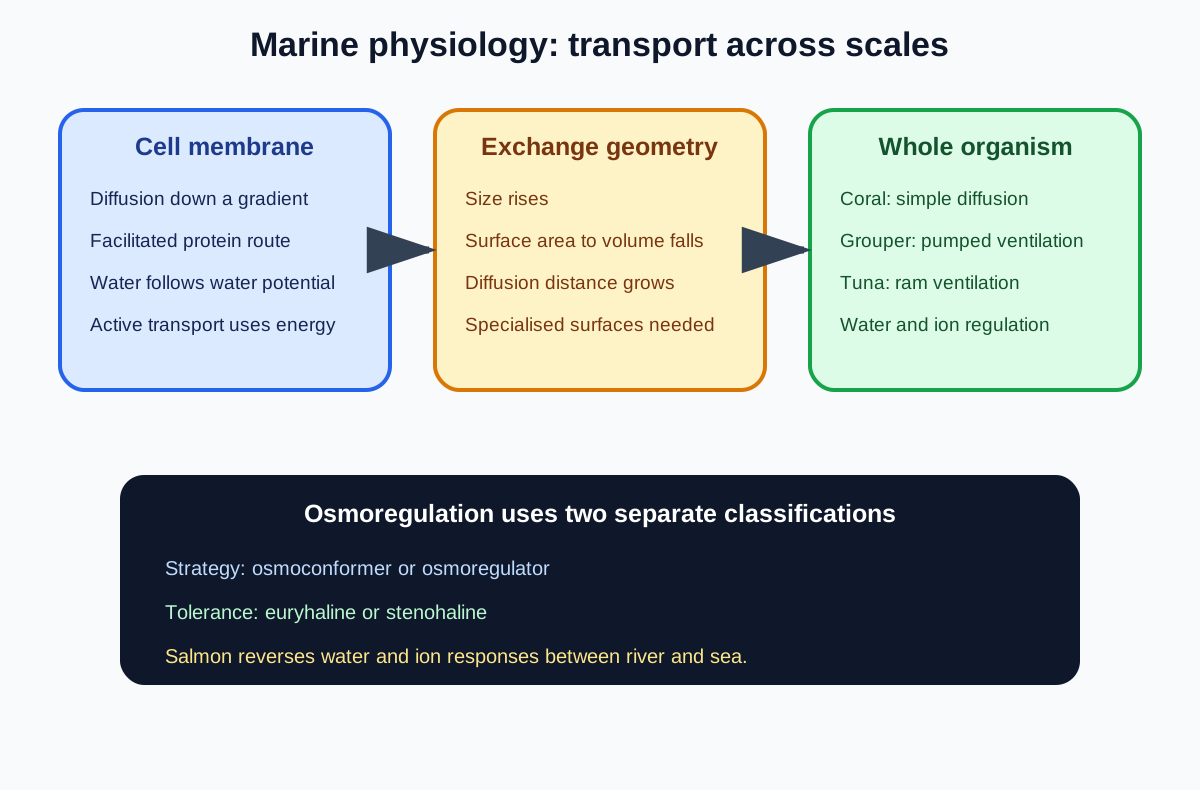
Euryhaline or stenohaline describes tolerance range; conformer or regulator describes the control strategy.
Salmon osmoregulation
In fresh water, salmon gain water and lose ions. They drink little, produce abundant dilute urine and actively take up ions across gills.
In seawater, they lose water and gain ions. They drink seawater, absorb water and excrete excess salts through specialised gill cells, producing less urine.
Hormonal and physiological adjustment during migration reverses the direction and intensity of transport processes.
Worked application: surface area and diffusion
A cube-shaped organism model has side length 1 centimetre, giving surface area 6 square centimetres, volume 1 cubic centimetre and a surface area to volume ratio of 6 to 1. A similar cube with side length 3 centimetres has surface area 54 square centimetres and volume 27 cubic centimetres, so its ratio is only 2 to 1. Although the larger cube has more total surface, it has less exchange area per unit volume and longer internal diffusion distances. This is why size can create a need for folded gas-exchange surfaces, ventilation and transport systems rather than relying on the external body surface alone.
Common misconceptions and corrections
Calling the cell membrane a rigid wall. It is fluid and selectively permeable.
Putting genetic material in ribosomes. The nucleus contains the main genetic material.
Saying rough endoplasmic reticulum makes lipids only. Its ribosomes support protein production.
Saying the Golgi body synthesises proteins. It modifies and packages them.
Putting chloroplasts in typical animal cells. They occur in photosynthetic cells.
Calling the cell wall selectively permeable. The membrane provides the main selectivity.
Drawing phospholipid tails facing water. Hydrophobic tails face inward.
Treating channels and carriers as identical. Their transport mechanisms differ.
Identifying organelles by colour in an electron micrograph. Use structure and scale.
Using different units in a magnification calculation. Convert first.
Giving magnification a length unit. It is a ratio.
Shading a biological drawing. Use clear single lines.
Saying diffusion requires cellular energy. It is passive.
Moving facilitated diffusion against a gradient. It follows the gradient.
Defining osmosis as solute movement. It is net water movement.
Saying solute raises water potential. Dissolved solute lowers it.
Calling active transport movement down a gradient. It works against the gradient.
Assuming Visking tubing models every cell function. It models selective permeability only.
Saying large organisms have less total surface. Their surface area to volume ratio is lower.
Comparing agar blocks by penetration depth alone. Compare the fraction reached.
Calling zero mass change zero molecular movement. Dynamic movement continues equally.
Saying plant cells burst readily in pure water. Their walls develop turgor pressure.
Saying animal cells plasmolyse. Plasmolysis refers to walled plant cells.
Calling respiration and gas exchange the same process. Exchange supplies and removes gases.
Saying every organism needs gills. Small forms may use body-surface diffusion.
Calling grouper ventilation ram ventilation. Grouper can pump water with mouth and operculum.
Assuming equal water potential means equal ion composition. Composition can differ.
Calling an osmoconformer completely unregulated. Specific internal chemistry can still be controlled.
Using euryhaline as a synonym for osmoregulator. Tolerance and strategy are different axes.
Saying salmon use the same ion transport in river and sea. The direction reverses.
Assessment guidance
Cell questions should identify structures from organisation and link each to function, then distinguish bilayer movement, channels, carriers and energy use. Magnification answers need explicit unit conversion. Transport responses should define gradient direction, selective membrane role and whether cellular energy is required; practical answers need controlled dimensions, repeats and percentage change. Gas-exchange comparisons should connect surface area, diffusion distance, ventilation and habitat to coral polyps, grouper and tuna. Osmoregulation answers must separate water potential from ion composition, conformer from regulator and salinity tolerance from strategy, then trace opposite salmon responses in fresh water and seawater.
Retrieval practice
Draw typical plant and animal cells and a fluid-mosaic membrane, then identify structures on unfamiliar images and complete three magnification conversions. Compare diffusion, facilitated diffusion, osmosis and active transport by substance, gradient, protein and energy. Plan the three marked transport investigations and calculate surface area to volume ratios. Finally, compare coral, grouper and tuna gas exchange and build a two-axis table for mussel, tuna and salmon using regulation strategy, salinity tolerance and transport direction.