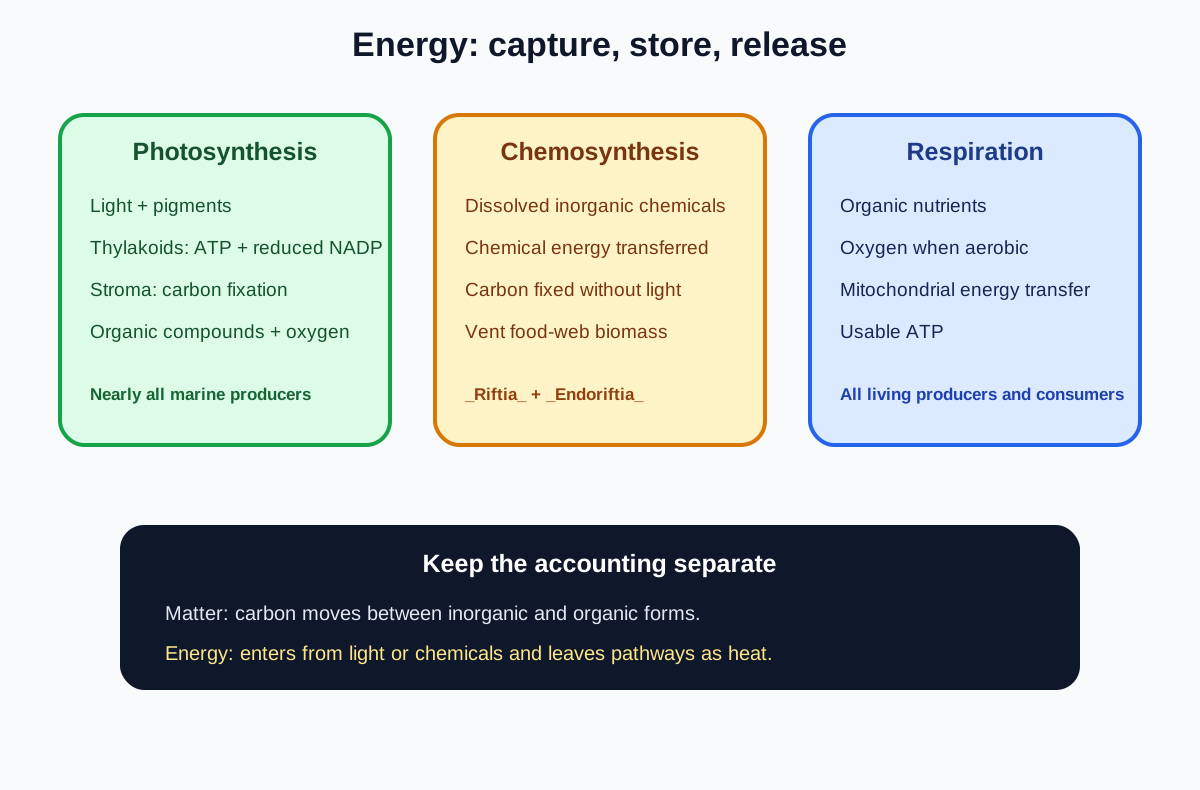
Energy is Topic 7 of the Cambridge International AS and A Level Marine Science 9693 full A Level syllabus. These notes follow official sections 7.1 Photosynthesis, 7.2 Chemosynthesis and 7.3 Respiration. They trace energy capture into organic compounds and its later release as ATP while keeping matter and energy pathways distinct.
7.1 Photosynthesis
Wavelength, intensity and penetration
White light contains a range of colours with different wavelengths. Wavelength is the distance between corresponding points on successive waves, while intensity is the amount of light energy arriving per unit area per unit time.
Penetration describes how far a wavelength travels through water before absorption or scattering removes it. These terms answer different questions and must not be used interchangeably.
Blue-green wavelengths generally penetrate farther through clear seawater than red wavelengths, so the spectral environment changes with depth.
Light with depth
Total light intensity decreases with depth. Water, dissolved material and particles absorb and scatter light, while different wavelengths disappear at different rates.
Turbidity shortens penetration by increasing scattering and absorption. Producers at depth receive dimmer light with a narrower wavelength range.
Depth alone does not determine light: water clarity, sun angle and mixing also matter.
Carbon fixation
Photosynthesis is the process used by nearly all marine producers to fix carbon into organic material. The required equation is six carbon dioxide plus six water producing glucose plus six oxygen, using light and chlorophyll.
Carbon fixation transfers inorganic carbon into organic compounds. Light supplies energy but does not become matter inside glucose.
Some marine producers use chemosynthesis instead, which is why nearly all matters.
Two-stage organisation
Photosynthesis has a light-dependent stage and a light-independent stage. The first captures light energy and produces ATP and reduced NADP.
The Calvin cycle uses those products to fix carbon dioxide and build organic molecules. The light-independent stage does not require photons directly, but depends on products generated by light-dependent reactions.
Calling it a process that happens only in darkness is therefore misleading.
Chloroplast structure
A chloroplast has an outer and inner membrane surrounding the stroma. Inside are flattened thylakoids with a thylakoid membrane and internal thylakoid space.
Thylakoids are arranged into grana. Their large membrane area holds pigments and components of the light-dependent stage.
Check this topic from memory
Attempt the matching topic bank before reopening the notes. Use each missed idea to decide what to review next.
The Calvin cycle occurs in the stroma, while the light-dependent reactions occur at thylakoid membranes.
Chlorophyll and accessory pigments
Chlorophyll a is a central photosynthetic pigment. Accessory pigments absorb wavelengths that chlorophyll a uses less effectively and transfer captured energy into the photosynthetic system.
Xanthophylls and phycobilins extend the usable wavelength range of marine producers. Pigment composition can therefore match the wavelengths penetrating a habitat.
Accessory pigments do not create extra light; they broaden absorption.
Pigment chromatography
Chromatography separates pigments because they differ in solubility in the mobile solvent and attraction to the stationary phase. Extracted pigments begin on a pencil origin below the solvent surface.
As solvent rises, pigment bands travel different distances. Mark the solvent front immediately, identify colours and calculate retention factor as distance travelled by pigment divided by distance travelled by solvent front.
Retention factors are comparable only under the same solvent, stationary phase and conditions.
Chromatography practical quality
Use a concentrated small origin spot, allowing it to dry between applications. Keep the origin above solvent so the sample does not dissolve directly into the reservoir.
Cover the chamber where appropriate, keep the paper or plate vertical and stop before solvent reaches the top. Measure from the origin to the centre of each band.
Diffuse or overlapping bands reduce identification confidence; repeating the separation unchanged may not resolve an unsuitable solvent system.
Absorption spectra
An absorption spectrum shows how strongly a pigment absorbs different wavelengths. Peaks identify wavelengths captured effectively.
Different pigments have different spectra. A combined pigment extract can absorb across a wider region than chlorophyll a alone.
Do not read an absorption peak as the direct photosynthesis rate without action-spectrum evidence.
Action spectra
An action spectrum shows photosynthesis rate at different wavelengths. It often resembles the combined absorption pattern because absorbed energy can drive photosynthesis.
Where action remains high despite low chlorophyll-a absorption, accessory pigments may contribute. Compare peak positions rather than expecting exact identical shapes.
The dependent measurement must be a photosynthetic response such as oxygen production or carbon-dioxide uptake.
Light-dependent stage
Light photoactivates chlorophyll. Water is split by photolysis, providing electrons and hydrogen-related components while oxygen is released.
Energy transfer produces ATP and reduced NADP. These carry energy and reducing power to the Calvin cycle.
Details of cyclic and non-cyclic photophosphorylation are outside the stated boundary.
Calvin cycle
In the stroma, rubisco catalyses carbon-dioxide fixation. ATP and reduced NADP from the light-dependent stage are used to produce organic molecules.
The syllabus does not require named intermediate compounds. Focus on carbon input, enzyme action, energy transfer and organic output.
Rubisco is an enzyme, not a pigment that absorbs light.
Light intensity as a limiting factor
At low intensity, more light increases photoactivation and photosynthesis rate. The response may plateau when carbon dioxide, temperature or another factor becomes limiting.
At very high intensities, stress or damage can reduce performance in some organisms, but use the evidence and range provided.
A plateau means light is no longer the main limiting factor under those conditions.
Wavelength as a limiting factor
Rate depends on whether pigments absorb the supplied wavelength. Blue or red light may drive high rates for chlorophyll-rich producers, while green light can be less effective unless accessory pigments capture it.
Marine pigment composition changes this response. Do not rank wavelengths without considering the organism's pigments.
Equal wavelength treatments should also have comparable intensity.
Carbon dioxide and temperature
Increasing carbon-dioxide availability can increase fixation until another factor limits. Temperature affects enzyme-controlled reactions, including the Calvin cycle.
Low temperature slows reactions; rising temperature increases rate toward an optimum. Above the optimum, enzyme disruption and physiological stress reduce rate.
Temperature also changes gas solubility, so an aquatic experiment must control or monitor it.
Wavelength investigation
The marked practical activity varies wavelength using filters or controlled light sources and measures photosynthesis rate; freshwater plants are acceptable.
Keep intensity, distance, plant amount, carbon-dioxide availability, temperature and measurement time constant. Filters may transmit unequal intensities and heat differently, so intensity should be measured or adjusted.
Use repeats and a no-light control, then connect the pattern to pigment absorption.
7.2 Chemosynthesis
Chemical energy and carbon fixation
Chemosynthesis fixes carbon using chemical energy from dissolved substances. Required energy sources include hydrogen sulfide, methane, hydrogen and iron-containing substances.
Chemosynthetic bacteria convert inorganic chemical energy into organic compounds available to other organisms. Light and chlorophyll are not required.
This process supports food chains where sunlight cannot penetrate.
Hydrothermal-vent food webs
At vents, dissolved reduced chemicals mix with oxidising seawater. Bacteria obtain energy from chemical reactions and use it to fix carbon.
Consumers feed on free-living bacteria or depend on symbiotic bacteria. This transfers energy into animals and higher trophic levels.
The vent plume supplies chemicals, but heat alone is not the organisms' food-energy source.
Riftia and Endoriftia
The giant tubeworm Riftia houses chemosynthetic Endoriftia bacteria in specialised internal tissue. The tubeworm lacks a conventional adult digestive system.
It supplies bacteria with hydrogen sulfide, oxygen and carbon dioxide obtained from the environment. Endoriftia uses hydrogen-sulfide energy to fix carbon and produce organic compounds such as glucose for the association.
The relationship is mutualistic because both partners gain resources or habitat.
7.3 Respiration
Aerobic respiration
Aerobic respiration releases energy from organic nutrients and transfers it into ATP when oxygen is available. ATP supplies energy for active transport, movement, synthesis and other cellular work.
The word equation is glucose plus oxygen producing carbon dioxide plus water. The chemical equation is glucose plus six oxygen producing six carbon dioxide plus six water.
Respiration releases energy in controlled reactions; it is not ordinary combustion inside cells.
Anaerobic respiration
When oxygen is limited or unavailable, most organisms can use anaerobic respiration. It yields far less ATP per glucose because the organic substrate is not fully oxidised.
Word and chemical equations are not required here. Emphasise low ATP yield and the environmental condition.
Anaerobic respiration is not zero-energy metabolism.
Mitochondrial structure and sites
A mitochondrion has an outer membrane and an inner membrane folded into cristae around the matrix. The folds increase surface area for membrane-associated aerobic processes.
Aerobic respiration occurs in mitochondria, with different stages associated with matrix and inner membrane. Anaerobic respiration occurs in cytoplasm.
Cells with high energy demand often contain many mitochondria.
Photosynthesis and respiration together
Photosynthesis stores transferred energy in organic compounds and releases oxygen. Respiration releases usable energy from organic compounds and often consumes oxygen.
Producers perform both processes. In light, net gas exchange depends on their relative rates; in darkness photosynthesis stops while respiration continues.
The equations have related reactants and products but the processes are not simple one-step reversals.
Worked application: identifying a pigment band
A pigment band travels 48 millimetres from the origin while the solvent front travels 80 millimetres, giving a retention factor of 0.60. A reference pigment has a value of 0.61 under the same solvent and stationary phase, so the band is consistent with that pigment. The match is supporting evidence, not absolute identification, because measurement uncertainty and overlapping compounds remain possible. If the solvent front were measured from the bottom of the paper rather than the origin, the ratio would be invalid. A repeat using the same controlled system and a reference mixture can assess reproducibility, while a different solvent would require new reference values.
Common misconceptions and corrections
Using wavelength and intensity as synonyms. Colour position and energy amount differ.
Saying all wavelengths penetrate equally. Water absorbs them differently.
Calling light matter incorporated into glucose. Light supplies energy.
Saying every producer photosynthesises. Chemosynthetic producers are the exception.
Calling light-independent reactions dark-only reactions. They depend on light-stage products.
Putting the Calvin cycle on thylakoid membranes. It occurs in stroma.
Putting light-dependent reactions in the stroma. They occur at thylakoid membranes.
Calling grana separate chloroplasts. They are thylakoid stacks inside one chloroplast.
Saying accessory pigments generate wavelengths. They absorb additional wavelengths.
Putting the chromatography origin in solvent. Keep it above the solvent level.
Drawing the origin in ink. Use pencil.
Calculating retention factor from container height. Use pigment and solvent-front distances from the origin.
Comparing retention factors from different solvents directly. Conditions must match.
Treating an absorption spectrum as an action spectrum. One measures absorption; the other measures rate.
Saying photolysis splits carbon dioxide. It splits water.
Adding detailed photophosphorylation routes beyond the boundary. They are not required.
Calling rubisco a light-absorbing pigment. It catalyses carbon fixation.
Saying a light-response plateau means photosynthesis stopped. Another factor limits further increase.
Ranking wavelength without pigment evidence. Accessory pigments alter use.
Changing filter colour and intensity together. Control intensity.
Assuming more carbon dioxide always increases rate. Another factor eventually limits.
Saying temperature only affects light absorption. It strongly affects enzyme reactions.
Calling chemosynthesis photosynthesis in darkness. Its energy source is chemical.
Saying vent heat directly powers the food chain. Oxidation of dissolved chemicals supplies energy.
Calling Endoriftia the tubeworm. It is the symbiotic bacterium.
Saying Riftia feeds conventionally through a mouth. Adult nutrition depends on symbionts.
Calling respiration energy production from nothing. It transfers energy from organic molecules.
Omitting oxygen from aerobic respiration. Oxygen is required.
Saying anaerobic respiration yields no ATP. It yields less ATP.
Putting anaerobic respiration in mitochondria. It occurs in cytoplasm.
Saying producers only photosynthesise. They also respire.
Assessment guidance
Light questions should distinguish wavelength, intensity and penetration and connect depth to pigment absorption. Chloroplast answers need exact structure-stage ownership and the bounded roles of ATP, reduced NADP, photolysis and rubisco without unnecessary intermediates. Chromatography requires origin, solvent front, retention-factor working and controlled comparison. Limiting-factor explanations should identify the rising region, plateau or optimum and name the new limiting process. Chemosynthesis answers must identify chemical energy, carbon fixation and both sides of the Riftia-Endoriftia relationship. Respiration responses need correct equations, ATP purpose, oxygen condition, relative anaerobic yield and mitochondrion-versus-cytoplasm sites.
Retrieval practice
Sketch wavelength penetration with depth and match pigment spectra to action spectra. Draw a chloroplast and place every photosynthetic stage and product. Plan pigment chromatography and the wavelength practical, including calculations and controls. Compare light, carbon dioxide and temperature response curves. Then construct a vent food chain around Riftia and Endoriftia, draw a mitochondrion, write both aerobic equations and explain why a producer's net oxygen exchange changes between bright light and darkness.