Cambridge International AS and A Level Marine Science 8: Fisheries for the future
Cambridge International AS and A Level Marine Science 8: Fisheries for the future
Study guide/
Cambridge Marine Science 9693 A Level notes on marine life cycles, fertilisation, sustainable fisheries, stock evidence, controls, rehabilitation and aquaculture.
Fisheries for the Future is Topic 8 of the Cambridge International AS and A Level Marine Science 9693 full A Level syllabus. These notes follow official sections 8.1 Life cycles, 8.2 Sustainable fisheries and 8.3 Marine aquaculture. The central task is to match biological evidence and human objectives to management rather than treating one restriction or production system as universally best.
8.1 Life cycles
Larval stages and metamorphosis
A larval stage is a distinct immature form that differs from the adult. Metamorphosis is the substantial change in body form and function between stages.
Marine larvae often drift as plankton and disperse from adult habitat before settling or developing further. This connects distant populations but exposes larvae to variable currents, food and predators.
A larva is not simply a smaller adult.
Sessile and non-sessile organisms
A sessile adult remains attached to one location, while a non-sessile organism can move from place to place.
For sessile animals, a mobile gamete or larval stage is important for dispersal, colonisation and gene flow. Mobile adults can migrate to feeding or breeding grounds, but larvae may still spread populations more widely.
Life-cycle stage and mobility must be stated together.
Simple and complex cycles
Marine mammals have relatively simple life cycles with young resembling smaller adults and no major larval metamorphosis. Crustaceans often have complex cycles with several larval forms and metamorphic transitions.
Complexity can divide feeding, dispersal and settlement roles among stages. It also means that failure of one specialised habitat or environmental cue can interrupt recruitment.
Simple does not mean ecologically unimportant or without juvenile dependence.
Stage-specific importance
Eggs and larvae can provide dispersal, while juveniles may depend on nursery habitat for food and shelter. Adults may occupy feeding grounds and produce gametes.
Protecting only adult habitat can fail if spawning areas, migration routes or nurseries are degraded. Stock management must consider the whole cycle.
For sessile species, successful settlement determines adult distribution strongly.
External fertilisation in tuna
Tuna release eggs and sperm into water. External fertilisation can produce many offspring and disperse them widely, but gametes are diluted and many embryos or larvae die.
Little parental care reduces energy invested per offspring but requires high fecundity to compensate for low survival.
Check this topic from memory
Attempt the matching topic bank before reopening the notes. Use each missed idea to decide what to review next.
Synchronised spawning and suitable currents increase fertilisation and recruitment success.
Internal fertilisation in sharks
Sharks use internal fertilisation, increasing the chance that sperm reaches eggs. Fewer, larger young may receive greater investment through yolk, uterine support or retained development depending on species.
Survival per offspring can be higher, but low fecundity and slow maturity reduce the rate at which depleted populations recover.
Do not generalise one shark developmental mode to every species.
Internal fertilisation and care in whales
Whales use internal fertilisation, pregnancy and live birth. Mothers invest heavily through gestation, milk and prolonged care.
Few offspring are produced, but each has a relatively high survival chance. Long generation time makes populations sensitive to additional adult mortality.
The comparison with tuna must include both fertilisation site and subsequent investment.
8.2 Sustainable fisheries
Meaning of sustainable exploitation
A fishery is sustainable when harvesting can continue without driving the target population, dependent species or habitat into long-term decline.
Catch must remain compatible with recruitment and growth after natural mortality and environmental variation. Sustainability is ecological, social and economic rather than simply maintaining one year's catch.
Use a named organism and its life history when explaining need.
Sonar
Sonar helps vessels locate fish schools efficiently, reducing search time and fuel per catch. It can also allow rapid concentration of fishing pressure on aggregations.
Spawning or schooling populations may be removed faster than they replace themselves. Better detection therefore needs catch and effort control.
Technology is not harmful by itself; impact depends on how it changes effort and selectivity.
Purse seine fishing
A purse seine surrounds a school with a large net and closes underneath. It can capture large quantities of schooling fish efficiently.
When target and non-target species mix, bycatch can be substantial. Juveniles may be caught if mesh and location are poorly controlled.
Observer data, exclusion design and spatial rules can improve selectivity.
Benthic trawling
Benthic trawls are dragged over or near the seabed to capture bottom-associated organisms. They can produce large catches but disturb sediment and damage slow-growing habitat-forming organisms.
Bycatch and resuspended sediment extend effects beyond the target stock. Repeated trawling can simplify benthic communities.
Area closures and gear restrictions target habitat damage directly.
Factory ships
Factory ships process and freeze catches at sea, allowing vessels to remain offshore longer and exploit distant stocks. Waste may be reduced through on-board processing, but fishing capacity rises greatly.
High capacity can outpace monitoring and concentrate economic control. It also creates jobs and reliable supply.
Evaluate scale, regulation and stock status rather than naming size alone.
Recruitment and growth evidence
Recruitment is addition of young organisms to the fishable or measured stock. Growth determines how biomass changes before capture.
Age of reproductive maturity shows whether organisms reproduce before being retained. Fecundity indicates reproductive output, while habitat dependence identifies vulnerable nursery, feeding and spawning areas.
A stock with late maturity and low fecundity generally recovers slowly.
Mortality evidence
Natural mortality includes predation, disease and environmental causes. Fishing mortality is death caused by capture.
Managers need both because a decline cannot be attributed to fishing from catch data alone. Environmental shifts can change recruitment even when effort is stable.
Catch per unit effort may indicate abundance only if technology and fish behaviour are considered.
Seasonal restriction
Closing a fishery during spawning protects reproductive adults and eggs or larvae. Seasonal rules can focus protection while allowing harvest at other times.
They shift income and effort into shorter periods and may redirect boats to other stocks. Timing must follow local biology, not a fixed calendar assumption.
Enforcement at landing sites and sea is required.
Quotas and licences
A quota limits catch, while licensing limits who may fish. Quotas can cap total removal but depend on accurate stock estimates, reporting and prevention of discarding or illegal landings.
Licences can control participation and support monitoring, yet too many licences or excessive capacity per licence defeats the purpose.
Fair allocation affects community support and compliance.
Location restrictions
Refuge zones, no-take zones and marine protected areas limit or prohibit harvest in defined places. They can protect breeding stocks, nursery habitat and complete communities.
Adults or larvae may spill into surrounding fisheries, but benefits depend on size, placement, connectivity and enforcement. Effort can be displaced into unprotected areas.
An MPA label alone does not prove effective protection.
Method and size restrictions
Minimum mesh sizes let smaller individuals escape, increasing the chance of reproduction before capture. Rod-and-line requirements can reduce habitat damage or bycatch compared with some bulk methods.
Minimum or maximum retained sizes can protect juveniles, large fecund adults or both. Handling and release mortality must be considered.
Gear rules should match body shape and target species.
Fishing-intensity restrictions
Managers can limit boat number, vessel or engine size, net area, gear amount or trap number. These measures cap capacity or effort.
Fishers may compensate with better technology or longer trips, so nominal limits need effort and catch monitoring.
Reducing capacity can cause short-term job and income loss but protect long-term stock value.
Monitoring and sanctions
Air and sea patrols, satellite vessel tracking and inspection of catch and gear reveal compliance. Monitoring data also improve stock assessment.
Fines, confiscation and imprisonment deter offences only when detection is likely and penalties are proportionate and enforced.
Weak governance can turn well-designed restrictions into paper rules.
Consumer tools
Labelling and publicity can shift demand towards verified sustainable products. Price tariffs can change incentives and cover management costs.
Consumers need trustworthy traceability; confusing or false labels reduce effectiveness. Higher prices may affect access and livelihoods unevenly.
Demand-side tools complement rather than replace stock controls.
Short-term and long-term impacts
Restrictions can reduce immediate catch, income and employment, especially where communities lack alternatives. Costs include monitoring and transition.
Over time, recovered stocks can produce more stable catches, food security and ecosystem services. Unrestricted fishing may raise short-term supply but risks collapse, job loss and food insecurity later.
Equity, compensation and participation influence whether management succeeds.
Mangrove rehabilitation
Replanting mangroves can restore nursery habitat, sediment trapping and coastline protection. Benefits take time and require correct hydrology, species and land protection.
Planting seedlings without restoring tidal flow or stopping clearing often fails. Space may conflict with aquaculture or development.
Measure survival and ecological function, not only planted numbers.
Artificial reefs and stock release
Artificial reefs can create structure and shelter but may aggregate fish for easier capture or introduce unsuitable materials. Site design and fishing rules determine outcome.
Releasing cultivated stock can raise abundance temporarily. Genetic difference, disease, domesticated behaviour and failure to remove the original cause of decline can undermine rehabilitation.
Habitat and harvest pressure must be addressed alongside release.
8.3 Marine aquaculture
Intensive and extensive systems
Intensive aquaculture uses high stocking density, supplied feed and close control of water, disease and growth. Output per area can be high, but waste and disease risks are concentrated.
Extensive systems use lower density and more natural food or ecosystem processes over larger areas. Inputs are lower but production is less controlled and still affects habitat.
The classification is a continuum, not a guarantee of good or bad impact.
Salmon aquaculture
Salmon are bred and reared in hatcheries, grown through freshwater stages and transferred to marine cages after physiological preparation. They receive formulated feed and are monitored for disease, growth and water quality.
Harvest, processing and market access complete the production chain. Risks include waste, parasites, disease, escapes and dependence on feed ingredients.
Site currents can disperse waste but also spread pathogens.
Mussel aquaculture
Mussel larvae or seed attach to ropes, poles or other structures and grow by filtering natural plankton. Feed inputs can be low.
Farmers manage stocking, fouling, predators, water quality and harvest. Dense farms alter particle deposition and compete with other filter feeders.
Because mussels filter water, contamination and harmful algal blooms affect food safety.
Shrimp aquaculture
Shrimp are stocked in coastal ponds or controlled systems, supplied feed and managed for water quality, oxygen and disease before harvest.
Pond construction can destroy mangroves, and nutrient-rich effluent can pollute nearby water. Disease can spread among ponds and wild crustaceans.
Improved siting, treatment, stocking density and biosecurity reduce but do not erase impacts.
Requirements for long-term success
Projects need reliable healthy stock, clean water, suitable feed and efficient feed conversion. Labour, disease management and an environmentally appropriate location are essential.
Market demand, access to buyers and return on investment determine economic survival. Infrastructure and regulations affect all these factors.
Success must persist without exhausting feedstocks or degrading the water and habitat supporting production.
Aquaculture impacts
Potential harms include habitat destruction, feedstock overexploitation, pollution, escape of cultured stock, invasive introduction, disease spread and competition for water, space or feed.
Potential benefits include reduced pressure on native stocks, reliable food, employment and local income. Whether wild pressure falls depends on feed sources and whether farmed supply substitutes for capture.
Social impacts include land access, labour conditions, food prices and conflicts with other coastal users.
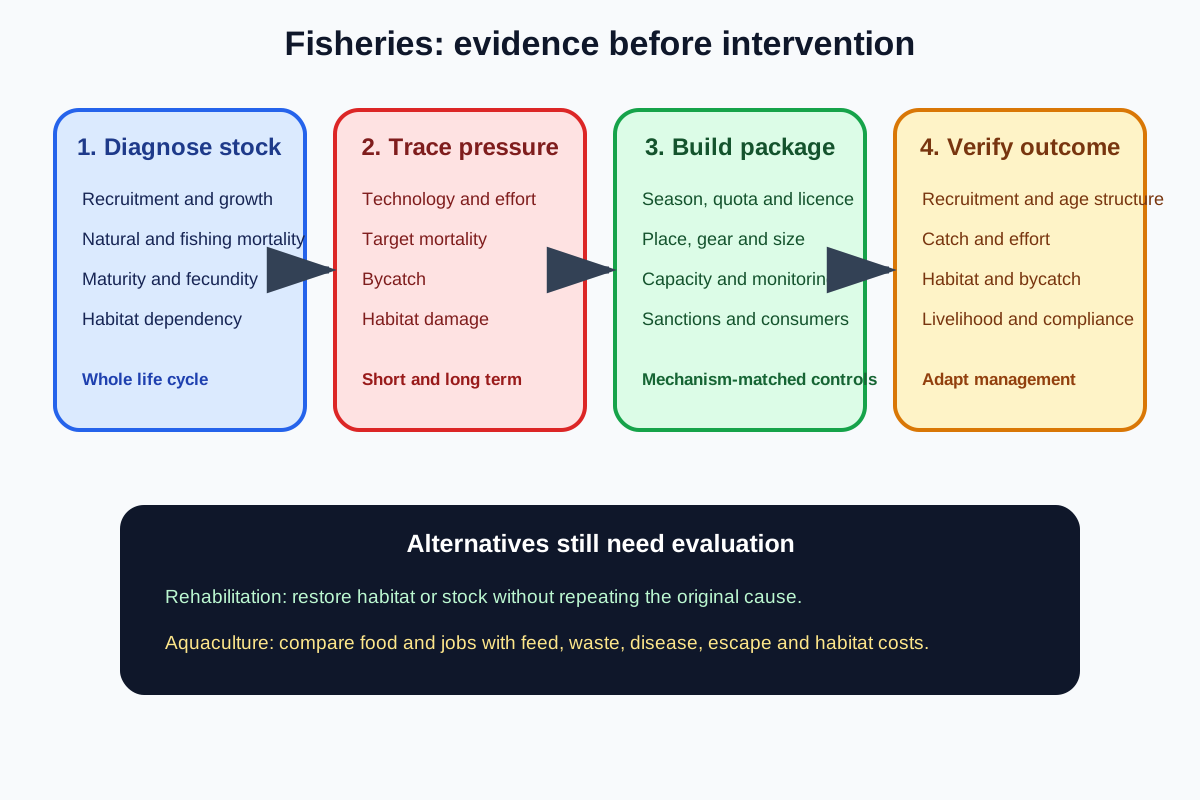
Worked application: choosing a management package
A shark stock matures late, produces few young and has falling catch per unit effort despite improved sonar. A quota alone may fail because the stock estimate is uncertain and vessels can still target breeding aggregations. A safer package combines a conservative quota, seasonal closure during breeding, protection of nursery and aggregation areas, bycatch-reducing gear, vessel tracking and landing inspection. Short-term catches and income will fall, so transition support and community participation matter. The package targets slow replacement, spatial vulnerability and enforcement together. Recovery should be judged through recruitment, age structure and fishing mortality, not by one year's total catch.
Common misconceptions and corrections
Calling a larva a miniature adult. Larvae can differ greatly and metamorphose.
Saying sessile species cannot disperse. Gametes or larvae often disperse.
Calling mammal life cycles complex because care is long. The required contrast concerns larvae and metamorphosis.
Saying external fertilisation guarantees many survivors. Many gametes and larvae die.
Saying internal fertilisation always means many offspring. Sharks and whales often produce few.
Protecting only adult fishing grounds. Nurseries and spawning areas can be limiting.
Defining sustainability as stable catch this year. Long-term stock, habitat and society matter.
Calling sonar itself a fishing method. It locates targets and changes efficiency.
Saying purse seines have no bycatch. Mixed schools and juveniles may be captured.
Treating benthic trawling as only a stock issue. It damages habitat.
Calling factory ships automatically efficient enough to be sustainable. Capacity can increase pressure.
Using catch alone as abundance. Effort and technology alter catch.
Confusing natural and fishing mortality. Their causes differ.
Setting a season without life-cycle evidence. Timing must protect the relevant stage.
Assuming a quota enforces itself. Reporting and inspection are needed.
Calling every licensed fleet sustainable. Capacity and catches still matter.
Treating every MPA as no-take. Protection levels differ.
Assuming spillover is immediate and guaranteed. It depends on recovery and connectivity.
Using larger mesh to protect every body shape equally. Selectivity is species-specific.
Ignoring release mortality in size rules. Discarded organisms may die.
Limiting boat number while allowing unlimited gear. Effective effort can remain high.
Listing patrols without sanctions. Detection and deterrence work together.
Trusting any sustainability label. Verification and traceability matter.
Considering only short-term restriction costs. Compare long-term recovery benefits.
Counting planted mangroves as restored habitat automatically. Hydrology and survival matter.
Calling artificial reefs fish production without evidence. They may aggregate fish.
Releasing hatchery stock without disease or genetic checks. It can damage wild populations.
Calling intensive aquaculture always more sustainable. High density concentrates impacts.
Calling extensive aquaculture impact-free. It can occupy and alter large habitats.
Saying mussels require formulated feed. They can filter natural plankton.
Ignoring mangrove loss in shrimp farming. Pond siting can destroy habitat.
Assuming aquaculture always reduces wild fishing. Feed and demand links can maintain pressure.
Evaluating a farm only by profit. Water, feed, disease, habitat and social outcomes matter.
Assessment guidance
Life-cycle answers should identify stage, mobility, dispersal and parental investment and compare tuna, shark and whale mechanisms. Sustainable-fishery responses need a named stock, the seven required information types and a package of biological, spatial, effort, monitoring, enforcement and consumer tools. Evaluate effectiveness, bycatch or habitat effects, enforcement and short-versus-long-term social and economic outcomes. Rehabilitation answers must state what caused depletion and whether habitat repair or stock release addresses it. Aquaculture comparisons should name organisms, describe the production process and balance stock, water, feed, labour, disease, site, market and investment requirements against environmental, social and economic impacts.
Retrieval practice
Compare crustacean and marine-mammal cycles and build an external-versus-internal fertilisation table for tuna, sharks and whales. For one named fishery, recall all seven stock evidence categories and design a management package using every tool class. Evaluate mangrove, artificial-reef and cultivated-stock rehabilitation. Finally, diagram salmon, mussel and shrimp production, classify intensive and extensive features and audit each project against the ten success requirements and all listed ecological, social and economic impacts.
Cambridge International, AS and A Level Marine Science 9693 syllabus for examinations in 2028, 2029 and 2030, A Level Topic 8 sections 8.1 Life cycles, 8.2 Sustainable fisheries and 8.3 Marine aquaculture, including every named technology, stock-information category, management tool, rehabilitation strategy and aquaculture impact.