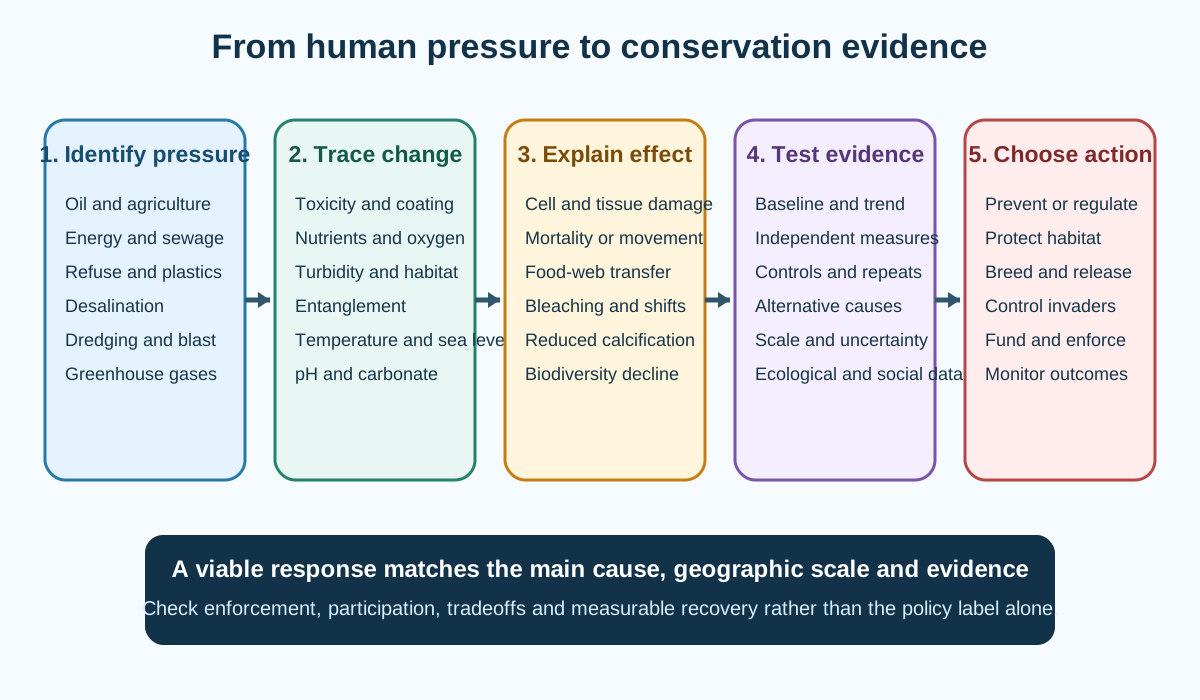
Human Impacts on Marine Ecosystems is Topic 9 of the Cambridge International AS and A Level Marine Science 9693 full A Level syllabus. These notes follow official sections 9.1 Ecological impacts of human activities, 9.2 Global warming and its impact, 9.3 Ocean acidification and 9.4 Conservation of marine ecosystems. The organising question is how a human pressure creates a measurable change, how that change reaches organisms and food webs, and which response is viable at the required scale.
9.1 Ecological impacts of human activities
A causal framework for impacts
Strong explanations connect four levels: source, environmental change, biological response and food-web consequence. For example, fertiliser runoff adds nitrate and phosphate, which can increase algal growth, reduce light and lower dissolved oxygen after decomposition. Organisms then die or move, changing predator and prey populations.
An activity can affect water quality, habitat and organisms through different pathways. State the pathway rather than attaching a generic word such as pollution.
Impact also depends on dose, persistence, location, currents, season and the sensitivity of exposed species.
Oil industry
Exploration, extraction, transport and refining can release crude oil or fuel. A surface slick reduces light penetration and gas exchange, while toxic hydrocarbons can damage cells, gills, eggs and larvae.
Oil coats feathers and mammal fur, reducing insulation and buoyancy. Cleaning behaviour can increase ingestion. Shoreline oil smothers sessile organisms and nursery habitats, and persistent material can enter sediment.
Physical containment and removal may reduce spread, but rough seas, remoteness and shoreline penetration limit recovery. Dispersants break oil into droplets but can increase exposure within the water column.
Agriculture
Rain can carry fertilisers, manure, pesticides and soil into rivers and coastal waters. Added nutrients can cause eutrophication: rapid producer growth is followed by death, microbial decomposition and increased respiration, so dissolved oxygen falls.
Turbidity and algal growth reduce light for seagrass or corals. Pesticides may poison non-target organisms, and sediment can smother benthic habitat.
The final food-web effect can include loss of oxygen-sensitive species, altered competition and fewer prey for predators.
Renewable-energy installations
Offshore wind, tidal and wave installations can reduce fossil-fuel emissions during operation, but construction noise, seabed disturbance and cables affect marine habitat. Foundations can create hard surfaces and exclusion zones, sometimes increasing local shelter or acting as artificial reefs.
Check this topic from memory
Attempt the matching topic bank before reopening the notes. Use each missed idea to decide what to review next.
Turbines or moving components may disturb migration, feeding or navigation. Electromagnetic fields from cables can affect sensitive species, while maintenance traffic adds noise and collision risk.
Evaluation must compare site, design, construction and operational effects with the avoided impacts of fossil energy.
Sewage disposal
Untreated or poorly treated sewage adds organic matter, nutrients, pathogens and household chemicals. Microbial decomposition raises biochemical oxygen demand and can reduce dissolved oxygen.
Nutrients promote eutrophication, pathogens make seafood or bathing water unsafe, and solids reduce clarity or settle on habitats. Sewage outfalls can therefore affect human health as well as community composition.
Treatment, dilution and discharge location determine severity; dilution alone does not remove persistent substances.
Refuse disposal
Marine refuse includes plastics, metals, glass and abandoned fishing gear. Large objects injure or entangle organisms, cover habitats and continue ghost fishing.
Materials can travel across national boundaries and persist for long periods. Breakdown may create smaller particles rather than harmless products.
Waste prevention and collection address the source more directly than repeated shoreline cleanup.
Desalination plants
Desalination produces freshwater while creating concentrated brine. A discharge plume can raise salinity, temperature or chemical concentration near the outlet, stressing organisms that cannot regulate across the change.
Intakes can trap larger organisms or draw in eggs, larvae and plankton. Construction and energy use add further effects.
Diffusers, careful siting, intake screens, monitoring and lower-carbon energy can reduce impacts, but local current and background salinity matter.
Dredging and blast fishing
Dredging removes or disturbs seabed material. It destroys benthic habitat, resuspends sediment, reduces light and may release buried contaminants. Deposited sediment can smother filter feeders, seagrass and corals.
Blast fishing uses explosions to stun or kill fish. It is non-selective, kills non-target organisms and physically breaks reef structure. Loss of structural habitat reduces shelter, feeding surfaces and future recruitment.
Neither method should be evaluated from target catch alone.
Bioaccumulation and biomagnification
Bioaccumulation is the increase of a toxin within one organism because uptake exceeds removal. A persistent, fat-soluble substance may enter through food, water or contact and be stored in tissues.
Biomagnification is increasing toxin concentration at successive trophic levels. A predator consumes many contaminated prey, so its total retained burden can be high.
Heavy metals in antifouling paint can enter water and sediments. Mercury released during fossil-fuel combustion can be deposited, transformed into biologically available compounds and taken up by organisms. Top predators and humans eating seafood can receive the greatest exposure.
The two terms describe different scales and should not be used interchangeably.
Primary and secondary microplastics
Microplastics have a diameter below 5 mm. Primary microplastics are manufactured at small size or released already small, such as industrial pellets or fibres. Secondary microplastics form when larger plastic objects fragment.
Most conventional plastics are non-biodegradable. Ultraviolet radiation weakens polymer structure, while wind and wave action abrade and break material. Higher temperature can accelerate physical and chemical weathering, although rate also depends on polymer, light and exposure.
Fragmentation does not mean complete biological decomposition.
Ecological and human effects of plastics
Plankton can take up microplastics, allowing particles to enter food chains. Predators then ingest particles through contaminated prey. Plastics can absorb toxic compounds from surrounding water and later release them after uptake, although exposure depends on chemical and biological conditions.
Larger pieces can block digestive systems or create false satiation. Ropes, rings and ghost nets entangle animals, restrict movement and continue capturing organisms.
If particles or associated toxins enter seafood, humans may be exposed. A careful answer distinguishes demonstrated pathway from the size of a health risk, which needs dose evidence.
Limiting plastic release
Source strategies include reducing unnecessary single-use products, redesigning packaging, using deposit-return systems, controlling industrial pellets and improving product durability. Waste collection, sorting and recycling reduce leakage when systems are accessible and reliable.
Filters and treatment can capture fibres or particles in wastewater. Fishing-gear marking, retrieval schemes and disposal facilities reduce ghost gear. Drain traps, river barriers and shoreline collection intercept waste already moving towards the sea.
Legislation, producer responsibility, enforcement, education and international cooperation support these measures. Substitution must be assessed across its full environmental cost rather than assumed harmless.
9.2 Global warming and its impact
Natural greenhouse effect
Solar short-wave radiation passes through the atmosphere and warms Earth's surface. The surface emits longer-wave infrared radiation. Greenhouse gases absorb and re-emit some of this energy, reducing heat loss to space and maintaining an ambient temperature suitable for life.
The natural greenhouse effect is necessary. It is not the same as human-caused enhancement.
Enhanced greenhouse effect
Human activities increase atmospheric greenhouse-gas concentrations, especially through fossil-fuel combustion, land-use change and industry. More outgoing infrared radiation is absorbed and re-emitted, changing Earth's energy balance and raising average temperature.
Carbon dioxide is not the only greenhouse gas, but it is central to this syllabus boundary and has long-lived effects.
Global warming describes temperature rise; climate change includes wider long-term changes in weather and ocean systems.
Evidence for global warming
Evidence includes long-term instrumental temperature records, ocean heat content, retreating glaciers and ice sheets, reduced sea ice, rising sea level and shifts in seasonal or species patterns. No single short record is sufficient.
Confidence increases when independent measurements using different methods show consistent trends. Corrections for instrument, location and sampling changes must be transparent.
Local cold weather does not contradict a global long-term average trend.
Evaluating the human-contribution hypothesis
Evidence for a major human contribution includes the measured rise in greenhouse gases, known infrared absorption, fossil-carbon signatures and models that reproduce recent warming more accurately when human forcings are included.
Natural drivers such as solar variation, volcanic aerosols and internal ocean-atmosphere cycles also alter climate. They help explain variation around the trend but do not by themselves reproduce the magnitude and pattern of recent global change.
Evaluation should compare time scale, predicted pattern, independent data and uncertainty. Scientific uncertainty gives a range of plausible outcomes; it does not make all explanations equally supported.
Marine impacts of warming
Sea level rises through thermal expansion of warming water and addition of land ice melt. Coastal flooding, erosion, saltwater intrusion and habitat loss can follow.
Heat stress can cause corals to expel symbiotic algae, producing bleaching. Prolonged or repeated stress reduces growth, reproduction and survival, affecting reef food webs and services.
Species distributions can shift towards cooler latitudes or depths, changing competition, fisheries and predator-prey relationships. Not every species can move if habitat or dispersal is limited.
Warming and freshwater input may alter density-driven global seawater circulation. The direction and scale require evidence, so avoid claiming that circulation must simply stop.
9.3 Ocean acidification
Atmospheric carbon dioxide and the ocean
Carbon dioxide exchanges between atmosphere and surface water. As atmospheric concentration rises, more can dissolve, so the ocean acts as a carbon sink and slows the atmospheric increase.
This service changes seawater chemistry. Absorbed carbon dioxide does not remain chemically neutral.
The ocean can both limit atmospheric increase and experience harm from uptake.
Carbonate chemistry
Dissolved carbon dioxide reacts with water and ultimately produces hydrogen ions and hydrogen carbonate ions:
COX2+HX2O⇌HX++HCOX3X−
More hydrogen ions lower pH. Hydrogen ions also react with carbonate ions:
HX++COX3X2−⇌HCOX3X−
Carbonate-ion availability therefore falls. Ocean acidification means a decrease in pH; seawater may remain above pH 7 while becoming less alkaline.
Hard corals and shelled organisms
Hard corals and many molluscs use carbonate ions with calcium ions to build calcium carbonate structures. Lower carbonate availability increases the energetic cost of calcification and can reduce growth or weaken shells and skeletons.
Sensitivity varies with life stage, species, temperature, food and local chemistry. The mechanism supports a risk prediction but does not justify claiming identical responses everywhere.
Reef weakening also affects organisms that depend on the habitat.
Marked practical: pH and shell mass
The official practical activity investigates how pH affects mass loss from empty mollusc shells. Equal shell pieces should have measured initial masses and be placed for equal times in equal volumes at controlled pH. Temperature, shell source, surface area and agitation should be controlled; replicates improve reliability.
After rinsing and drying consistently, calculate mass loss or percentage mass loss. A graph of mass loss against pH tests the predicted relationship. Unequal exposed area, residual water and pH drift are important limitations.
This theory note owns the chemical reasoning and interpretation. The dedicated practical note owns full planning, apparatus, risk, table and evaluation detail.
9.4 Conservation of marine ecosystems
Why conserve biodiversity
Conservation aims to maintain or enhance genetic, species and ecosystem diversity. Biodiversity supports resilience, food webs, fisheries, coastal protection, tourism, cultural value and possible future uses.
Preventing decline is often cheaper and more reliable than rebuilding a collapsed population or habitat.
Conservation decisions still involve opportunity costs, uncertainty and competing community needs.
IUCN Red List and priority setting
The International Union for Conservation of Nature Red List assesses extinction risk using evidence such as population trend, range and population size. Categories help identify species facing greatest risk and support local, regional and global prioritisation.
Red List status does not automatically create legal protection or dictate one project. Decision-makers also consider ecological role, feasibility, threat reversibility, cost and benefits to other species.
Data Deficient is not the same as secure.
Invasive and endangered species
An invasive species is a non-native organism whose establishment or spread threatens biodiversity or causes harm. An endangered species faces a very high risk of extinction in the wild under IUCN terminology.
Invasive species may compete, prey on native species, spread disease, hybridise or alter habitat and food webs. Islands and ecosystems with few comparable competitors or predators can be especially vulnerable.
Non-native does not automatically mean invasive, and native range expansion must be described carefully.
Evaluating project viability
A viable project addresses the main threat, uses an effective method, has sufficient time, finance, expertise and legal authority, and can be monitored. Ecological benefits should be compared with displacement, bycatch, genetic, welfare and social risks.
Stakeholder support affects compliance and continuity. A plan that works biologically but cannot be enforced or funded may not be viable.
Use given evidence to rank constraints rather than listing every possible concern equally.
MPAs and no-take zones
Marine protected areas can restrict selected activities, while no-take zones prohibit extraction. Well-placed, connected and enforced areas protect habitat, breeding stock and community interactions.
Benefits may spread through adult movement or larval dispersal. Costs include displaced effort, monitoring and restricted access.
Designation without effective rules and enforcement is insufficient.
Captive breeding and release
Captive breeding can increase numbers when wild reproduction is too low. Release may rebuild populations after threats are controlled.
Risks include reduced genetic diversity, domesticated behaviour, disease, poor survival and failure to restore habitat. A release target and post-release monitoring are essential.
It is a supporting tool, not a substitute for removing the original pressure.
Legislation, CITES and the IWC moratorium
Local law can protect habitats, regulate harvest and penalise pollution. International agreements matter for migratory species, trade and waters beyond one jurisdiction.
CITES regulates international trade in listed wild species and products. The International Whaling Commission's commercial-whaling moratorium limits commercial whaling among participating members.
Effectiveness depends on sign-up, domestic implementation, monitoring and enforcement. Illegal trade and exemptions can weaken outcomes.
UNESCO biosphere reserves
UNESCO biosphere reserves combine conservation with sustainable use, research and learning. Zonation can place strict protection in a core area with compatible activity in surrounding zones.
They can coordinate people and ecosystems across a landscape or seascape, but recognition alone does not guarantee resources or compliance.
Marine zoos and aquaria
Zoos and aquaria can support breeding, rescue, research, public education and finance for conservation. They may maintain assurance populations for threatened species.
Evaluation should consider animal welfare, genetic value, whether education changes behaviour, opportunity cost and whether work benefits wild populations.
Display alone is not proof of conservation impact.
Ecotourism
Ecotourism can fund protection and create livelihoods tied to healthy wildlife. Guides and visitors may also supply sightings and public support.
Poorly managed tourism disturbs feeding or breeding, damages habitat, creates waste and concentrates benefits unfairly. Visitor limits, codes, local ownership and outcome monitoring improve viability.
Control of invasive species
Prevention uses ballast-water rules, hull cleaning, biosecurity and import controls. Early detection and rapid response are usually more feasible than removal after wide establishment.
Physical removal, trapping, chemical or biological control must be selective and sustained. A control organism can create a new problem if its effects are not tested.
Monitoring is needed to detect reinvasion and non-target harm.
International cooperation and its limits
Currents, migratory species, pollution and fishing fleets cross borders. Shared data, compatible rules and coordinated enforcement are therefore necessary at marine scale.
Cooperation is not always universal. States may decline to join or implement CITES or the IWC moratorium, creating enforcement gaps, market routes or continued exploitation.
An evaluation should recognise sovereignty, different costs and capacities, then explain the ecological consequence of incomplete coverage.
Worked application: evaluating a conservation proposal
A coastal state proposes a no-take zone around a reef where an endangered grouper breeds, but most fishing income comes from nearby villages and invasive lionfish are increasing. The zone addresses harvest and breeding habitat, yet it will not control lionfish and may displace effort. A viable package maps spawning and nursery areas, sets an enforced core zone, funds transition and local monitoring, and adds selective lionfish removal. Baseline grouper abundance, recruitment, habitat condition, fishing effort and household income allow ecological and social comparison through time. Regional cooperation is needed if adults, larvae or fishing vessels cross the boundary. The proposal is strongest when threat, tool, compliance and measurable outcome form one evidence chain.
Common misconceptions and corrections
Calling every human effect pollution. Some effects are physical disturbance, extraction or habitat change.
Listing an activity without a pathway. Link source, environmental change, organism and food web.
Saying oil only floats harmlessly. Toxicity, coating and shoreline persistence matter.
Equating fertiliser input with immediate fish growth. Decomposition can lower oxygen.
Calling renewable energy impact-free. Construction and operation can affect habitat and organisms.
Saying sewage only adds pathogens. It also adds organic matter and nutrients.
Treating dilution as destruction of a pollutant. Persistent substances remain.
Ignoring desalination intakes. They can entrain plankton, eggs and larvae.
Evaluating dredging only by water cloudiness. Seabed loss and contaminant release matter.
Calling blast fishing selective. It kills non-target organisms and breaks habitat.
Confusing bioaccumulation with biomagnification. One is within an organism; the other is across trophic levels.
Saying every toxin biomagnifies. Persistence and retention properties matter.
Defining microplastic as any visible plastic. Its diameter is below 5 mm.
Calling all microplastics secondary. Some enter the environment already small.
Calling fragmentation biodegradation. Smaller polymer pieces can remain plastic.
Saying plastic transfers only by direct ingestion. Contaminated prey can transfer it.
Treating cleanup as the only plastic strategy. Prevention and waste systems act upstream.
Calling the natural greenhouse effect harmful. It maintains habitable temperature.
Using global warming and climate change as exact synonyms. Climate change is broader.
Using one hot or cold year as trend evidence. Long records and independent indicators are needed.
Saying natural variability does not exist. It operates alongside human forcing.
Treating uncertainty as no evidence. It describes the supported range and confidence.
Saying sea level rises only because ice melts. Thermal expansion also contributes.
Calling all pale corals dead. Bleached corals may survive if stress ends.
Claiming every species can shift poleward. Habitat and dispersal can prevent movement.
Saying dissolved carbon dioxide only benefits the atmosphere. Uptake changes seawater chemistry.
Calling acidification seawater becoming strongly acidic. It is a pH decrease and may remain above 7.
Saying hydrogen ions increase carbonate availability. They convert carbonate to hydrogen carbonate.
Generalising one calcifier response to all species. Sensitivity varies.
Weighing wet shell pieces after treatment. Residual water confounds mass loss.
Calling Data Deficient an IUCN safe category. Evidence is insufficient to assess risk.
Calling every non-native species invasive. Harm or threat is part of the definition.
Treating Red List status as automatic law. It informs priorities but needs implementation.
Calling every MPA no-take. Protection levels differ.
Releasing captive animals before removing the threat. The same pressure can cause failure.
Saying CITES bans all wildlife trade. It regulates trade in listed species at different levels.
Assuming international agreements have universal participation. Sign-up and enforcement vary.
Calling every aquarium a conservation project. Wild-population benefit needs evidence.
Assuming ecotourism is harmless. Visitors can disturb wildlife and habitat.
Introducing biological control without testing. The control species may harm non-target organisms.
Assessment guidance
For ecological impacts, build a source-to-food-web chain and cover water quality, habitat and organisms where relevant. Keep bioaccumulation separate from biomagnification and classify primary versus secondary microplastics before discussing transfer and control. Climate answers should distinguish the necessary natural effect from its human enhancement, then evaluate multiple independent evidence lines and competing forcings. Acidification responses need the carbon dioxide, hydrogen-ion, pH and carbonate sequence before biological effects or shell data. Conservation evaluations should identify the threatened feature, main pressure, scale, named mechanism, feasibility, enforcement, stakeholders, tradeoffs and measurable outcome. Treat international participation as evidence to evaluate rather than assume.
Retrieval practice
For each of the seven named human activities, draw one pathway from source to food-web effect. Reconstruct the toxin and plastic pathways from memory, including definitions and control points. Explain greenhouse warming from Earth's energy balance, then sort evidence from impact. Write the two carbonate equations and predict shell-mass results. Finally, compare every named conservation strategy in a matrix of target, mechanism, limitation, scale and monitoring evidence, including the consequences of incomplete international cooperation.
Cambridge International, AS and A Level Marine Science 9693 syllabus for examinations in 2028, 2029 and 2030, A Level Topic 9 sections 9.1 Ecological impacts of human activities, 9.2 Global warming and its impact, 9.3 Ocean acidification and 9.4 Conservation of marine ecosystems, including the marked shell-mass practical and every named conservation strategy.