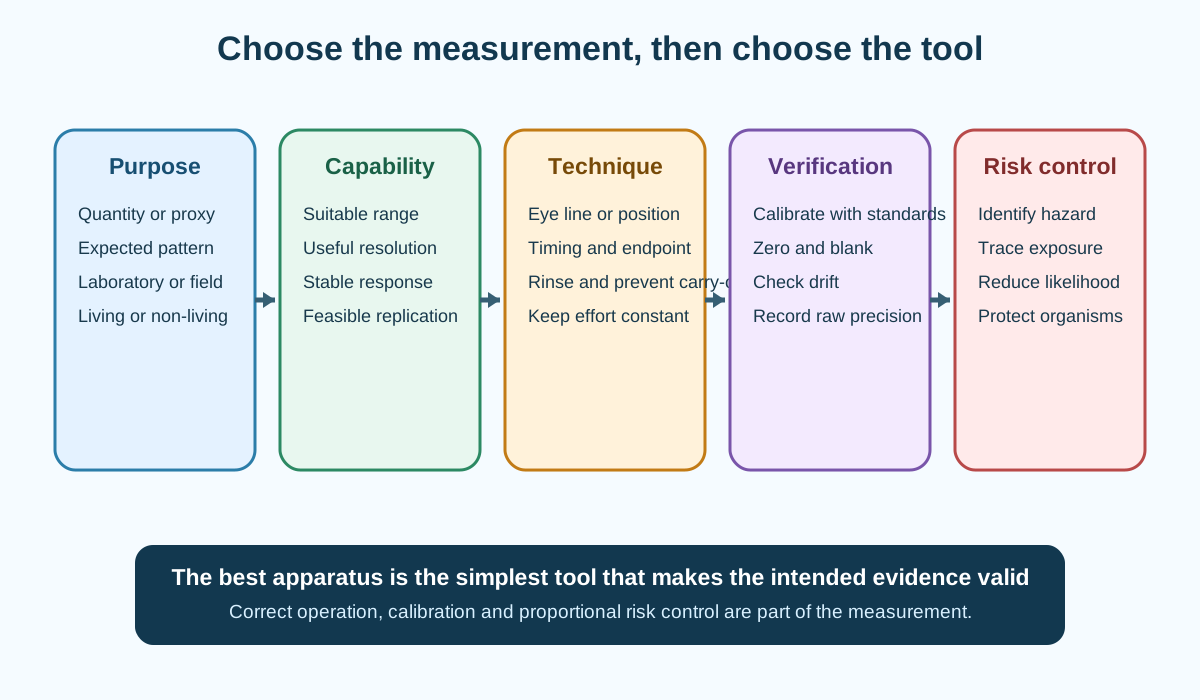
Apparatus, Methods and Risk develops the official Cambridge International AS and A Level Marine Science 9693 expectation that candidates choose appropriate techniques, know common school and field equipment, assess risk, minimise harm and treat organisms ethically. Apparatus earns its place by producing a valid measurement at suitable resolution, not by making a method sound technical.
Official assessment boundary
Paper 2 and Paper 4 can test apparatus selection and technique in familiar or unfamiliar investigations. The syllabus names common laboratory apparatus and ecological field equipment, while specialised equipment information will be supplied when required.
Planning must include how the independent variable is changed, how the dependent variable is measured, key standardisation, controls, risk assessment, precautions and ethical treatment. Practical questions can also require interpretation of apparatus diagrams.
The official apparatus list is recommended rather than exhaustive. Learn the measurement principles and limitations instead of memorising a catalogue without purpose.
Select apparatus from the measurement need
Begin with the quantity, expected range and required resolution. A 250 cubic-centimetre beaker can hold liquid but is unsuitable for measuring a small volume accurately. A syringe can deliver a small volume more precisely, while a measuring cylinder may be appropriate for a larger volume when moderate precision is sufficient.
Ask five questions:
Does the instrument measure the required quantity directly or through a valid proxy?
Does its range include every expected value?
Is its resolution fine enough to reveal the predicted difference?
Can the method be repeated consistently without changing another variable?
Can it be used safely in the laboratory or field setting?
More decimal places on a display do not automatically mean greater accuracy.
Volume apparatus and transfer
Measuring cylinders suit moderate-volume measurement. Read the liquid level at eye height on a level surface, using the correct part of the meniscus for the liquid and scale convention.
Syringes are useful for smaller measured volumes and controlled transfer. Remove trapped air when measuring liquid and read the specified plunger reference point. Tubing increases dead volume, so fill it consistently or account for liquid retained inside.
Droppers and teat pipettes transfer liquid but individual drops are not a reliable volume unless calibrated. Beakers and conical flasks are primarily containers and mixing vessels.
Check this topic from memory
Attempt the matching topic bank before reopening the notes. Use each missed idea to decide what to review next.
Use separate clean transfer tools or rinse appropriately between treatments to prevent concentration carry-over.
Mass measurement
The recommended balance has 0.01 g precision. Place it on a stable, level surface away from vibration or airflow, zero or tare the container and keep material within its capacity.
Wet specimens or shells must follow a standard blotting or drying procedure before comparison. Evaporation, retained water and salt crystals can alter mass independently of the process under study.
Record every mass to the balance's displayed resolution, including trailing zeros when meaningful.
If mass change is small compared with resolution, increase exposure time or total sample mass where scientifically and ethically valid rather than inventing precision.
Time and temperature
A stop-clock or timer showing seconds measures duration. Define the start and stop event so different observers use the same endpoint. Human reaction time matters most for very short intervals.
A thermometer must cover the required range and should be immersed to a consistent depth without touching the vessel wall or base. Allow the reading to stabilise.
A thermostatically controlled water bath standardises temperature across treatments. Monitor the actual experimental vessels because bath setting and sample temperature may differ during equilibration.
When changing light intensity with lamp distance, monitor temperature or use a low-heat light source to prevent confounding.
pH probes and indicators
A pH probe gives quantitative values and should be calibrated with suitable buffer solutions across the intended range. Rinse with distilled or deionised water between samples, blot gently rather than wiping the sensitive surface, immerse consistently and wait for a stable reading.
Universal Indicator paper or solution gives a less precise estimate and colour may be affected by a coloured or turbid sample. Use the same lighting and comparison chart.
Record pH before and after an investigation when biological activity or reaction can cause drift.
Calibration checks whether instrument response matches known reference values; simply turning an instrument on is not calibration.
Oxygen, light, flow and water clarity
An oxygen meter measures dissolved oxygen after appropriate calibration and equilibration. Prevent bubbles around the sensor and consider temperature because solubility and probe response can change.
A light meter measures irradiance or illuminance according to its design. Keep sensor orientation and depth constant and avoid casting a shadow.
A flow meter measures water speed at a defined position and depth. Repeated readings are needed in turbulent water.
A Secchi disc estimates water transparency from disappearance and reappearance depth. Use the same observer, viewing side, light conditions and lowering method where possible. It measures an operational clarity endpoint, not contaminant concentration directly.
Microscopes, hand lenses and slides
Microscopes with low- and high-power objectives support observation, measurement and drawing. Begin on low power, centre the specimen, focus safely and then increase magnification. High power gives a smaller field of view and shallower depth of field.
Use clean slides and coverslips, avoid trapped bubbles and prevent the objective from contacting the slide. Mounted needles and forceps position material without crushing it.
A hand lens of at least six-times magnification supports field or whole-specimen observation. State whether dimensions come from a ruler, eyepiece scale or calibrated image.
Magnification and scale calculations belong in the data and observation note, but apparatus setup must preserve scale validity.
Heating and glassware
Use heat-resistant tubes for heating, a holder or clamp, a heat-proof mat and suitable eye protection. Point tube openings away from people and heat gently to avoid bumping.
Bunsen burners introduce flame and hot-surface hazards. A thermostatic water bath offers more controlled, even heating where direct flame is unnecessary.
Inspect glassware for cracks. Handle hot glass as hot even when it looks unchanged, and allow it to cool in a safe place.
Bungs and delivery tubes create pressure risk if a system is sealed while gas is produced or heated. Provide a safe outlet and secure connections.
Filtration, dialysis and chromatography
Filter funnels and paper separate particles from liquid. Use the same paper grade, area and loading if filtration rate is compared. Avoid overfilling above the paper edge.
Dialysis tubing models selective permeability. Soak and open it correctly, tie leak-free ends, rinse the exterior and test for leakage. It is a model membrane, not a living cell membrane.
Chromatography paper separates substances through relative attraction to stationary and mobile phases. Apply small concentrated spots, keep the origin above the solvent and cover the chamber consistently. Mark the solvent front immediately after removal.
These techniques require a control or standard when identity or membrane selectivity is inferred.
Field sampling equipment
Open, grid and point quadrats estimate count, frequency or percentage cover. Define inclusion rules for organisms touching boundaries and place quadrats randomly or systematically according to the aim.
Long tapes establish transects and distances. Secure them without creating a trip or entanglement hazard.
Plankton, dip and sweep nets sample different organisms and habitats. Mesh size, tow distance, depth, speed and duration affect what is captured, so standardise them.
Calipers measure dimensions more precisely than a ruler when the object fits safely. Close gently to avoid damaging living specimens.
Non-toxic paint can mark organisms for mark-release-recapture. Marks must remain identifiable without changing survival or behaviour.
Contamination and carry-over control
Contamination can create a false treatment effect. Label vessels before use, keep tools assigned to treatments, rinse probes between samples and work from lower to higher concentration only when the method justifies it.
Distilled or deionised water is useful for rinsing and solution preparation, but rinsing a marine organism in it may cause osmotic stress. Match the rinse to the purpose.
Use blanks to reveal background signal from reagents, apparatus or solvent. Keep lids on samples where airborne material or evaporation matters.
Cleaning must not introduce detergent or disinfectant residues into biological systems.
Valid technique and calibration
A valid method measures the intended variable. A reliable method produces consistent results when repeated. Accuracy is closeness to the accepted or true value, while precision is closeness among repeated values or fineness of measurement.
Calibration compares an instrument against known standards. A calibration curve can convert instrument response into concentration within the tested range.
Zero checks detect offset. Replicate standards reveal whether response is stable. Never extrapolate far beyond calibrated values without justification.
The uncertainty note owns detailed precision and significant-figure treatment; this note owns selecting and operating the instrument correctly.
Hazard, risk and precaution
A hazard is something with the potential to cause harm. Risk combines likelihood and severity under the proposed conditions. A precaution reduces likelihood or consequence.
Write a linked chain:
Dilute acid can splash into eyes while being transferred, so use suitable eye protection, a stable rack and a syringe directed into the vessel below eye level.
"Be careful" is not a control measure. Personal protective equipment is often the final layer after substitution, reduced quantity, physical containment and procedural control.
The school's risk assessment and supervision govern actual practical work.
Chemical and biological hazards
The official list identifies hazard categories including corrosive, health hazard, acutely toxic, flammable, oxidising and hazardous to the aquatic environment. Use the supplied concentration and safety information because hazard depends on substance and form.
Avoid skin or eye contact, use small quantities, contain spills and dispose of material through the approved route. Never return used reagent to a stock container.
Marine specimens may carry pathogens, spines, sharp shells or allergens. Use forceps or gloves where appropriate, cover cuts, wash hands and disinfect surfaces with a specimen-safe workflow.
Do not release exposed or non-native organisms or chemicals into drains or natural water.
Field hazards
Tides, waves, slippery surfaces, deep water, unstable sediment, weather, sun, sharp organisms and remote access can create serious risk. Check tide and weather information, work in supervised groups, define boundaries and exit time, wear suitable footwear and carry communication and first-aid resources according to local policy.
Do not turn away from breaking waves or work below unstable cliffs. Avoid lifting rocks that cannot be replaced safely and do not enter water beyond the approved depth.
Risk controls must fit the actual site rather than repeat a laboratory goggles statement.
Ethical handling and environmental protection
Use non-destructive observation where possible. Minimise capture duration, density, temperature change, air exposure and repeated handling. Keep organisms in appropriate water and shade.
Return native organisms promptly to the exact collection area when permitted and safe. Do not relocate them across habitats.
For marking, use a non-toxic method that does not increase visibility to predators or restrict growth. Check permits and protected-species rules.
Ethics includes habitat: replace stones gently, avoid trampling, remove equipment and prevent chemical or plastic release.
Worked application: selecting apparatus for a light investigation
Investigate light intensity and aquatic-plant oxygen production. Use a flexible-arm LED lamp, calibrated light meter, thermostatically controlled water bath, clear vessel, timer and oxygen probe. Set at least five measured light values with filters or distance while keeping temperature constant. Calibrate the oxygen probe, rinse it between vessels, exclude trapped bubbles and record stable initial and final oxygen after the same duration. A plant-free vessel controls for non-biological oxygen change. Independent plant pieces provide replicates. Keep volume, plant mass, dissolved carbon source and acclimation time constant. Electricity near water is the main apparatus hazard, so use low-voltage equipment, dry hands, keep connections away from spills and disconnect power before adjustment. Handle plants minimally and dispose of solutions through the approved route.
Common misconceptions and corrections
Choosing apparatus by familiarity. Match range, resolution and purpose.
Calling a beaker a precise volume instrument. It is mainly a container.
Using drop count as volume without calibration. Drops vary.
Reading a meniscus from above. Eye height prevents parallax.
Ignoring liquid trapped in syringe tubing. Dead volume affects delivery.
Recording more decimal places than the instrument supports. Display resolution limits recording.
Weighing wet shells inconsistently. Retained water changes mass.
Touching the thermometer to the vessel base. It may not measure sample temperature.
Trusting a water-bath setting as sample temperature. Verify the vessel.
Calling a pH probe calibrated after rinsing only. Known buffers are required.
Wiping a delicate probe vigorously. It can damage or charge the surface.
Treating indicator colour as highly precise. It provides a bounded estimate.
Leaving bubbles on an oxygen sensor. They distort exposure.
Changing light-meter angle between readings. Orientation changes response.
Calling Secchi depth a direct pollutant concentration. It is an operational transparency measure.
Starting microscopy on high power. Finding and focusing the specimen is harder and riskier.
Using ordinary glass in direct heating without checking. Thermal failure is possible.
Sealing a heated gas-producing system. Pressure can build.
Putting a chromatography spot below solvent. The sample dissolves into the reservoir.
Calling dialysis tubing a living membrane. It is a selective-permeability model.
Changing net tow speed among sites. Sampling effort changes.
Using calipers to squeeze a live organism. Measurement can cause harm.
Rinsing marine organisms with deionised water. Osmotic stress may result.
Using the same dropper across treatments. Carry-over can create false effects.
Calling precision the same as accuracy. They describe different properties.
Calling instrument zeroing complete calibration. Standards across a range may be needed.
Writing a hazard with no route of harm. Link it to exposure and precaution.
Writing "wear goggles" for every field risk. Controls must match the site.
Pouring biologically exposed solution down a drain automatically. Follow approved disposal.
Returning organisms to any nearby water. Return only when lawful, safe and ecologically appropriate.
Assessment guidance
Name apparatus only after stating what it measures, its suitable range or resolution and the technique that prevents systematic error. For every probe, consider calibration, rinsing, equilibration, orientation and drift. For field tools, standardise sampling effort and define placement and counting rules. A risk response should identify hazard, exposure route, harmed person or organism and a proportional precaution; distinguish chemical, biological, physical and site hazards. Include ethical handling and waste or release control. When evaluating a proposed method, explain the direction in which poor apparatus use could change data. Do not award false precision to a result merely because a digital screen displays it.
Retrieval practice
For volume, mass, time, temperature, pH, oxygen, light, flow, transparency, microscopy and ecological sampling, recall one suitable instrument, one correct-use rule and one limitation. Then design a field and a laboratory risk table with hazard, exposure, consequence and control. Finish by identifying contamination routes in a five-treatment experiment and adding calibration, blank and cleaning steps without harming the organisms.