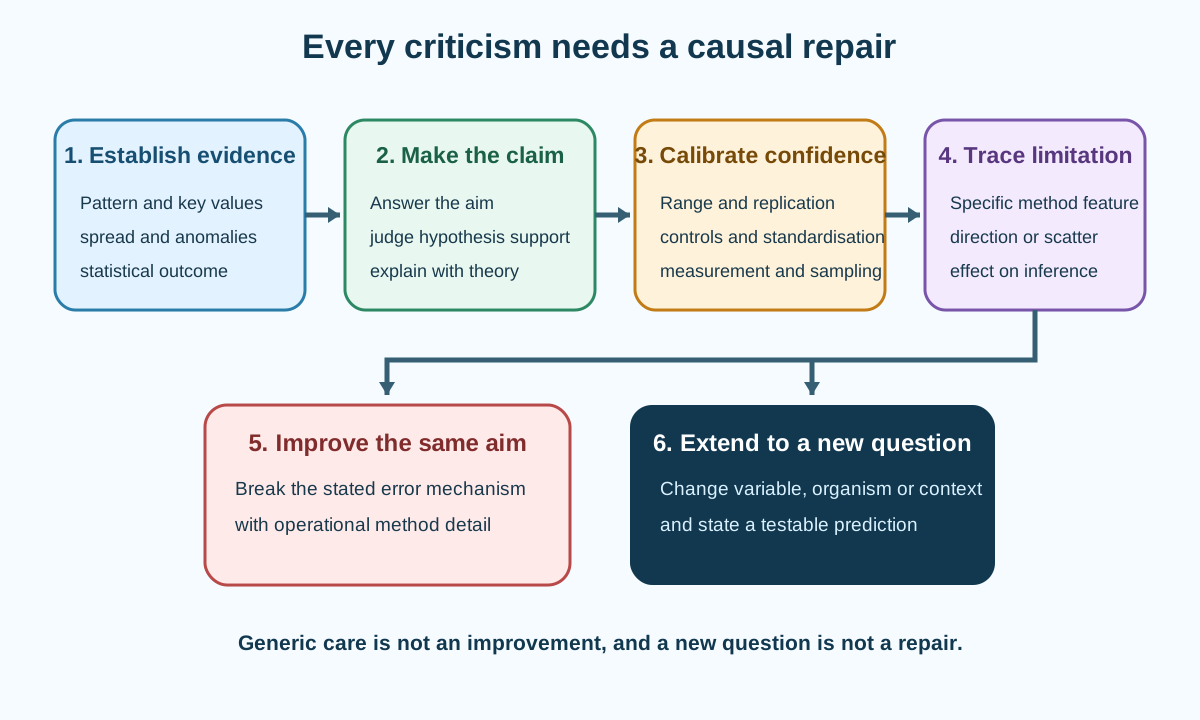
Conclusions, Limitations and Improvements develops the official Cambridge International AS and A Level Marine Science 9693 AO3 evaluation and AO2 conclusion requirements. Candidates must criticise procedures, judge standardisation, error, anomalies, replication, range and confidence, then propose specific improvements or extensions. A strong evaluation follows a causal chain from evidence to claim, limitation, effect and repair.
Official assessment boundary
Paper 2 and Paper 4 can assess procedure criticism, effectiveness of standardisation, main errors, random and systematic error, anomalies, replication, range and confidence.
Candidates must suggest improvements that increase observation or measurement accuracy through better standardisation, a more accurate dependent-variable method, smaller independent-variable intervals or replicates for a mean. They must also distinguish an improvement from an extension into a new question or context.
Conclusions must describe key observations, data and analyses, decide whether evidence supports a hypothesis, explain findings scientifically and make further predictions or questions.
Begin with the aim and hypothesis
Restate the tested relationship, not the entire procedure. A conclusion must answer the original aim using the dependent response and independent variable.
If a null hypothesis was used, make the statistical decision in the language of the test. Reject or do not reject; do not claim permanent proof.
For a directional prediction, state whether the observed pattern supports it, supports only part of it or does not support it.
Do not replace the conclusion with a theory paragraph that never mentions the data.
Describe the key evidence
Identify direction, shape, maximum, minimum, plateau, threshold, gradient, difference or association. Support claims with selected values and units.
Compare like with like. A change from first to last treatment may conceal a mid-range optimum or anomaly.
Refer to variation through range, standard deviation, standard error, confidence intervals or scatter as appropriate to level.
Use enough numerical evidence to establish the pattern without copying every table entry.
Separate description from explanation
Description states what the results show. Explanation links the pattern to relevant marine-science theory.
For example, shell mass loss increases as pH falls. Increased hydrogen-ion availability reduces carbonate availability and favours calcium-carbonate dissolution.
The mechanism must fit the measured response. Do not explain a proxy as if a different variable was measured directly.
Check this topic from memory
Attempt the matching topic bank before reopening the notes. Use each missed idea to decide what to review next.
Alternative explanations belong in evaluation when the design cannot isolate one cause.
Support, partial support and no support
Evidence supports a hypothesis when the predicted relationship occurs across an adequate range with acceptable variation and no stronger alternative explanation.
Partial support can arise if the direction occurs only within part of the range, the effect plateaus, or some treatments have overlapping uncertainty.
No clear support may mean no effect or an investigation too weak to detect one. Distinguish those possibilities.
One anomalous point does not automatically invalidate an otherwise strong pattern.
Confidence in a conclusion
Confidence grows when the range tests the expected relationship, intervals resolve important features, independent replicates show consistent results, controls behave as expected, key variables are standardised and measurement resolution is suitable.
Confidence falls with few values, narrow range, large unexplained spread, pseudoreplication, confounding, weak calibration or method bias.
At A Level, SD, SE and confidence intervals can quantify aspects of spread or mean precision. They do not correct poor design.
State a calibrated judgement such as high, moderate or limited confidence and justify it with evidence.
Validity, reliability and accuracy
Validity asks whether the method tests the intended relationship without a competing explanation. Reliability concerns consistency. Accuracy concerns closeness to the intended or accepted value.
A study can be reliable but invalid if a confounder changes consistently with treatment. It can be valid in concept but imprecise because the response varies widely.
Use each term only when the evidence supports it. Generic claims that repeats make a result "more valid" usually confuse reliability with validity.
Improvements should name which quality they strengthen.
Criticise the procedure specifically
A limitation identifies a real feature of the given method, not a possibility invented without evidence. State:
what was uncontrolled or measured poorly
how it affected the independent variable, dependent variable or sample
whether the effect was directional or random
how this changes confidence or interpretation
"Human error" is too broad. Name reaction time, subjective endpoint, inconsistent angle, transcription or handling difference.
Evaluate standardisation
List only variables with plausible influence on the response. Check whether the method actually kept them constant and whether verification was adequate.
"Same room" may not standardise sample temperature. A shared water bath and measured vessel temperatures provide stronger evidence.
In fieldwork, variables such as substrate, tide or exposure may be measured, stratified or blocked rather than held constant.
Residual variation should be linked to a predicted effect.
Random error in evaluation
Random error creates unpredictable scatter and can obscure the trend. Identify its source, such as biological variation, endpoint judgement, turbulent flow or instrument fluctuation.
Independent replicates, automated endpoints, longer measurement periods or more stable conditions can reduce its influence or estimate it better.
Do not say random error makes every value too high. Its direction varies.
A mean can reduce random influence but cannot recover information absent from a poor measurement.
Systematic error in evaluation
A fixed systematic error shifts readings in one direction and may preserve the overall trend, as stated in the syllabus. It still affects absolute values and threshold comparisons.
Calibration error, zero offset, consistent sample loss or a biased sampling position are examples. Explain direction through the calculation or mechanism.
Calibration, blanks, corrected technique or a different valid method target systematic bias. More repeats of the same bias do not.
If bias changes with treatment, it may distort the trend as well as the level.
Anomalous readings
Identify an anomaly from replicate disagreement or departure from the main graph pattern. Check transcription, calculation and plotting first.
In a familiar context, propose a plausible method explanation such as leakage, contamination, misidentification or probe disturbance.
Repeat the treatment where possible. Preserve the original value and justify exclusion before recalculating a mean.
A genuine rare ecological observation is not automatically an error.
Adequacy of replication
Independent replicates reveal natural and random variation. Judge number, independence and balance across treatments.
Three readings of one vessel are not three biological replicates. Many quadrats on one transect may not represent multiple independent shores.
If spread is large, additional independent replicates may improve the mean estimate. If all replicates share a confounder, more of them do not restore validity.
Explain what population or condition the replicates actually represent.
Adequacy of range and intervals
The official planning minimum is five independent-variable values. Evaluation must ask whether the observed range covers the biologically relevant effect and whether intervals reveal its shape.
A narrow range can produce no detectable change even when a wider relationship exists. Wide intervals can miss an optimum or threshold.
Smaller intervals should target the uncertain region rather than be recommended everywhere without cost.
Extending into harmful conditions is not justified merely to widen the graph.
Sampling limitations
Biased placement, unsuitable quadrat size, inconsistent effort, low taxonomic resolution and limited sites or seasons restrict ecological inference.
Randomisation reduces selection bias within a sampling frame. Systematic transects address gradients but need replication across independent locations for broader generalisation.
Detection probability can differ among species or habitats. A net or visual count may not sample every organism equally.
State the population, place, time and conditions to which the conclusion reasonably applies.
Controls and blanks
An appropriate control shows whether the procedure changes without the independent factor. A blank detects background signal from reagent, vessel or sensor.
If a control changes unexpectedly, treatment effects may not be attributable to the intended variable. Evaluate the size and direction of that change.
Absence of a necessary control is a validity limitation. Add a specific comparison, not simply "use a control".
A control does not standardise all other variables automatically.
Match improvement to limitation
An improvement must break the identified causal link:
temperature variation: use one thermostatic bath and verify vessels
subjective colour endpoint: use a calibrated sensor or reference scale
small mass change: use finer balance resolution or longer safe exposure
random biological spread: increase independent replicates
unclear optimum: add smaller intervals around the peak
sampling bias: randomise coordinates within a defined frame
Name apparatus, method, placement, quantity or timing rather than saying "be more careful".
More accurate dependent-variable measurement
Replace a weak proxy only when the new method measures the intended response more directly or with suitable resolution.
Counting bubbles is a variable proxy for gas volume; an oxygen probe or gas syringe may improve quantification if operated and calibrated correctly.
Visual colour may be replaced by a colorimeter within a calibration range. Wet mass may be replaced by consistently dried mass when water retention confounds comparison.
Explain how the proposed method reduces the stated error.
Improvement versus extension
An improvement answers the same aim with stronger evidence. It changes quality, not the scientific question.
An extension asks a new question, perhaps by changing a different independent variable, applying the method to another species, site or season, or investigating the mechanism.
Adding salinity levels to an inadequate salinity range is an improvement. Testing temperature after completing salinity is an extension.
Label the two explicitly in an answer.
Further predictions and questions
A further prediction should follow from the observed pattern and theory. If rate plateaus with light, predict how added dissolved carbon availability might change the plateau.
State the new independent and dependent variables and expected direction or shape. Avoid vague suggestions to "do more research".
A strong question targets an unresolved mechanism, boundary or generalisability limit.
Do not extrapolate beyond safe or biologically possible conditions without qualification.
Weighing tradeoffs in improvements
More replicates, finer intervals and higher-resolution apparatus can improve evidence but cost time, money or organism use. Prioritise the dominant limitation.
Automation may reduce observer variation but introduces calibration and technical failure risks. Laboratory control can improve causal inference but reduce ecological realism.
Field replication improves generalisability but increases environmental variation.
Evaluate net benefit rather than presenting every change as unconditionally better.
Worked application: evaluating a shell pH investigation
Mean shell-mass loss increased as pH decreased across five values, supporting the predicted acidification effect, but two middle treatments had wide overlapping spread. Lower pH can increase calcium-carbonate loss through carbonate chemistry, yet confidence is moderate because shell pieces differed in exposed area and final drying was timed rather than taken to constant mass. Unequal area could change loss unpredictably among replicates; standardise area or calculate loss per unit area. Residual water makes final mass too high and loss too low; dry, cool and reweigh until consecutive masses agree. Add independent pieces at each pH and smaller intervals across the uncertain middle range. These changes improve the same aim. Testing shell mineral type as a new independent variable is an extension, with a prediction that composition alters dissolution rate.
Common misconceptions and corrections
Restating the method as the conclusion. Answer the aim with evidence.
Giving theory without data. Establish the observed pattern first.
Copying every result. Select key values and variation.
Saying a hypothesis is proven. Evidence supports or does not support it.
Calling partial-range agreement full support. State the boundary.
Treating no significant effect as proof of no effect. Power may be limited.
Ignoring spread when means differ. Confidence depends on variation.
Calling a precise study automatically valid. Confounding can remain.
Saying repeats increase validity automatically. They mainly address reliability and precision.
Writing "human error". Name the exact action and mechanism.
Inventing a limitation absent from the method. Use contextual evidence.
Listing an uncontrolled variable without its effect. Trace it to the response.
Saying random error always raises values. Direction is unpredictable.
Using repeats to fix calibration bias. Calibrate or correct the method.
Calling every systematic error trend-changing. A fixed offset can preserve trend.
Deleting anomalies silently. Preserve and justify.
Calling rare field observations errors. They may be genuine.
Counting repeated readings as independent organisms. They test a different variation source.
Adding replicates to a pseudoreplicated design. Independence remains absent.
Calling five values automatically an adequate range. Relevance and intervals matter.
Recommending smaller intervals everywhere. Target an unresolved feature.
Widening a range into harmful conditions. Ethics constrain design.
Generalising one shore transect to every coast. Scope is limited.
Saying use random sampling for a gradient aim. Systematic transects may be appropriate.
Writing only "add a control". Define the comparison and purpose.
Calling a control a controlled variable. Their roles differ.
Saying use better equipment. Name it and explain benefit.
Replacing a proxy with another uncalibrated proxy. Validity is not improved.
Calling a new independent variable an improvement. It is usually an extension.
Calling more sites an improvement without the same aim. It may extend generalisability.
Writing "investigate further" without variables. State a testable new question.
Assuming every improvement has no cost. Consider feasibility and welfare.
Assessment guidance
Build conclusions in four moves: answer the aim, describe the key numerical pattern and variation, decide support for the hypothesis or null hypothesis, then explain the pattern scientifically. Calibrate confidence from range, intervals, independent replication, controls, standardisation, measurement resolution and statistical evidence. For every limitation, name the procedural feature, error type or confounder, trace its direction or variability effect and state how it limits the claim. Match the improvement to that mechanism with operational detail. Separate improvements to the same aim from extensions that change variable, organism, site or context. Finish with a testable further prediction rather than a vague request for more work.
Retrieval practice
Take one laboratory graph and one field dataset. Write a data-supported conclusion, theoretical explanation and confidence judgement for each. Identify three limitations across measurement, standardisation, replication, range and sampling, trace each effect and design a matched improvement. Then propose one distinct extension with new variables and a directional prediction, checking that it does not merely repeat the original aim.