

Cambridge International AS and A Level Mathematics 1: Pure Mathematics 1
Cambridge International AS and A Level Mathematics 9709 Paper 1 notes on quadratics, functions, coordinate geometry, circular measure, trigonometry, series and calculus.
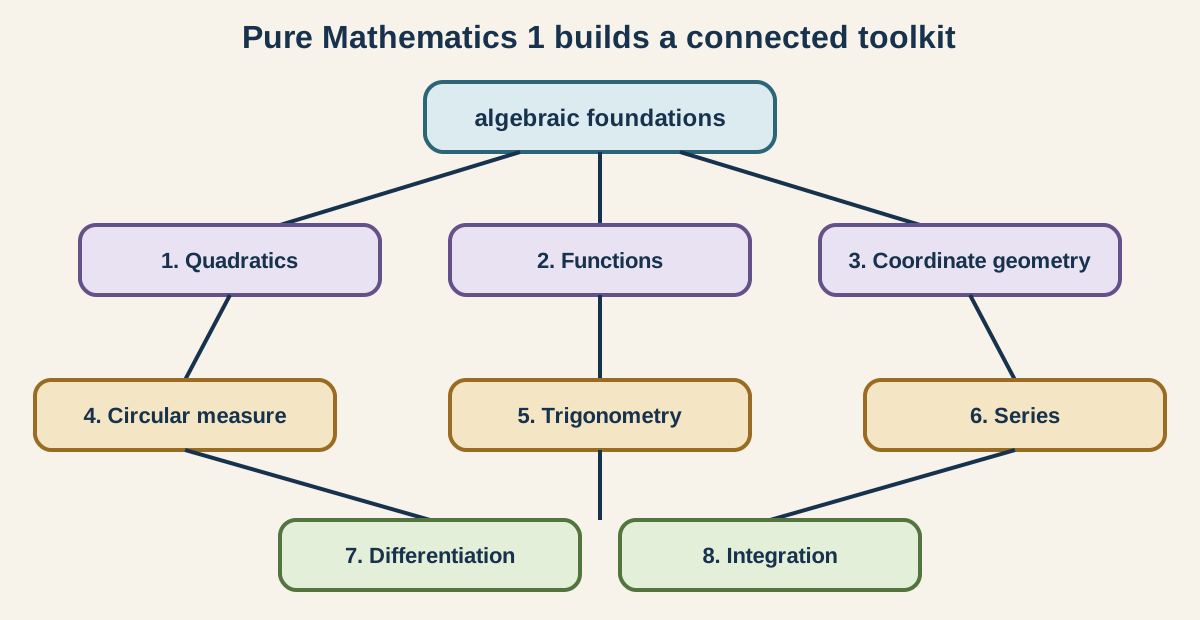
Pure Mathematics 1 is the content for Cambridge International AS and A Level Mathematics 9709 Paper 1. It covers eight official sections: quadratics, functions, coordinate geometry, circular measure, trigonometry, series, differentiation and integration. This is an AS Level paper and also forms part of permitted full A Level routes. The note keeps later Paper 2 and Paper 3 methods outside this boundary unless they are needed as prior knowledge.
1. Quadratics
Completing the square changes a quadratic into a form that exposes its geometry. For y = ax^2 + bx + c, write the expression as a(x - h)^2 + k. The vertex is (h, k), and the sign of a determines whether it is a minimum or maximum. The same form supports graph sketching and range decisions.
The discriminant is b^2 - 4ac. A positive discriminant gives two distinct real roots, zero gives one repeated real root, and a negative value gives no real roots. In a parameter problem, translate the requested number of intersections or roots into the appropriate discriminant condition before solving the resulting inequality.
Solve quadratic equations by factorisation, completing the square or the quadratic formula. For inequalities, locate the critical roots and use the graph's sign or a sign chart. Keep strict and inclusive inequality endpoints distinct.
For one linear and one quadratic simultaneous equation, substitute the linear relation into the quadratic equation. Check every resulting pair in both original equations. Equations such as x^4 - 5x^2 + 4 = 0 are quadratic in a function of x: set u = x^2, solve for u, then return to x and enforce any domain restrictions.
2. Functions
A function assigns exactly one output to every input in its domain. The range is the set of outputs actually produced. A one-one function never assigns the same output to two different inputs, so it can have an inverse function on the stated domain.
For a composition gf, apply f first and then g. It is defined only when the range of f used by the composition lies inside the domain of g. Domain checks are therefore part of the method, not an optional note after the algebra.
To find an inverse, write y = f(x), rearrange for x, and swap the variable names. State the inverse domain and range when restrictions matter. Graphs of a one-one function and its inverse reflect in y = x.
Recognise transformations by their effect on coordinates. Adding outside, y = f(x) + a, moves the graph vertically. Adding inside, y = f(x + a), moves it horizontally in the opposite sign direction. Multiplying outside changes vertical scale and can reflect in the x-axis; multiplying the input changes horizontal scale and can reflect in the y-axis. Track a known point through the transformation instead of relying only on a memorised phrase.
Check this topic from memory
Attempt the matching topic bank before reopening the notes. Use each missed idea to decide what to review next.
Start the topic quiz