

Cambridge International AS and A Level Mathematics 2: Pure Mathematics 2
Cambridge International AS and A Level Mathematics 9709 Paper 2 notes on algebra, logarithms, trigonometry, calculus and numerical solution.
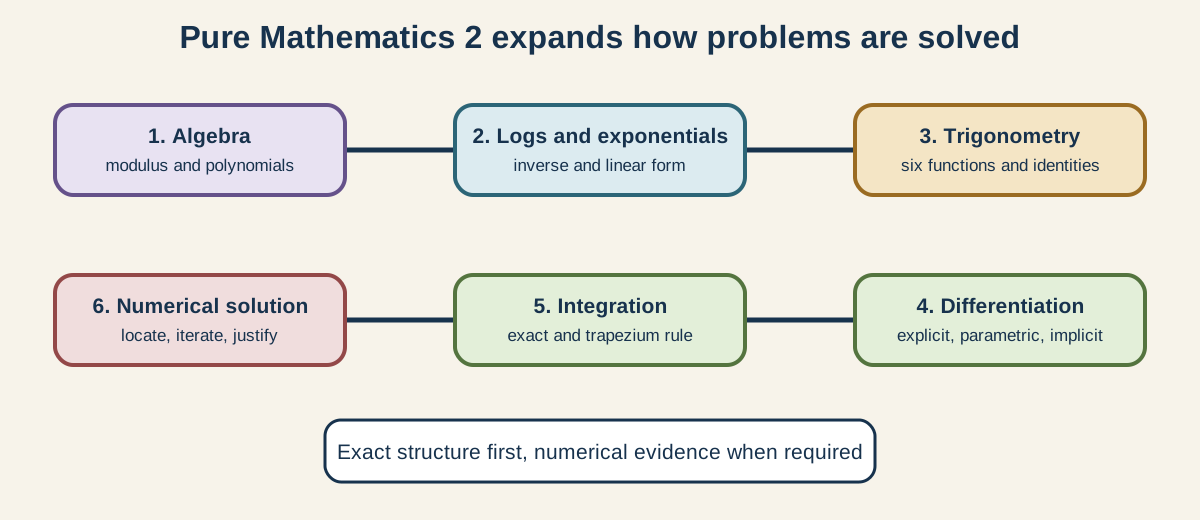
Pure Mathematics 2 is the content for Cambridge International AS and A Level Mathematics 9709 Paper 2. Paper 1 knowledge is assumed. The six official sections extend algebra and calculus through modulus, polynomial division, logarithmic models, all six trigonometric functions, parametric and implicit differentiation, numerical integration and iterative root finding.
1. Algebra
The modulus |x| is the non-negative distance of x from zero. For a linear expression, y = |ax + b| reflects any part of y = ax + b below the x-axis upwards. Solve equations such as |A| = |B| by using A^2 = B^2 or by considering A = B and A = -B. Check solutions in the original equation.
For |x - a| < b with b positive, x lies within distance b of a, so a - b < x < a + b. More complicated inequalities may require a number-line split at the points where expressions inside modulus signs change. Graphs of y = |f(x)| and y = f(|x|) for non-linear f are explicitly excluded from Paper 2.
Polynomial division applies to a dividend of degree at most 4 and a linear or quadratic divisor. Write dividend = divisor times quotient + remainder, where the remainder has lower degree than the divisor. The factor theorem says that x - a is a factor of f(x) exactly when f(a) = 0. For a factor ax + b, test the root x = -b/a. The remainder theorem supplies a remainder and can create equations for unknown coefficients.
2. Logarithmic and exponential functions
A logarithm reverses an index: log base a of b = c means a^c = b. Use product, quotient and power laws, but change of base is not part of this paper. Logarithm arguments must be positive.
The functions e^x and ln x are inverses. Their graphs reflect in y = x. The exponential graph is always positive and passes through (0, 1); ln x is defined only for x > 0 and passes through (1, 0). For y = e^(kx), the sign of k controls growth or decay.
To solve an equation with the unknown in an exponent, isolate the exponential structure, take logarithms and retain any inequality sign reversal caused by multiplying or dividing by a negative quantity. In exponential inequalities, monotonicity matters.
Linearisation turns a model into a straight-line relation. From y = kx^n, obtain ln y = ln k + n ln x, so a plot of ln y against ln x has gradient n and intercept ln k. From y = k(a^x), obtain ln y = ln k + x ln a, so plotting ln y against x gives gradient ln a. Recover k or a by exponentiating the fitted intercept or gradient.
3. Trigonometry
Secant, cosecant and cotangent are reciprocal functions: sec x = 1/cos x, cosec x = 1/sin x and cot x = 1/tan x. Their graphs inherit excluded values and asymptotes from zeros of their denominators. Use periods and symmetry to extend graphs to angles of any magnitude.
Check this topic from memory
Attempt the matching topic bank before reopening the notes. Use each missed idea to decide what to review next.
Start the topic quiz