

Cambridge International AS and A Level Mathematics 3: Pure Mathematics 3
Cambridge International A Level Mathematics 9709 Paper 3 notes on advanced algebra, calculus, vectors, differential equations and complex numbers.
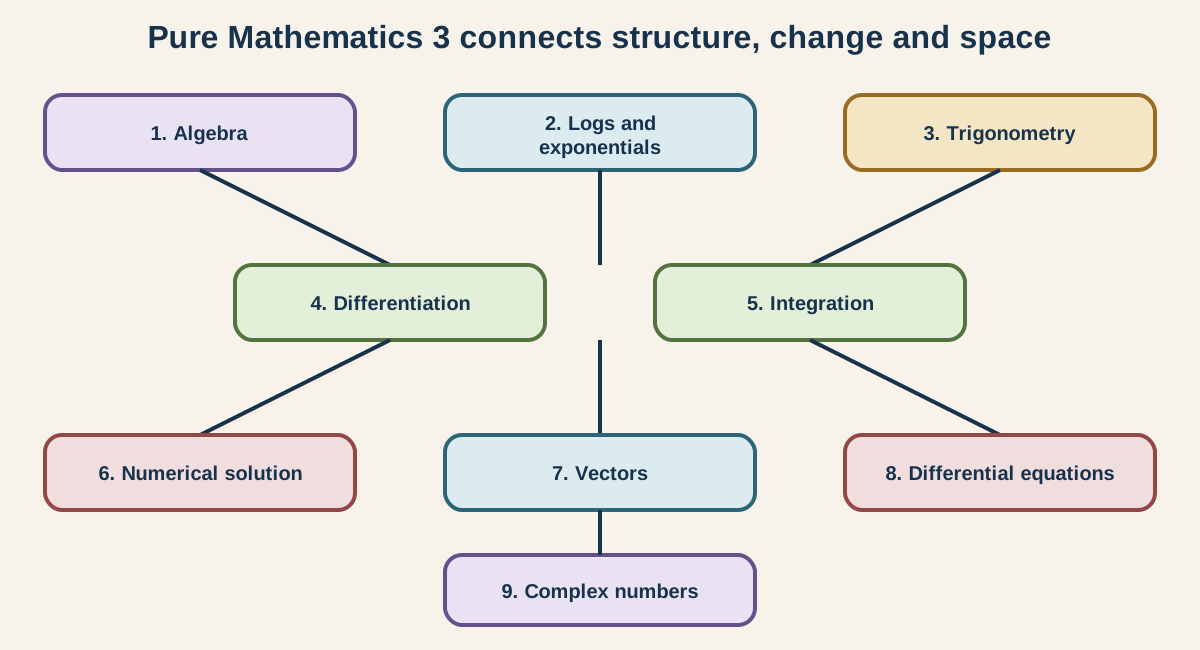
Pure Mathematics 3 is the content for Cambridge International AS and A Level Mathematics 9709 Paper 3. Paper 1 knowledge is assumed. Nine official sections develop algebra, logarithmic and exponential functions, trigonometry, differentiation, integration, numerical solution, vectors, differential equations and complex numbers for a full A Level route.
1. Algebra
Paper 3 includes the Paper 2 modulus, polynomial division, factor theorem and remainder theorem content. For modulus equations and inequalities, use distance interpretation, cases or an equivalent squared relation, then check the original domain. Non-linear graphs of y = |f(x)| and y = f(|x|) remain excluded.
Decompose proper rational functions into partial fractions. The permitted denominators contain up to three distinct linear factors, a repeated linear factor, or a linear factor with an irreducible quadratic factor. Match the numerator form to each denominator: constants over linear factors, separate constants over each power of a repeated factor, and a linear numerator over an irreducible quadratic. Improper rational functions, where the numerator degree exceeds the denominator degree, are excluded.
For rational n and |x| < 1, expand (1 + x)^n using the binomial series. Adapt an expression by factoring out its constant part and rewriting the remainder as 1 + u. State the validity condition by applying |u| < 1. Finding a general term is not required.
2. Logarithmic and exponential functions
Logarithms reverse indices and obey product, quotient and power laws. Change of base is excluded. The natural exponential and natural logarithm are inverse functions, with e^(kx) modelling growth when k is positive and decay when k is negative.
Use logarithms to solve exponential equations or inequalities. Preserve positive logarithm arguments and apply monotonicity correctly. For y = kx^n, the relation ln y = ln k + n ln x is linear in ln x and ln y. For y = k(a^x), ln y = ln k + x ln a is linear in x and ln y. Interpret transformed gradients and intercepts before recovering the original constants.
3. Trigonometry
Use sine, cosine, tangent and their reciprocals secant, cosecant and cotangent for angles of any magnitude. Graphs must show periods, symmetry and vertical asymptotes.
Required identities include sec^2 x = 1 + tan^2 x, cosec^2 x = 1 + cot^2 x, the addition formulas for sine, cosine and tangent, and double-angle formulas. Express a sin x + b cos x as R sin(x plus or minus alpha) or R cos(x plus or minus alpha), where R = sqrt(a^2 + b^2), by matching coefficients.
In simplification and equation solving, select identities strategically. Do not cancel a factor until its zero case has been checked. Generate every solution in the requested interval and reject values that make an original denominator zero.
Check this topic from memory
Attempt the matching topic bank before reopening the notes. Use each missed idea to decide what to review next.
Start the topic quiz