

Cambridge International AS and A Level Mathematics 5: Probability and Statistics 1
Cambridge International AS and A Level Mathematics 9709 Paper 5 notes on data, counting, probability, random variables and normal models.
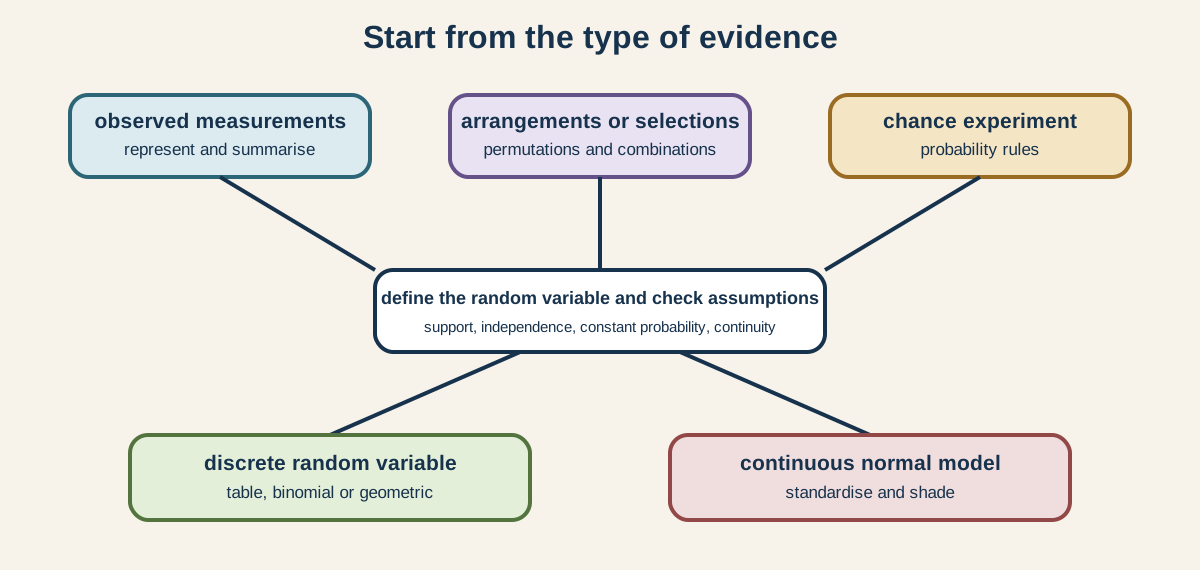
Probability and Statistics 1 is the content for Cambridge International AS and A Level Mathematics 9709 Paper 5. It is a mainly numerical option built on Paper 1 algebra. The five official sections cover representation of data, permutations and combinations, probability, discrete random variables and the normal distribution.
1. Representation of data
Choose a representation that matches the variable and comparison. Stem-and-leaf diagrams preserve individual values and reveal shape; back-to-back versions compare two distributions on a common scale. Box-and-whisker plots compress data into median, quartiles and extremes. Histograms represent grouped continuous data with bar area proportional to frequency, so unequal class widths require frequency density. Cumulative-frequency graphs support estimates of medians, quartiles, percentiles and proportions within ranges.
Mean uses every value and is sensitive to extremes. Median is resistant to extremes. Mode identifies the most frequent value or class. Range uses only extremes, while interquartile range measures the spread of the central half. Standard deviation measures typical spread about the mean. Compare both centre and spread, and include distribution shape or outliers when visible.
Calculate mean and standard deviation from raw data, grouped data, totals of x and x^2, or coded totals. Grouped calculations use class midpoints and are estimates. For coding such as y = x - a, translate the resulting mean back correctly; a shift changes the mean but not the standard deviation. Problems may link totals for up to two data sets, so combine sample sizes, sums and sums of squares before recalculating the overall statistics.
2. Permutations and combinations
A permutation is an ordered arrangement; a combination is an unordered selection. Use nPr when choosing and ordering r distinct objects and nCr when only the selected group matters.
For repeated identical objects, divide the factorial of the total positions by the factorial of each repeated count. Under a restriction, convert the words into a structural condition. Objects that must stay together can be treated as one block, with internal arrangements counted separately. Objects that must not stay together can often be handled by total arrangements minus forbidden adjacent arrangements.
Several rows can be counted by choosing who occupies each row and then arranging within rows, while avoiding double-counting if the rows are indistinguishable. Circular arrangements are explicitly excluded from Paper 5.
3. Probability
For equiprobable elementary outcomes, probability is favourable outcomes divided by total outcomes. Enumerate a sample space or use permutations and combinations when outcomes correspond to arrangements or selections. Ensure the outcomes counted are equally likely.
Check this topic from memory
Attempt the matching topic bank before reopening the notes. Use each missed idea to decide what to review next.
Start the topic quiz