Cambridge International AS and A Level Physics 1: Physical quantities and units
Cambridge International AS and A Level Physics 1: Physical quantities and units
Study guide/
Cambridge Physics 9702 AS Level notes on physical quantities, SI base units, dimensional homogeneity, prefixes, errors, uncertainty, scalars and vectors.
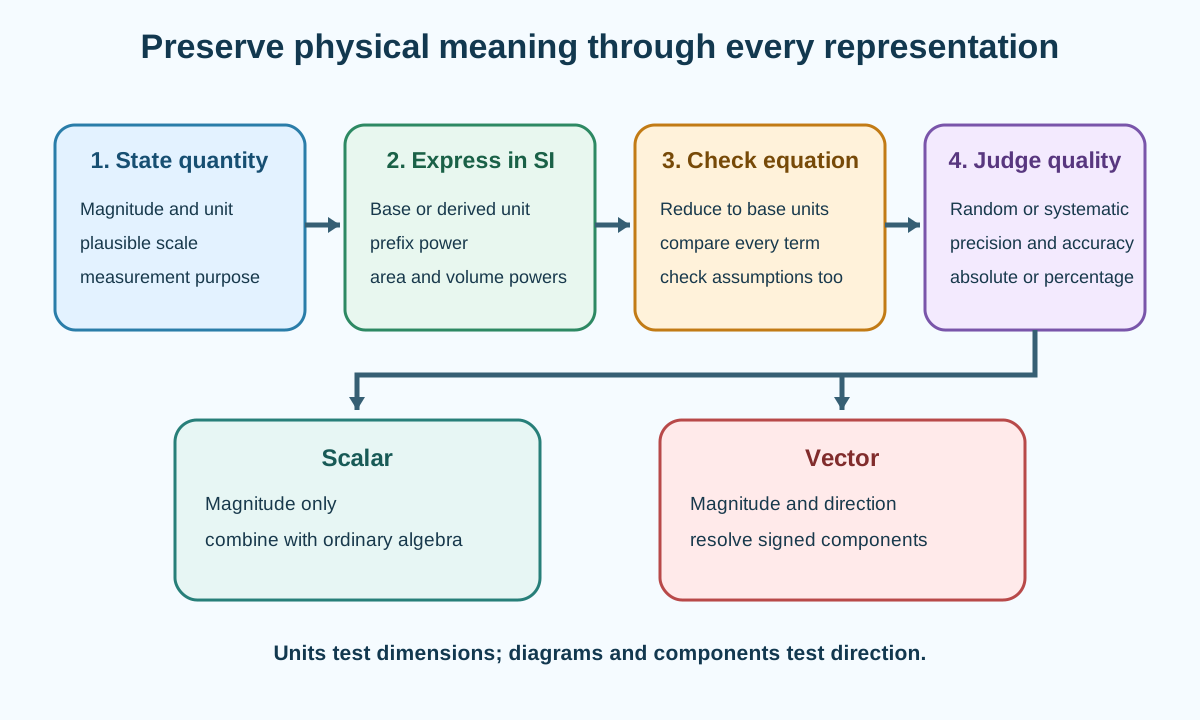
Physical Quantities and Units is Topic 1 of the Cambridge International AS and A Level Physics 9702 AS Level syllabus. These notes follow official sections 1.1 Physical quantities, 1.2 SI units, 1.3 Errors and uncertainties and 1.4 Scalars and vectors. The core skill is to preserve physical meaning while moving among measurement, unit, equation, uncertainty and vector representation.
1.1 Physical quantities
Magnitude and unit
A physical quantity consists of a numerical magnitude and a unit. In a length of 2.4 m, 2.4 is the magnitude and metre is the unit.
The number changes when the unit changes, but the physical quantity does not. A length of 2.4 m is the same as 240 cm.
A number without a required unit is incomplete because it does not state the measurement scale. A unit without a magnitude does not state how much.
Some ratios are dimensionless, but their meaning must still be clear.
Reasonable estimates
An estimate gives a physically plausible order of magnitude using familiar references and simple modelling. It is not an unsupported guess.
For a person's height, a value near 2 m is reasonable; 200 m is not. For a walking speed, distance divided by a plausible time gives an estimate near the correct scale.
Break unfamiliar quantities into known dimensions. Estimate a room volume from length times width times height, or a mass from density times volume.
State assumptions and check the resulting unit, sign and order of magnitude.
Order-of-magnitude checks
Scientific notation helps compare scales. A result many powers of ten from expectation often indicates a prefix, unit-conversion or calculator-entry error.
Round inputs to one significant figure for a quick estimate, then compare with the detailed calculation. Agreement in order of magnitude does not prove exact correctness, but disagreement demands investigation.
Use limiting cases where possible. A calculated efficiency above one or a negative absolute distance is physically suspicious in ordinary contexts.
Do not change an unexpected result merely to fit expectation; find the mathematical or physical cause.
1.2 SI units
Required SI base quantities
The official Topic 1 list contains five base quantities and units:
mass in kilogram, kg
length in metre, m
time in second, s
electric current in ampere, A
thermodynamic temperature in kelvin, K
Use unit symbols with correct capitalisation. The quantity name may be lower case while a symbol named after a person can be capitalised, such as A for ampere.
Check this topic from memory
Attempt the matching topic bank before reopening the notes. Use each missed idea to decide what to review next.
Derived units are products or quotients of base units. Speed has unit metre per second, while acceleration has metre per second squared.
Force follows from mass times acceleration:
N=kg⋅m⋅s−2
Energy follows from force times distance:
J=N⋅m=kg⋅m2⋅s−2
Expressing a named derived unit in base units reveals dimensions and helps test equations.
Building a derived unit
Start from the defining equation and replace each quantity with its unit. For density,
ρ=Vm
so the unit is kilogram divided by cubic metre.
For power, energy divided by time gives joule per second, equivalent to watt.
Keep algebraic powers attached to the full unit. Area uses square metres, not metres multiplied by two.
Cancel identical units only when the algebra permits it.
Homogeneity of physical equations
A physically valid equation must be homogeneous: every term being added or equated has the same base-unit dimensions.
For
s=ut+21at2,
the left side has unit metre. The term ut has metre per second times second, and the term at2 has metre per second squared times second squared. Both reduce to metre.
Homogeneity can reject an equation but cannot prove it fully correct. A missing dimensionless factor such as one-half is invisible to a unit check.
Checking sums and functions
Quantities can be added or subtracted only when their dimensions match. Energy plus force is meaningless because joule and newton do not share dimensions.
The argument of a pure mathematical function such as sine, exponential or logarithm must be dimensionless in a complete physical model.
A ratio of two quantities with the same unit can be dimensionless, such as strain.
Unit consistency does not guarantee that vectors point in the correct direction or that physical assumptions hold.
Prefixes and powers of ten
The required prefixes are:
pico, p, 10−12
nano, n, 10−9
micro, μ, 10−6
milli, m, 10−3
centi, c, 10−2
deci, d, 10−1
kilo, k, 103
mega, M, 106
giga, G, 109
tera, T, 1012
Capitalisation matters: m means milli while M means mega.
Converting prefixed units
Replace the prefix by its power of ten. For example, 3.2 mm is 3.2×10⁻³ m.
When a prefixed unit is squared or cubed, the conversion factor is also squared or cubed:
1cm2=(1e−2m)2=1e−4m2
and
1cm3=1e−6m3
Converting only the prefix once in an area or volume is a common scale error.
Choosing an appropriate prefix
Choose a prefix that keeps the numerical magnitude readable and preserves appropriate significant figures. A wavelength may be clearer in nanometres than as a long decimal in metres.
Use one unit consistently within a calculation before substitution. Convert back to a requested unit only at the end.
Do not mix millimetres and metres in the same product without explicit conversion.
Scientific notation is often safer than mental movement of a decimal point.
1.3 Errors and uncertainties
Random errors
Random errors vary unpredictably among repeated readings. They cause scatter and arise from reaction time, fluctuating displays, judgement of an endpoint or small environmental changes.
Repeated measurements and a mean reduce the influence of random error and reveal its spread. A more precise instrument or automated method may also help.
Random error does not always increase a reading. Its direction changes unpredictably.
Repeats cannot remove a fixed calibration error.
Systematic errors
Systematic errors shift measurements consistently because of apparatus or method bias. A zero error, incorrect calibration or consistent parallax position can produce systematic error.
Zero-checking, calibration, blanks or method correction address the cause. Taking more readings with the same bias makes the biased mean more precise but not more accurate.
A fixed offset may preserve a graph's gradient while shifting its intercept. A scale-factor error can alter the gradient.
State the mechanism and likely direction when evaluating an error.
Precision and accuracy
Precision describes closeness among repeated readings or fineness of measurement. Accuracy describes closeness to the accepted or true value.
Readings can be precise but inaccurate if they cluster around a biased value. They can be imprecise yet have a mean near the accepted value by chance.
Resolution contributes to possible precision, but a display with many digits is not automatically accurate.
Use calibration evidence to discuss accuracy and replicate spread to discuss precision.
Absolute uncertainty
Absolute uncertainty has the same unit as the measured quantity. If a length is reported as 0.520±0.002 m, the absolute uncertainty is 0.002 m.
For addition or subtraction, simple absolute uncertainties add:
ΔQ=ΔA+ΔB.
This gives a conservative uncertainty for a result formed from independent measured quantities under the syllabus's simple rule.
Match uncertainty and measured value decimal places.
Percentage uncertainty
Percentage uncertainty is absolute uncertainty divided by measured value, multiplied by 100 per cent:
percentage uncertainty=QΔQ×100%.
For multiplication or division, simple percentage uncertainties add. For a power, multiply the percentage uncertainty by the magnitude of the power.
A fixed absolute uncertainty creates a larger percentage uncertainty for a smaller measured value.
Keep guard digits until the final uncertainty and value are reported.
Uncertainty in repeated readings
When repeated values are available, half the range can provide an estimate of random uncertainty when that convention is requested:
ΔQ=2Qmax−Qmin.
This estimate depends on sample size and extremes. Use the convention specified by the question.
Compare uncertainty with the observed difference before claiming two values are distinct.
No uncertainty calculation corrects systematic bias or poor experimental design.
1.4 Scalars and vectors
Scalar quantities
A scalar has magnitude only. Examples include mass, time, temperature, distance, speed, energy, power and density.
Scalars combine by ordinary algebra when their units and meanings are compatible.
A negative scalar value can encode a reference convention, such as temperature on a Celsius scale, without turning it into a vector.
Calling a quantity scalar does not mean it is always positive in every convention.
Vector quantities
A vector has magnitude and direction. Examples include displacement, velocity, acceleration, force, momentum and electric field strength.
Write a direction or use a diagram, component notation or sign convention. A magnitude alone is incomplete when direction affects the result.
Two equal vector magnitudes can have different vectors if their directions differ.
The negative of a vector has equal magnitude and opposite direction.
Adding coplanar vectors
Coplanar vectors lie in one plane. Add them head-to-tail, use a scale drawing or resolve them into perpendicular components.
The resultant joins the start of the first vector to the end of the last. Vector addition is commutative even though the head-to-tail order can be rearranged.
Parallel vectors in the same direction add magnitudes; opposing parallel vectors subtract magnitudes and take the direction of the larger.
Perpendicular magnitudes do not add arithmetically.
Subtracting vectors
Subtracting vector B means adding −B. Reverse B's direction, then add head-to-tail.
Relative velocity and change in velocity often require vector subtraction. The order matters because A−B is the negative of B−A.
Keep the chosen positive directions visible in component calculations.
A smaller final magnitude does not mean no vector change occurred.
Resolving into perpendicular components
For a vector of magnitude F at angle θ measured from the positive horizontal axis:
Fx=Fcosθ,Fy=Fsinθ.
This component choice depends on how the angle is defined. If the angle is measured from the vertical, sine and cosine roles swap.
Assign signs from direction after choosing positive axes. Components are not additional forces; together they are an equivalent representation of the original vector.
Recombining components
For perpendicular resultant components Rx and Ry:
R=Rx2+Ry2
and direction can be found from
tanθ=RxRy.
Use component signs or a quadrant-aware diagram to select the correct direction. A calculator's inverse tangent alone may return an angle in the wrong quadrant.
Check that the resultant magnitude is plausible from the vector geometry.
Worked application: combining measurement and vector evidence
A force is measured as 12.0±0.3 N at 35 degrees above the horizontal. Its components are found from Fx=Fcos35∘ and Fy=Fsin35∘, giving about 9.83 N and 6.88 N before final rounding. Both components inherit the force's fractional uncertainty if the angle uncertainty is neglected, so the percentage uncertainty is 0.3/12.0×100=2.5 per cent. Report components to justified precision and retain their signs. A unit check confirms both are forces, but cannot reveal an incorrect sine-cosine choice. The diagram and angle definition decide that. If a second force is added, combine horizontal components and vertical components separately before calculating the resultant magnitude and quadrant.
Common misconceptions and corrections
Giving a magnitude without a unit. A physical quantity needs both.
Treating an estimate as a random guess. Use reference values and assumptions.
Accepting any calculator output. Check unit, sign and order of magnitude.
Listing mole and candela as required Topic 1 recall. The official list here specifies five base quantities.
Writing kg with a capital K. Unit symbols are case-sensitive.
Adding plural letters to symbols. Write kg, not kgs.
Calling newton an SI base unit. It is derived.
Squaring a number but not its unit. Area conversion squares the prefix factor.
Using 1cm2=10−2m2. The correct factor is 10−4.
Calling a homogeneous equation certainly correct. Dimensionless factors may still be wrong.
Adding terms with different dimensions. They cannot form a physical sum.
Ignoring dimensions inside a function argument. A complete pure-function argument is dimensionless.
Confusing milli and mega. Capitalisation changes the power by nine orders.
Moving a decimal without writing the prefix factor. Powers of ten are safer.
Mixing prefixed and SI units in substitution. Convert consistently first.
Saying random error always makes readings high. Its direction varies.
Repeating to remove zero error. Repeats do not correct fixed bias.
Calling precise readings accurate automatically. They may cluster around the wrong value.
Calling a digital instrument accurate because it has more digits. Calibration still matters.
Adding percentage uncertainties for addition. Add absolute uncertainties for sums or differences.
Adding absolute uncertainties for multiplication. Add percentage uncertainties under the simple rule.
Reporting uncertainty with incompatible decimal places. Align it with the value.
Treating uncertainty as proof the result is useless. It quantifies the evidence limit.
Calling speed a vector. Velocity includes direction; speed does not.
Calling every negative quantity a vector. Sign can be a scalar convention.
Adding perpendicular vector magnitudes directly. Resolve or use geometry.
Subtracting vectors by subtracting magnitudes only. Reverse direction and add.
Using sine and cosine without defining the angle. Components depend on reference axis.
Treating components as extra forces. They represent the original vector.
Ignoring component signs. Direction controls the resultant.
Trusting inverse tangent without checking quadrant. Use signs and a sketch.
Giving a resultant direction without reference. State the axis or compass direction.
Assessment guidance
For every numerical result, state or preserve the unit and test its order of magnitude. Derive unfamiliar units from equations, reduce named units to the five required SI base units and use homogeneity to reject dimensionally inconsistent expressions. Convert squared and cubed prefixes with the full power. In uncertainty questions, diagnose random versus systematic error, distinguish precision from accuracy, add absolute uncertainties for sums or differences and percentage uncertainties for products or quotients under the stated simple rules. For vector questions, draw the direction, define axes and angle, resolve signed perpendicular components, combine component-wise and check the resultant quadrant. Unit checks and vector diagrams test different failure modes, so use both.
Retrieval practice
Recall the five required base quantities and every prefix from pico to tera. Derive base units for ten syllabus quantities and test three equations for homogeneity. Convert length, area and volume prefixes, then propagate uncertainty through one sum and one quotient. Finally, classify twenty quantities as scalar or vector and solve coplanar addition, subtraction and component problems with explicit axes and quadrant checks.