Cambridge International AS and A Level Physics 2: Kinematics
Cambridge International AS and A Level Physics 2: Kinematics
Study guide/
Cambridge Physics 9702 AS Level notes on distance, displacement, speed, velocity, acceleration, motion graphs, constant-acceleration equations, free fall and projectiles.
Kinematics is Topic 2 of the Cambridge International AS and A Level Physics 9702 AS Level syllabus. The official boundary is section 2.1, Equations of motion. It connects precise definitions, motion graphs, uniform-acceleration equations, free-fall measurement and perpendicular motion without first asking what force caused the motion.
2.1 Equations of motion
Distance and displacement
Distance is the total length of the path travelled. It is a scalar and cannot be negative. Displacement is the straight-line change in position from the initial point to the final point. It is a vector, so its direction or sign must be stated.
An object that travels around a track and returns to its starting point has a positive distance but zero displacement. Distance depends on the path; displacement depends only on the two endpoint positions.
In one dimension, choose a positive direction before calculating displacement. If east is positive, a westward displacement is negative.
The magnitude of displacement cannot exceed distance for the same journey. Equality occurs only when the path is straight and does not reverse.
Speed and velocity
Average speed is total distance divided by total time:
average speed=total timetotal distance.
Check this topic from memory
Attempt the matching topic bank before reopening the notes. Use each missed idea to decide what to review next.
Average velocity is displacement divided by elapsed time:
vav=ΔtΔs.
Speed is a scalar. Velocity is a vector and includes direction. An object can move at constant speed while its velocity changes, as in circular motion, because its direction changes.
Instantaneous speed or velocity describes motion at one instant. On a position-time graph, it is associated with the tangent gradient at that instant rather than the gradient over a long interval.
Average speed is not generally the arithmetic mean of two speeds. That shortcut works only under special timing conditions.
Acceleration
Acceleration is the rate of change of velocity:
a=ΔtΔv.
Its SI unit is m⋅s−2. Because velocity is a vector, acceleration can change the magnitude of velocity, its direction, or both.
Negative acceleration means acceleration in the chosen negative direction. It does not automatically mean slowing down. An object slows when acceleration and velocity point in opposite directions and speeds up when they point in the same direction.
Uniform acceleration has constant magnitude and direction. It produces a constant gradient on a velocity-time graph.
Graphical representations of motion
Distance-time and displacement-time graphs
The horizontal axis represents time. The vertical coordinate represents distance travelled or signed displacement, depending on the graph.
The gradient of a displacement-time graph is velocity:
v=ΔtΔs.
A straight line has constant velocity. A horizontal line has zero velocity. A curve has changing velocity, so draw a tangent to find instantaneous velocity.
A negative displacement-time gradient represents motion in the negative direction. It does not mean negative speed.
A distance-time graph cannot decrease because accumulated path length cannot be undone. A displacement-time graph can decrease when the object moves toward the negative direction.
Speed-time and velocity-time graphs
The gradient of a velocity-time graph is acceleration:
a=ΔtΔv.
A horizontal velocity-time line represents constant velocity and zero acceleration. A straight sloping line represents uniform acceleration. A curve represents non-uniform acceleration, whose instantaneous value is found from a tangent gradient.
The signed area under a velocity-time graph is displacement:
Δs=∫v,dt.
At AS Level, use geometric areas where the graph consists of rectangles, triangles or trapezia. Areas below the time axis are negative and must be subtracted when finding net displacement.
The total area magnitude is not always distance. To find distance, add the magnitudes of positive and negative areas.
The area under an acceleration-time graph gives change in velocity, although the explicit Topic 2 requirement emphasises the gradients and velocity-time area stated above.
Reading motion from shape
State what a graph feature means before calculating it. A zero velocity coordinate means momentarily at rest; it does not by itself prove that the object stays at rest.
A change of sign in velocity indicates reversal of direction. A change of sign in acceleration indicates a change in the direction of acceleration, not necessarily a reversal of motion at that instant.
At a turning point on a displacement-time graph, the tangent gradient is zero. At a turning point in vertical free fall, vertical velocity is zero but acceleration remains downward.
Use axes, scale and units when sketching. A qualitative sketch still needs the correct sign, intercept, slope trend and relevant continuity.
Uniformly accelerated motion in a straight line
Variables and conditions
The standard symbols are:
u: initial velocity
v: final velocity
a: constant acceleration
t: elapsed time
s: displacement during the interval
These equations apply only to motion in a straight line with constant acceleration over the selected interval. All vector quantities must use one consistent sign convention.
They do not apply unchanged when acceleration varies with time, when direction changes in two dimensions, or when air resistance makes acceleration speed-dependent.
Deriving the first equation
From the definition of uniform acceleration,
a=tv−u.
Rearranging gives
v=u+at.
This is not a rule to memorise without meaning: it states that final velocity equals initial velocity plus the constant change accumulated per second over time.
Deriving displacement equations
For uniform acceleration, average velocity is
2u+v.
Therefore,
s=2u+vt.
Substitute v=u+at to obtain
s=ut+21at2.
Alternatively, eliminate u to obtain
s=vt−21at2.
These results can also be derived from the rectangle and triangle areas under a straight-line velocity-time graph.
Eliminating time
Combining v=u+at with a displacement equation eliminates time:
v2=u2+2as.
Choose the equation containing the known variables and the requested unknown. Writing every equation and substituting blindly increases sign and algebra errors.
Check the result against the motion. If an object accelerates in its direction of travel, its speed should rise. A second mathematical root may represent an earlier or later event, so interpret it physically.
Free fall in a uniform gravitational field
Motion without air resistance
Near Earth's surface and over modest height changes, gravitational acceleration can be treated as uniform. Without air resistance, every freely falling object has the same downward acceleration g, independent of its mass.
Choose upward as positive or downward as positive, then keep the convention. If upward is positive, a=−g. If downward is positive, a=+g.
An object thrown upward slows because its velocity is upward while acceleration is downward. At maximum height, its instantaneous velocity is zero but its acceleration is still g downward.
For return to the same height without air resistance, the speed magnitude on return equals the launch speed. The velocity is opposite in direction.
Do not use the constant-acceleration equations with a=0 merely because the object is instantaneously at rest at the top.
Describing an experiment to determine free-fall acceleration
One valid design releases a small object from rest and measures its displacement at known times using an electronic release, light gates, video analysis or a motion sensor. Obtain multiple time-position pairs across a useful range.
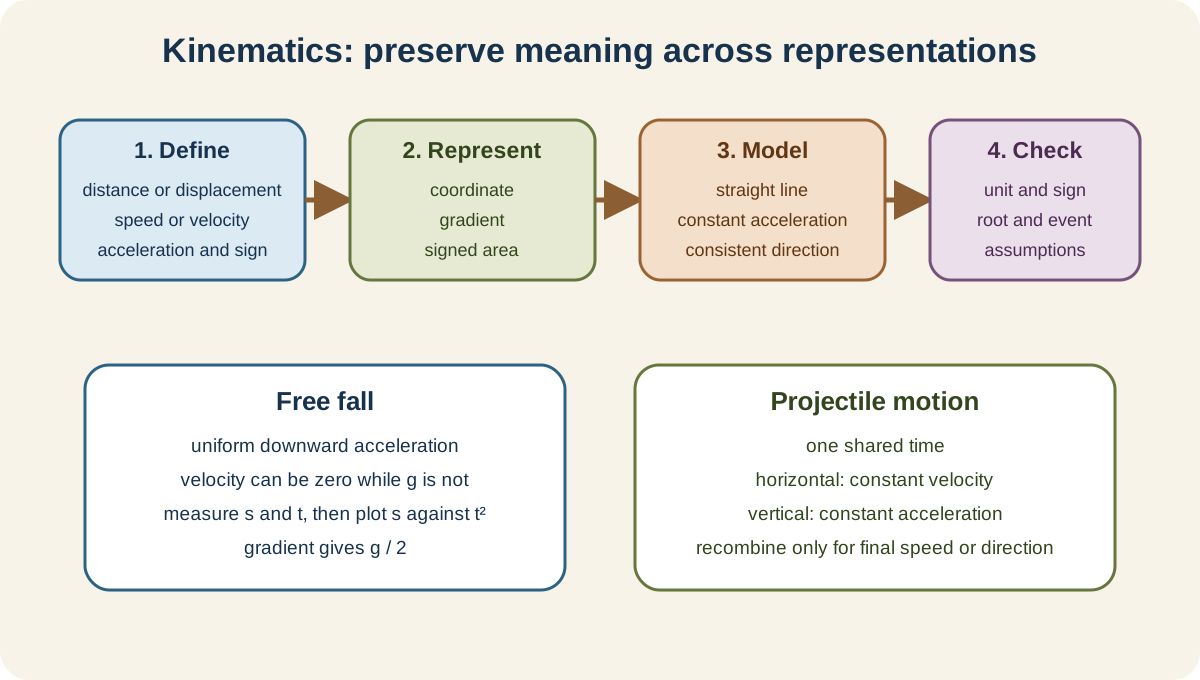
If release velocity is negligible, s=21gt2. Plot s against t2. A best-fit gradient m gives g=2m.
Alternatively, two light gates can measure velocities at known positions, allowing v2=u2+2gs to be tested with a linear graph.
Use a sufficiently large fall distance, a dense compact object, automatic timing and repeated readings to reduce relative timing uncertainty and air-resistance influence. Measure from a consistent reference point and ensure the release does not push the object.
Detailed apparatus handling, raw-table construction, uncertainty treatment and evaluation belong to the dedicated Cambridge Physics practical-skills hub. The theory requirement here is to describe a valid experiment and connect measured quantities to a defensible value of g.
Perpendicular uniform and accelerated motion
Independent components
Projectile motion without air resistance combines uniform horizontal velocity with uniform vertical acceleration. The two perpendicular components share the same time but otherwise evolve independently.
For horizontal launch speed ux:
x=uxt.
For upward-positive vertical motion:
y=uyt−21gt2,vy=uy−gt.
Horizontal acceleration is zero and vertical acceleration is downward. Gravity does not gradually consume horizontal velocity in this model.
Horizontal launch
For an object launched horizontally, initial vertical velocity is zero. Time to fall through height h follows from h=21gt2. The horizontal range is then x=uxt.
Increasing horizontal speed increases range but does not change fall time from the same height when air resistance is neglected.
The trajectory is curved because equal horizontal movements occur in successive equal times while vertical displacement grows with t2.
Angled launch
Resolve launch velocity into perpendicular components:
ux=ucosθ,uy=usinθ,
when θ is measured above the horizontal.
At the highest point, vy=0, but vx remains constant and the total velocity is not zero. The acceleration remains downward throughout.
For a return to launch height without air resistance, ascent and descent are symmetric in time and speed magnitude. This symmetry fails when landing height differs or drag matters.
Worked application: selecting evidence across a projectile model
A ball leaves a horizontal table at 3.0m⋅s−1 from a height of 1.25m. Neglect air resistance and take g=9.81m⋅s−2. Vertical motion gives 1.25=21(9.81)t2, so t=0.505 s. Horizontal motion then gives x=3.0(0.505)=1.52 m. The impact components are vx=3.0m⋅s−1 and vy=4.95m⋅s−1 downward. The fall time came only from vertical evidence; horizontal speed determined range. A negative time root is rejected because it represents an instant before launch.
Common misconceptions and corrections
Using distance and displacement interchangeably. Distance follows the path; displacement joins endpoints with direction.
Allowing distance to decrease. Accumulated path length cannot decrease.
Calling velocity speed with a unit. Velocity also requires direction.
Averaging two speeds without checking durations. Use total distance divided by total time.
Saying negative acceleration always means slowing. Compare acceleration and velocity directions.
Treating a horizontal displacement-time line as constant non-zero velocity. Its gradient is zero.
Reading a graph coordinate when a gradient is required. Identify the operation first.
Using a chord for instantaneous velocity on a curve. Draw a tangent.
Using velocity-time gradient for displacement. Gradient gives acceleration; area gives displacement.
Adding signed velocity-time areas to find distance. Add their magnitudes for distance.
Calling a zero velocity point a zero acceleration point. They are different quantities.
Assuming a velocity sign change happens when acceleration changes sign. Inspect velocity itself.
Using motion equations under variable acceleration. Confirm constant acceleration first.
Mixing positive directions partway through. Choose one convention and retain it.
Using speed where a signed velocity is needed. Direction controls the algebra.
Forgetting that s is displacement. It can be negative.
Selecting an equation with unnecessary unknowns. Choose by known and required variables.
Keeping every quadratic root. Interpret time and direction physically.
Saying heavier objects fall faster without air resistance. Their gravitational acceleration is the same.
Setting acceleration to zero at maximum height. Only vertical velocity is zero.
Assigning both g and a negative sign automatically. The sign follows the chosen axis.
Timing free fall manually over a short distance. Reaction time can dominate.
Plotting s against t for release from rest and expecting a straight line. Plot s against t2.
Allowing gravity to reduce horizontal velocity in the no-drag model. Acceleration is vertical.
Using the full launch speed in both components. Resolve it with the defined angle.
Saying the projectile is stationary at its highest point. Its horizontal velocity remains.
Solving horizontal and vertical motion with different times. Both components describe the same event.
Claiming launch speed changes fall time from a fixed horizontal launch height. Vertical motion sets the time.
Assuming every projectile path is symmetric. Equal launch and landing heights and negligible drag are required.
Reporting a range without model assumptions. State the gravitational and drag conditions.
Assessment guidance
Begin by defining the positive direction and separating scalar from vector quantities. On graphs, state whether the question needs a coordinate, gradient or signed area, then include units and distinguish displacement from distance. Before using a constant-acceleration equation, state or verify straight-line motion and uniform acceleration, choose the equation from the known variables and test any second root physically. In free-fall answers, retain downward acceleration at the highest point. In projectile questions, resolve the initial velocity once, give horizontal and vertical motion separate equations but one shared time, and recombine components only when the requested speed or direction requires it. Experimental descriptions must identify measured quantities, a valid relationship, repeat strategy and a gradient route to g.
Retrieval practice
Define distance, displacement, speed, velocity and acceleration, then sketch one graph that distinguishes each gradient and area operation. Derive all four uniform-acceleration equations from definitions or velocity-time area. Solve upward throw, horizontal launch and angled launch problems using explicit sign conventions. Finally, design a free-fall experiment, name its graph, derive the gradient relationship and propose two improvements tied to specific errors.