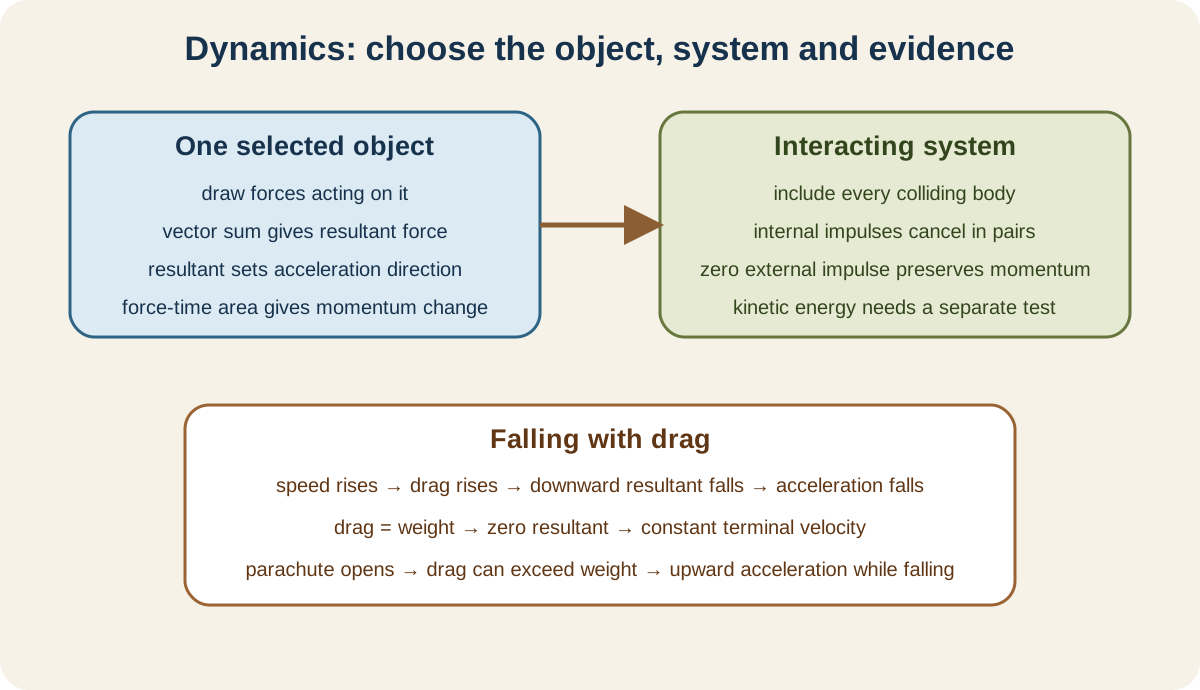
Dynamics is Topic 3 of the Cambridge International AS and A Level Physics 9702 AS Level syllabus. It asks why motion changes. The official boundary covers section 3.1 Momentum and Newton's laws of motion, section 3.2 Non-uniform motion and section 3.3 Linear momentum and its conservation.
3.1 Momentum and Newton's laws of motion
Mass as resistance to changing motion
Mass is a property of an object that resists change in motion. This inertial meaning explains why the same resultant force produces less acceleration in a larger mass.
Mass is a scalar measured in kilograms. It does not change when an object moves between gravitational fields. Weight is a force and can change with field strength.
Do not explain inertia as a force that opposes motion. Inertia is a property, not an additional force on a free-body diagram.
At this level, use inertial mass through F=ma and momentum rather than introducing later relativistic ideas.
Resultant force and acceleration
The vector sum of all external forces is the resultant force:
∑F=ma.
Check this topic from memory
Attempt the matching topic bank before reopening the notes. Use each missed idea to decide what to review next.
Acceleration and resultant force always have the same direction. Individual forces do not each equal ma; their vector resultant does.
Draw a free-body diagram showing only forces acting on the selected object. Choose axes, resolve angled forces and add signed components.
If the resultant force is zero, acceleration is zero. The object may be stationary or move with constant velocity.
For constant mass, doubling the resultant force doubles acceleration. Doubling mass for the same force halves acceleration.
Linear momentum
Linear momentum is the product of mass and velocity:
p=mv.
Momentum is a vector with SI unit kg⋅m⋅s−1, equivalent to N⋅s. Its sign or direction follows velocity.
An object at rest has zero momentum even though it has mass. Two objects can have equal momentum magnitudes with different masses and speeds.
System momentum is the vector sum of every selected object's momentum. Define the system before applying conservation.
Force as rate of change of momentum
The general definition of resultant force is
F=ΔtΔp.
For constant mass, Δp=mΔv, giving F=ma.
The product of force and time is impulse:
FΔt=Δp
for a constant or average force over the interval. The area under a force-time graph is impulse and therefore change in momentum.
For the same momentum change, increasing collision time reduces average force. Crumple zones, airbags and follow-through use this relationship. They do not reduce the required momentum change when initial and final velocities are fixed.
Newton's first law
An object remains at rest or moves with constant velocity unless acted on by a resultant external force.
The law identifies inertial motion and rejects the idea that continued motion requires a forward resultant force. A driving force can balance resistance, producing constant velocity with zero resultant.
The condition concerns resultant external force, not the absence of every force.
Use the first law to connect equilibrium of forces to zero acceleration.
Newton's second law
The rate of change of momentum is proportional to the resultant force and occurs in its direction. In SI units, the proportionality constant is one:
∑F=dtdp.
For constant mass this becomes ∑F=ma. The momentum form remains conceptually primary because it handles changes over finite interactions and motivates impulse.
State the selected object and resolve the resultant before substitution.
The acceleration direction follows the resultant even when velocity points elsewhere.
Newton's third law
When object A exerts a force on object B, B simultaneously exerts an equal-magnitude, opposite-direction force of the same type on A.
The pair acts on different objects. Therefore, the forces do not cancel on one object's free-body diagram.
Examples include gravitational forces between Earth and an object, contact forces between two blocks, and thrust forces between expelled material and a vehicle.
To identify a pair, name both objects and the interaction: force of A on B and force of B on A.
Balanced forces on one object are not necessarily a third-law pair.
Weight
Weight is the effect of a gravitational field on a mass:
W=mg.
It acts in the direction of the gravitational field and is measured in newtons. Near Earth's surface it acts downward.
The normal contact force is not automatically equal to weight. It depends on the object's acceleration and other vertical forces.
Apparent weight readings can change in an accelerating lift even though mass and gravitational field remain essentially constant.
Weightlessness can mean zero support force during free fall, not necessarily zero gravitational force.
3.2 Non-uniform motion
Friction and drag
Friction acts between contacting surfaces and opposes relative motion or its tendency. Viscous or drag forces act on an object moving through a fluid and oppose its velocity relative to that fluid.
The syllabus requires a qualitative model in which drag increases as speed increases. Coefficients of friction and viscosity are not required here.
Resistance converts mechanical energy into internal energy of the object and surroundings. It can make acceleration change even while driving force or weight stays constant.
State the relative motion and the force direction rather than saying resistance always points backward without a reference.
Falling with air resistance
At release from rest, drag is zero or negligible because speed is zero. Weight acts downward, so the resultant is downward and acceleration is approximately g.
As downward speed rises, upward drag rises. The resultant downward force decreases, so downward acceleration decreases.
When drag equals weight, resultant force and acceleration are zero. The object continues at constant terminal velocity.
The speed-time graph rises with a decreasing gradient and approaches a horizontal line. The acceleration-time graph begins near g and approaches zero.
Terminal velocity is not zero velocity. It is constant velocity produced by balanced forces.
Changes at a condition transition
When a parachute opens, drag increases rapidly and can exceed weight. The resultant is upward while the velocity is still downward, so the object decelerates.
As it slows, drag falls until it again balances weight at a lower terminal speed.
This sequence demonstrates why velocity and acceleration directions must be considered separately.
An object of larger mass can have a different terminal speed because greater weight requires greater drag for balance, but shape and area also matter.
3.3 Linear momentum and its conservation
Conservation principle and system boundary
The total momentum of a system remains constant when the resultant external force on the system is zero:
∑pbefore=∑pafter.
Internal interaction forces occur in equal and opposite third-law pairs and produce equal, opposite impulses, so they redistribute momentum without changing the system total.
Momentum is always conserved for an isolated system, whether the interaction is elastic or inelastic.
Choose the system to include every interacting object and define positive directions before writing the equation.
One-dimensional interactions
For two objects moving along one line:
m1u1+m2u2=m1v1+m2v2.
Velocities carry signs. An object rebounding has final velocity opposite to its initial direction.
If objects stick together after collision, they share one final velocity. This is perfectly inelastic, and kinetic energy is not conserved.
In explosions from rest, total momentum remains zero, so fragment momenta are equal in magnitude and opposite in direction when there are only two fragments.
Momentum conservation alone may not supply enough equations for an elastic interaction. Use the additional elastic condition when given or required.
Elastic interactions
In an elastic collision, total kinetic energy is conserved:
∑21mu2=∑21mv2.
For a one-dimensional elastic collision, relative speed of approach equals relative speed of separation:
u1−u2=v2−v1
when the variables follow one consistent direction and object ordering.
Momentum is vector; kinetic energy is scalar. Keep signs in the momentum equation but square speeds in kinetic-energy calculations.
The syllabus does not require coefficient of restitution.
Inelastic interactions and kinetic energy
In an inelastic interaction, momentum is conserved for an isolated system but total kinetic energy decreases. The lost kinetic energy is transferred to deformation, internal energy, sound or other forms.
Do not say energy is lost. Total energy remains conserved; only the kinetic-energy store changes.
An explosion can increase total kinetic energy by converting internal or chemical energy while conserving total momentum.
Calculate kinetic energy before and after if the question asks for elastic classification or energy transfer.
Two-dimensional momentum
Resolve momentum into perpendicular components and conserve each component separately:
∑px before=∑px after,∑py before=∑py after.
Use a vector diagram and define angles from a named axis. A system that starts with zero vertical momentum must have final vertical components that sum to zero.
After finding components, use trigonometry to obtain an unknown speed or direction.
Kinetic energy remains a scalar check independent of direction.
Worked application: collision evidence and energy classification
A 0.40kg trolley moving at 3.0m⋅s−1 collides with a stationary 0.60kg trolley, and they move together. Taking the initial direction as positive, conservation gives 0.40(3.0)+0=1.00v, so v=1.2m⋅s−1. Initial kinetic energy is 21(0.40)(3.0)2=1.8J; final kinetic energy is 21(1.00)(1.2)2=0.72J. Momentum is conserved, but kinetic energy falls by 1.08J, so the collision is inelastic. The missing kinetic energy is transferred, not destroyed.
Common misconceptions and corrections
Calling inertia a force. It is the mass property that resists change in motion.
Saying mass changes on the Moon. Weight changes; mass does not.
Applying F=ma to one force without finding the resultant. Add forces vectorially first.
Saying zero resultant means zero velocity. It means zero acceleration.
Drawing forces exerted by the selected object. Draw forces acting on it.
Leaving angled forces unresolved. Work in consistent perpendicular components.
Treating momentum as a scalar. Its direction follows velocity.
Using speed rather than signed velocity in momentum. Direction controls conservation.
Calling force momentum multiplied by time. Force is rate of momentum change.
Reading force-time gradient as impulse. Area gives impulse.
Saying airbags reduce momentum change. They mainly increase time and reduce average force.
Claiming continued motion needs a resultant forward force. Constant velocity needs zero resultant.
Pairing weight and normal force as third-law partners. They act on the same object.
Putting both third-law forces on one free-body diagram. They act on different objects.
Calling every equal-opposite pair a third-law pair. They must be one interaction on two objects.
Equating normal force to weight automatically. Apply vertical dynamics.
Calling weight mass. Weight is a gravitational force.
Saying drag has one fixed value. In the required model it increases with speed.
Giving drag at release from rest a large value. It begins negligible.
Calling terminal velocity zero. It is constant non-zero velocity.
Saying acceleration is downward after a parachute opens because velocity is downward. The resultant can be upward.
Assuming terminal speed depends only on mass. Shape, area and fluid conditions matter.
Conserving one object's momentum through a collision. Conserve the isolated system total.
Omitting an interacting object from the system. Include all bodies exchanging impulse.
Using unsigned speeds in a one-dimensional collision. Rebounds require negative velocity.
Saying momentum is conserved only in elastic collisions. Isolation, not elasticity, is the condition.
Saying kinetic energy is always conserved. It is conserved only in elastic collisions.
Saying kinetic energy disappears in an inelastic collision. It transfers to other forms.
Using momentum conservation as a scalar equation in two dimensions. Conserve each component.
Applying the relative-speed rule to an inelastic collision. It is the elastic condition here.
Introducing coefficient of restitution. It is outside the stated syllabus requirement.
Conserving kinetic energy in an explosion. Internal energy may become kinetic while momentum stays conserved.
Assessment guidance
Define the object or system before writing equations. For a single object, draw a force diagram, resolve components, form the resultant and ensure acceleration points in its direction. For momentum change, choose a positive direction and preserve velocity signs through impulse and collision equations. State Newton's laws with resultant external force and identify third-law partners by naming both objects. In drag explanations, give the causal sequence speed, drag, resultant and acceleration, then state the terminal balance. For collisions, conserve vector momentum first, apply the relative-speed or kinetic-energy condition only when elasticity is established, and calculate kinetic energy before and after when classification is requested. In two dimensions, write separate component equations and check that the final vector fits the initial system momentum.
Retrieval practice
State and apply all three Newton laws, derive F=ma from momentum for constant mass and connect force-time area to impulse. Explain a complete fall-to-terminal-speed and parachute-opening sequence. Solve signed one-dimensional sticking, rebound, elastic and explosion problems, then resolve a two-dimensional collision into components. For each interaction, define the system and decide separately whether momentum and kinetic energy are conserved.