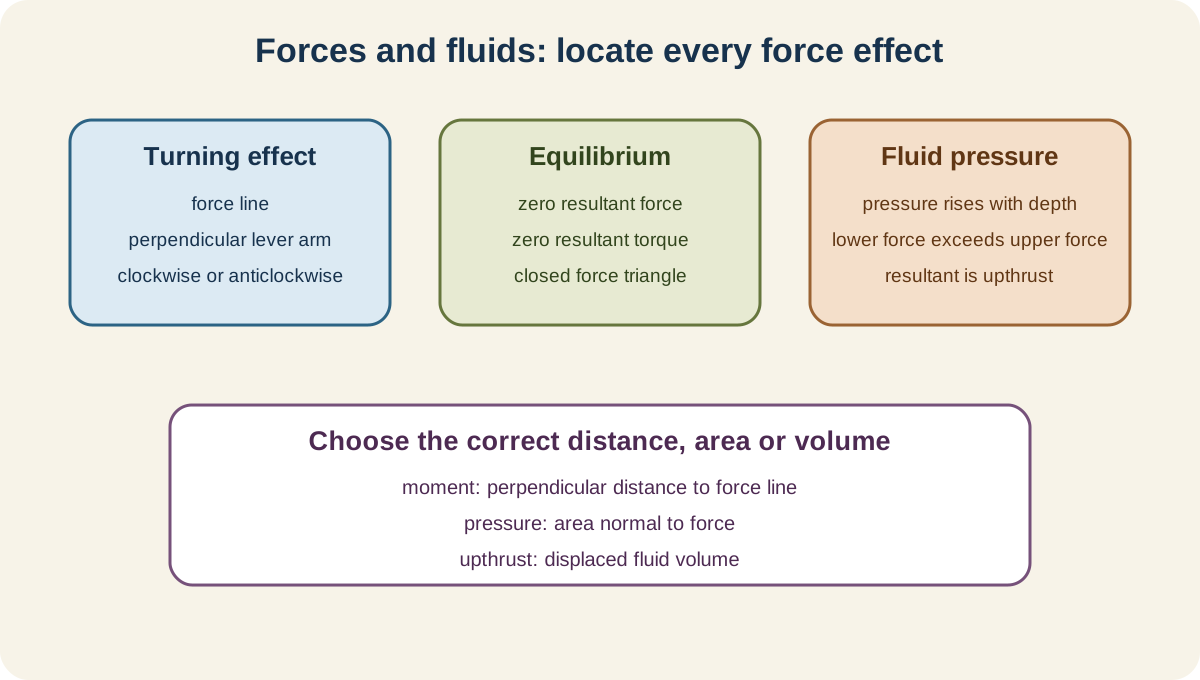
Forces, density and pressure is Topic 4 of the Cambridge International AS and A Level Physics 9702 AS Level syllabus. The official boundary joins rotational effects in section 4.1, equilibrium in section 4.2 and fluid quantities in section 4.3. Each part depends on identifying where forces act and whether their effects translate, rotate or vary with depth.
4.1 Turning effects of forces
Centre of gravity
The weight of an object may be treated as acting at a single point called its centre of gravity. In a uniform gravitational field, this coincides with its centre of mass.
For a uniform symmetric object, symmetry often locates the centre of gravity. For an irregular lamina, suspend it from different points and draw vertical plumb lines; their intersection locates the centre.
Stability depends on the vertical line through the centre of gravity. An object remains stable while this line falls within its base. Once it falls outside, the weight produces an overturning moment.
A lower centre of gravity and wider base generally improve stability. Mass alone does not determine stability.
Moment of a force
The moment of a force about a point is
moment=Fd⊥,
Check this topic from memory
Attempt the matching topic bank before reopening the notes. Use each missed idea to decide what to review next.
is the perpendicular distance from the pivot to the force's line of action. The SI unit is
N⋅m
.
The distance is not necessarily the length of the object or the distance to the point where the force is applied. Extend the force line and measure the shortest distance from pivot to that line.
State clockwise or anticlockwise sense, or use a consistent sign convention.
A force whose line of action passes through the pivot has zero moment about that pivot.
For an angled force, either use the perpendicular distance to its line of action or resolve the component perpendicular to the position vector. Do not do both.
Couples
A couple is a pair of equal, opposite and parallel forces whose lines of action are separated. The resultant force is zero, so it produces rotation only.
The torque of a couple is
τ=Fs,
where s is the perpendicular separation between the two force lines.
The torque is independent of the point about which moments are taken. Moving a pure couple does not introduce a resultant translation.
Two equal and opposite forces along the same line are not a couple because their separation and torque are zero.
Couple examples include turning a steering wheel with two hands and forces on a current-carrying coil, provided the force geometry meets the definition.
4.2 Equilibrium of forces
Principle of moments
For a body in rotational equilibrium, the sum of clockwise moments about any point equals the sum of anticlockwise moments about that point:
∑Mclockwise=∑Manticlockwise.
Equivalently, the resultant torque is zero. Choose a pivot that removes unknown forces whose lines of action pass through it.
Include the object's own weight at its centre of gravity unless the question states that the object is light or its mass is negligible.
The principle of moments alone does not guarantee complete equilibrium; the resultant force must also be zero.
Complete equilibrium
A system is in equilibrium when both conditions hold:
∑F=0,∑τ=0.
Zero resultant force prevents translational acceleration. Zero resultant torque prevents angular acceleration.
An object can have zero resultant force but a non-zero couple, producing angular acceleration. It can also have zero torque about one chosen point under special geometry while a resultant force still accelerates it.
Write horizontal and vertical force equations and one independent moment equation where required.
Static equilibrium means rest. Dynamic equilibrium means constant velocity with no acceleration, although many rigid-body questions focus on static cases.
Vector triangle for three coplanar forces
When three coplanar forces keep an object in equilibrium, their vectors form a closed triangle when placed head-to-tail.
The arrow directions must follow the actual force directions. A closed triangle represents zero vector sum.
Use scale drawing, sine rule, cosine rule or component resolution according to the given information. Label each side with the corresponding force.
The force triangle does not show where forces act and cannot by itself test torque equilibrium. The physical diagram and moment equation still matter for an extended body.
If three non-parallel forces keep a rigid body in equilibrium, their lines of action must be concurrent; otherwise they create a residual turning effect.
4.3 Density and pressure
Density
Density is mass per unit volume:
ρ=Vm.
Its SI unit is kg⋅m−3. Density describes how much mass occupies a given volume, not how heavy an entire sample is.
For a uniform object, use total mass and total volume. For mixtures or non-uniform objects, an average density may hide internal variation.
Convert cubed length units correctly. Since 1cm3=1e−6m3, 1g⋅cm−3=1000kg⋅m−3.
An object floats or sinks according to force balance and displaced fluid, often summarised by comparing average object density with fluid density.
Pressure
Pressure is normal force per unit area:
p=AF.
Its SI unit is pascal, where 1Pa=1N⋅m−2.
For the same normal force, a smaller contact area produces greater pressure. Pressure is a scalar field quantity even though the force on a surface has direction normal to that surface.
Use the area perpendicular to the force. Convert squared units with the squared prefix factor.
At a point in a stationary fluid, pressure acts in all directions. The force on a small surface element is normal to the surface.
Deriving hydrostatic pressure difference
Consider a vertical fluid column of cross-sectional area A, density ρ and height difference Δh. Its volume is AΔh, mass is ρAΔh, and weight is ρAΔh,g.
The pressure difference supporting that weight is force divided by area:
Δp=AρAΔh,g=ρgΔh.
Pressure difference depends on vertical depth difference, fluid density and gravitational field strength, not container shape or total fluid volume.
For a fluid open to the atmosphere, absolute pressure at depth is atmospheric pressure plus ρgh. If only the pressure increase is requested, use Δp=ρgΔh.
The equation assumes a stationary fluid of uniform density and approximately uniform g.
Upthrust from pressure difference
Pressure increases with depth, so the fluid force on the lower surface of an immersed object is generally larger than the downward force on its upper surface. The resultant of these pressure forces is upthrust.
Sideways pressure forces cancel for a symmetric closed surface or combine without a net vertical contribution once the complete surface is considered.
Archimedes' principle gives the upthrust as the weight of displaced fluid:
FU=ρfluidgVdisplaced.
Use displaced fluid volume, not automatically the object's full volume. They are equal only when the object is fully submerged.
For a floating object in equilibrium, upthrust equals the object's weight. The displaced volume adjusts until this balance occurs.
For a fully submerged object held at rest, other forces such as tension may also be present. Upthrust need not equal weight.
Floating, sinking and apparent weight
If weight exceeds upthrust with no other support, the resultant is downward and the object accelerates downward. If upthrust exceeds weight, the resultant is upward.
An object of average density lower than the fluid can float partially submerged. Force balance gives
VobjectVsubmerged=ρfluidρobject
for a uniform floating object.
The apparent weight measured by a support or tension is reduced by upthrust. Do not call upthrust the apparent weight itself.
For a denser fluid, the same displaced volume gives greater upthrust.
Worked application: linking moments and fluid equilibrium
A uniform horizontal beam of length 2.0m and weight 120N is hinged at one end. A vertical cable at the other end holds it in equilibrium while a 200N load acts 1.5m from the hinge. Taking moments about the hinge, T(2.0)=120(1.0)+200(1.5), so T=210N. Vertical force balance then gives the hinge reaction as 120+200−210=110N upward. Moments found cable tension, but the force equation was still needed for complete equilibrium. The beam's weight acted at its centre of gravity, not at the hinge.
Common misconceptions and corrections
Putting weight at the geometric centre for every object. Use its centre of gravity.
Saying a lower mass always means greater stability. Base width and centre height matter.
Using distance from pivot to force application. Use perpendicular distance to the line of action.
Ignoring moment direction. State clockwise or anticlockwise.
Giving a moment in joules. Use newton metre, but do not call it energy.
Counting a force through the pivot as having a moment. Its lever arm is zero.
Resolving a force and also using its perpendicular lever arm. That double-counts geometry.
Calling any opposite forces a couple. They must be equal, parallel and separated.
Giving couple torque as twice force times separation. Use one force times the force-line separation.
Using moments alone for complete equilibrium. Resultant force must also vanish.
Omitting the beam's weight. Include it unless negligible.
Taking moments about a point without showing distances. Mark perpendicular lever arms.
Saying equilibrium means stationary only. Constant velocity can also have zero acceleration.
Drawing an open force triangle. Equilibrium requires closure.
Using a force triangle to prove torque balance. It tests vector force sum only.
Calling density mass. Density is mass per unit volume.
Converting cubic centimetres with a single power of ten. Cube the length conversion.
Calling pressure force. Pressure is force per unit area.
Using total surface area for contact pressure. Use the area carrying the normal force.
Treating fluid pressure as downward only. It acts in all directions.
Using sloping path length instead of vertical depth. Hydrostatic pressure uses vertical difference.
Including container shape in ρgh. Shape does not enter.
Adding atmospheric pressure when only pressure difference is asked. Read the quantity carefully.
Using object density in the upthrust equation. Use fluid density.
Using full object volume for a partly floating object. Use displaced volume.
Saying upthrust equals weight for every immersed object. That equality is an equilibrium condition.
Saying no gravity acts on a floating object. Weight is balanced by upthrust.
Calling side pressure irrelevant. Its combined vector effect must cancel or be included.
Equating upthrust with apparent weight. Upthrust reduces the support force.
Deciding float or sink from mass alone. Compare average density and forces.
Assessment guidance
On every turning-effect diagram, draw or extend the force line and mark its perpendicular distance from the chosen pivot. State the sense of each moment and include the object's weight at its centre of gravity. For equilibrium, write both vector-force and torque conditions; use a closed force triangle only for coplanar force balance. In fluid questions, identify whether the requested quantity is density, contact pressure, hydrostatic pressure difference, absolute pressure or upthrust. Derive Δp=ρgΔh from a fluid column rather than quoting it when derivation is requested. For Archimedes calculations, use fluid density and displaced volume, then add weight, tension or support forces separately to decide equilibrium or acceleration.
Retrieval practice
Locate centre of gravity experimentally, calculate moments using lines of action and distinguish a couple from balanced collinear forces. Solve one rigid-body equilibrium problem with two force equations and a moment equation, then construct a closed force triangle. Derive hydrostatic pressure from a fluid column, convert three density units, and solve fully submerged, floating and tethered-object problems using displaced volume and explicit force balance.