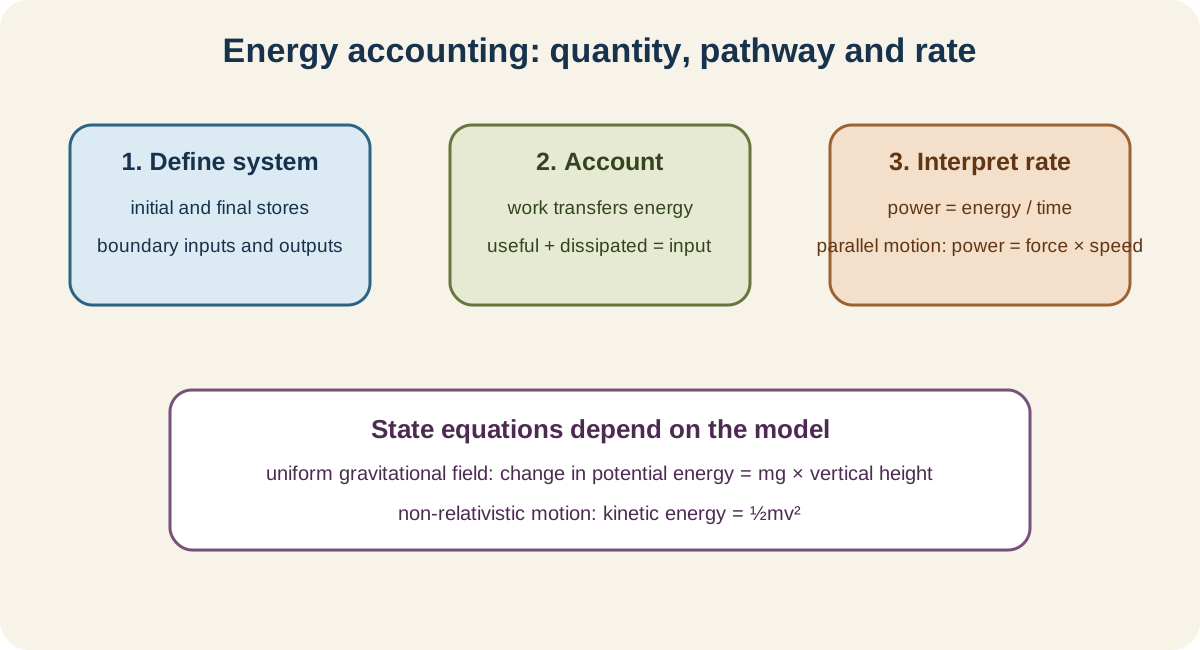
Work, energy and power is Topic 5 of the Cambridge International AS and A Level Physics 9702 AS Level syllabus. Section 5.1 follows energy across transfers, efficiency and transfer rate. Section 5.2 derives and applies the gravitational potential and kinetic energy expressions used in mechanics.
5.1 Energy conservation
Work as an energy transfer
Work is done when a force causes displacement. For a constant force whose component along the displacement is F∥:
W=F∥s.
Check this topic from memory
Attempt the matching topic bank before reopening the notes. Use each missed idea to decide what to review next.
A force perpendicular to displacement does no work on the object. A force opposing displacement does negative work, reducing the object's mechanical energy.
The displacement in the equation is the displacement of the force's point of application in the force direction, not automatically total path length.
For a varying force, work is the area under a force-displacement graph. The explicit integral notation is useful conceptually:
W=∫F∥,ds.
Conservation of energy
Energy cannot be created or destroyed. It is transferred between stores or across the system boundary:
Einitial+Einput=Efinal+Eoutput.
Define the system before accounting. If Earth and a falling object form the system, gravitational potential energy transfers to kinetic energy and thermal stores.
Mechanical energy is the sum of kinetic and relevant potential energies. It is conserved only when no mechanical energy is transferred to other stores by resistance or external work.
Total energy remains conserved even when mechanical energy decreases. Friction transfers energy to internal energy rather than destroying it.
Use an energy pathway or equation that includes every significant input, useful output and dissipative transfer.
Efficiency
Efficiency is the ratio of useful energy output to total energy input:
η=Etotal inputEuseful output.
It can also be calculated from powers:
η=Ptotal inputPuseful output.
Efficiency has no unit and lies between zero and one, or between zero and 100 per cent. State the useful output for the device and context.
An efficient system transfers a greater fraction usefully; it does not necessarily use less total energy for every task or deliver greater power.
If efficiency is given, distinguish input from output before rearranging. Useful output equals efficiency times input.
Power
Power is the rate of doing work or transferring energy:
P=tW=ΔtΔE.
Its SI unit is watt, with 1W=1J⋅s−1.
Power measures transfer rate, not total transferred energy. A low-power device can transfer more energy if it operates for much longer.
Average power uses total work divided by total time. Instantaneous power refers to the rate at one instant.
For a machine lifting at constant speed, useful power is the rate of gain of gravitational potential energy.
Deriving and using P=Fv
For a force parallel to motion,
P=tW=tFs=Fv.
More generally, only the velocity component along the force contributes:
P=F⋅v=Fvcosθ.
At constant velocity, a driving force balances resistance, so P=Fv can relate driving power to resistive force.
At changing speed, distinguish the engine force from the resultant force. Engine power based on driving force is not generally resultant force times speed.
For fixed power, available driving force decreases as speed rises because F=P/v, under the model's assumptions.
5.2 Gravitational potential energy and kinetic energy
Deriving gravitational potential energy change
In a uniform gravitational field, lifting mass m vertically through height Δh at constant speed requires an upward force equal to weight mg.
Work done against gravity is
W=Fs=mgΔh.
This becomes the increase in gravitational potential energy:
ΔEP=mgΔh.
The expression gives a change, so the zero level is arbitrary. Only vertical height difference matters, not path shape or distance travelled.
If height decreases, Δh and ΔEP are negative for an upward-positive convention.
The formula assumes a uniform field. Later A Level gravitational fields use a different potential expression over large distance changes.
Applying gravitational energy
Without resistance, loss of gravitational potential energy equals gain of kinetic energy. With resistance, include work done against resistance or thermal transfer:
mgΔh=ΔEK+Edissipated.
For lifting by a motor, useful output energy can be mgΔh, while electrical input is larger according to efficiency.
On a slope, use vertical height change for gravitational energy even if the force-work calculation uses distance along the slope.
Do not attach gravitational potential energy solely to the object without recognising the object-field system.
Deriving kinetic energy
For constant resultant force along the displacement:
W=Fs=mas.
The equation of motion v2=u2+2as gives
as=2v2−u2.
Therefore,
W=21mv2−21mu2=ΔEK.
This work-energy relation identifies
EK=21mv2.
Kinetic energy is scalar and cannot be negative. Reversing velocity does not change kinetic energy if speed is unchanged.
Momentum and kinetic energy behave differently: momentum is proportional to v and has direction, while kinetic energy is proportional to v2.
Energy methods in mechanics
Energy methods avoid solving explicitly for time and often simplify motion between positions. Start and end states matter, plus transfers across the system boundary.
Use force methods when acceleration, force direction or time evolution is requested. Use energy when speeds, heights and work transfers connect the states.
For a vehicle accelerating against resistance:
Wengine=ΔEK+Wagainst resistance.
For braking, the negative work of the braking force equals the decrease in kinetic energy. Doubling speed makes stopping work four times as large for the same mass.
Keep energy in joules and power in watts; they are not interchangeable.
Worked application: combining efficiency, power and motion
A motor lifts a 75kg load vertically at constant 0.80m⋅s−1. With g=9.81m⋅s−2, useful power is P=Fv=mgv=(75)(9.81)(0.80)=589W. If the motor is 70 per cent efficient, input power is 589/0.70=841W. In 12 s, the height gained is 9.6 m and useful energy is mgΔh=7.06kJ, matching useful power times time. Constant speed means no kinetic-energy change, not zero energy transfer.
Common misconceptions and corrections
Using total force when only its parallel component does work. Resolve along displacement.
Calling work a vector. It is scalar.
Giving work in newtons. Use joules.
Saying a perpendicular force does work because it acts. Its force-direction displacement is zero.
Using path length for every work calculation. Use displacement of the force point in its direction.
Using Fs for a varying force without area analysis. Use force-displacement area.
Saying friction destroys energy. It transfers energy to internal stores.
Calling mechanical energy always conserved. Dissipative transfers can reduce it.
Leaving the system undefined. State what crosses its boundary.
Dividing input by output for efficiency. Useful output is the numerator.
Giving efficiency in joules. It is dimensionless.
Reporting efficiency above 100 per cent. Recheck input and output.
Assuming high efficiency means high power. Fraction and rate are different.
Calling power energy. Power is energy transfer rate.
Using watts for energy. Use joules.
Comparing device energy use without time. Include operating duration.
Using P=Fv when force and velocity are perpendicular. Use the parallel component.
Using resultant force in place of driving force automatically. Identify which power is requested.
Saying constant velocity means zero power. Power can maintain motion against resistance.
Using slope length in mgΔh. Use vertical height.
Treating the gravitational zero level as physically fixed. Only changes matter here.
Using mgΔh across a strongly non-uniform field. Its assumption is uniform g.
Saying gravitational potential energy belongs only to the mass. It is an interaction-system store.
Calling kinetic energy directional. It depends on speed squared.
Giving negative kinetic energy after reversal. Direction does not set its sign.
Assuming equal momenta imply equal kinetic energies. Mass affects the relationship.
Using energy conservation but omitting resistance. Include dissipated transfer.
Setting input energy equal to useful output for an inefficient device. Apply efficiency.
Saying constant speed means no work. It means no kinetic-energy change.
Using power times distance for energy. Multiply power by time.
Assessment guidance
Define the system and label initial, final, input, useful output and dissipative transfers before writing an energy equation. In work questions, resolve the force along displacement and use graph area when force varies. In efficiency questions, identify which quantity is total input before rearranging. Distinguish average from instantaneous power and derive P=Fv from work per time when asked. For gravitational energy, use vertical height and state the uniform-field assumption. For kinetic energy derivations, connect W=Fs, F=ma and the constant-acceleration equation without skipping the identification of work as kinetic-energy change. Check units: joules for work and energy, watts for power, and no unit for efficiency.
Retrieval practice
Calculate work for parallel, angled, opposing and varying forces. Build energy accounts with and without dissipation, then solve efficiency from energy and power data. Derive P=Fv, ΔEP=mgΔh and EK=21mv2 from their stated starting equations. Finally, compare force and energy methods for a lift, a braking vehicle and an object descending a resistive slope.