Cambridge International AS and A Level Physics 6: Deformation of solids
Cambridge International AS and A Level Physics 6: Deformation of solids
Study guide/
Cambridge Physics 9702 AS Level notes on load, extension, Hooke's law, stress, strain, Young modulus, elastic and plastic behaviour, and strain energy.
Deformation of solids is Topic 6 of the Cambridge International AS and A Level Physics 9702 AS Level syllabus. Section 6.1 develops force-extension behaviour into stress, strain and Young modulus. Section 6.2 distinguishes elastic and plastic response and connects force-extension area to stored elastic energy.
6.1 Stress and strain
Tensile and compressive deformation
Deformation is a change in shape or dimensions caused by forces. A tensile force pulls a specimen and usually increases its length. A compressive force pushes and usually shortens it.
The syllabus treats forces and deformation in one dimension. The applied forces should be equal and opposite so the specimen is loaded without a resultant translational force.
Load is the applied force. Original length is measured before loading. Extension is
x=L−L0,
where L0
Check this topic from memory
Attempt the matching topic bank before reopening the notes. Use each missed idea to decide what to review next.
is loaded length. Compression can be expressed as a decrease in length or a signed negative extension if the convention is stated.
Extension is not the same as final length. It has unit metre and depends on both material and specimen geometry.
Force-extension evidence
A force-extension graph describes one specimen. In an initial straight-line region, extension is proportional to applied force.
The limit of proportionality is the point beyond which force and extension cease to be proportional. It is identified by departure from the initial straight line.
The graph gradient, when force is vertical and extension horizontal, is
k=xF,
the spring constant or stiffness of that specimen. Its unit is N⋅m−1.
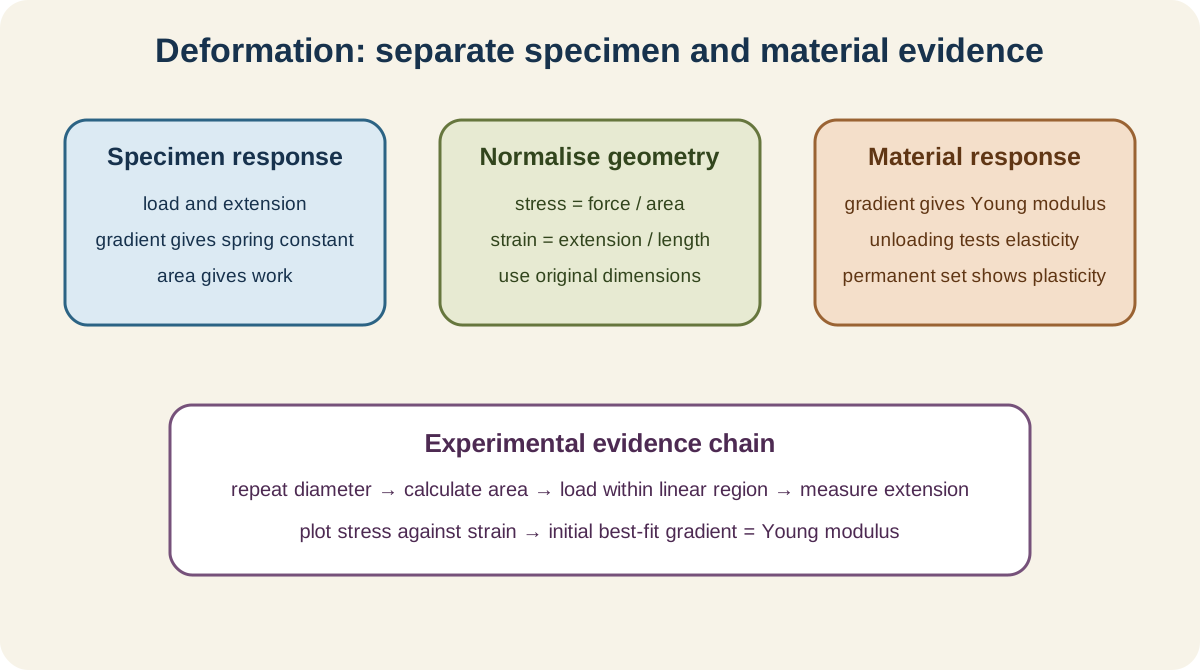
A steeper force-extension gradient means a stiffer specimen. It does not by itself prove that the material has a greater Young modulus because length and cross-sectional area also affect stiffness.
Hooke's law
Hooke's law states that extension is proportional to applied force, provided the limit of proportionality is not exceeded:
F=kx.
The condition is part of the law. Beyond the proportional region, k=F/x is not a single constant that characterises the whole curve.
Hooke's law does not mean the specimen must return to its original length after every load. Return is an elasticity question, and the elastic limit need not coincide exactly with the limit of proportionality.
For springs in series or parallel, analyse the force and extension ownership of each spring rather than applying an unsupported shortcut.
Stress
Tensile stress is force per original cross-sectional area:
σ=AF.
Its SI unit is pascal, Pa=N⋅m−2. Use the area perpendicular to the tensile force and convert squared units carefully.
Stress normalises load for specimen thickness. Two wires carrying the same force have different stress if their areas differ.
At AS Level, use the original cross-sectional area for the defined engineering stress unless a question specifies otherwise.
Stress is not the same as pressure in context, even though both have unit pascal. Stress describes internal loading of the solid specimen.
Strain
Tensile strain is extension divided by original length:
ε=L0x.
Strain is a dimensionless ratio. It may be expressed as a decimal or percentage, but no SI unit should be attached.
Strain normalises extension for specimen length. The same extension represents greater strain in a shorter original specimen.
Use original length, not current length, in the denominator.
Young modulus
Young modulus is tensile stress divided by tensile strain:
E=εσ=AxFL0.
This definition applies in the linear elastic region. Its SI unit is pascal.
Young modulus is a material property under the stated conditions. Spring constant is a specimen property. For a uniform wire:
k=L0EA.
A larger Young modulus means more stress is required to produce the same strain. It does not mean the material is necessarily stronger, tougher or able to sustain a larger breaking stress.
On a stress-strain graph, Young modulus is the gradient of the initial straight-line region.
Experiment to determine Young modulus of a wire
Use a long, thin metal wire securely clamped at one end. Measure its original test length L0 between fixed reference points. Measure diameter at several positions and in perpendicular directions with a micrometer, correct any zero error, find the mean diameter and calculate A=πd2/4.
Add known loads gradually within the proportional region. Force is the added mass times g. Measure extension with a fiducial marker and a fixed scale, travelling microscope or other high-resolution displacement method. Take readings only after oscillations settle.
Record repeat readings and, where safe, unloading readings. Plot stress against strain; the best-fit gradient in the linear region is Young modulus.
Alternatively, plot force against extension. Its gradient k gives E=kL0/A.
A long thin wire makes fractional extension larger and easier to measure. Keep extensions small enough to avoid permanent deformation, use eye protection and ensure falling loads cannot injure anyone.
Diameter uncertainty is important because area depends on d2. Avoid parallax, measure original length between the actual reference points and do not include slack or clamp movement as wire extension.
Detailed apparatus execution, table design, uncertainty propagation and evaluation remain owned by the dedicated Cambridge Physics practical-skills series. This theory note establishes the required experimental relationship and evidence route.
6.2 Elastic and plastic behaviour
Elastic and plastic deformation
Elastic deformation is fully reversed when the deforming force is removed. The specimen returns to its original dimensions.
Plastic deformation is not fully reversed. A permanent extension remains after unloading.
The elastic limit is the greatest load or stress for which the specimen returns to its original dimensions after unloading. It is defined by recoverability, not simply by whether the loading graph is straight.
The limit of proportionality marks loss of F∝x. The elastic limit marks onset of permanent deformation. They are related but conceptually distinct.
Loading and unloading graphs
Within ideal Hookean behaviour, loading and unloading follow the same straight line through the origin.
If plastic deformation occurs, the unloading path reaches zero force at a positive extension, showing permanent set.
If loading and unloading paths differ, the enclosed area represents energy transferred to internal energy rather than recovered mechanically.
Do not infer microscopic mechanisms beyond the evidence requested; describe the shape, intercept and energy meaning.
Work from force-extension area
For a small extension dx, work is F,dx. Therefore, total work done in deforming a specimen is the area under its force-extension graph:
W=∫F,dx.
The axes matter. Area under a stress-strain graph is energy per unit volume, not total energy, unless multiplied by specimen volume.
Within the proportional region, the force-extension graph is a triangle. Elastic potential energy is
EP=21Fx=21kx2.
The force in 21Fx is the final force, not an average added separately. The factor one-half already accounts for force rising linearly from zero.
Outside the proportional region, use the actual graph area. The simple triangular formula no longer applies automatically.
Energy storage and recovery
During elastic loading, work transfers energy into elastic potential energy. During ideal unloading, that energy can be returned.
Plastic deformation transfers some work irreversibly to internal structural changes and thermal energy. The recovered unloading area is smaller than the loading area.
A material can have high stiffness but low elastic energy capacity if it fails or yields at small strain. Stiffness, strength and toughness answer different questions.
When springs or wires store energy, check that the stated deformation remains within the proportional region before using 21kx2.
Worked application: separating specimen stiffness from material modulus
A wire has original length 2.00m, diameter 0.50mm and extends 1.60mm under a 40N load within its proportional region. Its area is A=π(0.50×10⁻³)2/4=1.96⋅10−7m2. Stress is 2.04⋅108Pa, strain is 1.60×10⁻³/2.00=8.0×10−4, and Young modulus is 2.55⋅1011Pa. Its spring constant is only 2.50⋅104N⋅m−1: stiffness describes this wire, while modulus normalises its geometry.
Common misconceptions and corrections
Calling final length extension. Extension is the change from original length.
Treating load as mass. Load here is force.
Saying compression is always positive extension. State the sign convention.
Using Hooke's law beyond the proportional limit. Its condition must hold.
Calling every straight graph elastic forever. Check the range and unloading evidence.
Equating proportional limit with elastic limit by definition. They test different behaviours.
Taking extension-force gradient as spring constant. For that axis order, it is 1/k.
Calling a large extension specimen less stiff without comparing force. Use graph gradient.
Comparing material stiffness from force-extension graphs with different geometry. Use Young modulus.
Using total surface area for tensile stress. Use original cross-sectional area.
Forgetting to square the diameter conversion. Area depends on squared length.
Giving strain in metres. It is dimensionless.
Using current length in strain. Use original length.
Calling Young modulus stress multiplied by strain. It is their ratio.
Giving Young modulus in newtons. Use pascals.
Saying high modulus means high breaking strength. Stiffness and strength differ.
Using one diameter measurement. Sample positions and perpendicular directions.
Ignoring micrometer zero error. Check and correct it.
Including clamp slip as wire extension. Use fixed specimen reference points.
Using a short thick wire without considering resolution. A long thin wire gives greater measurable strain.
Loading beyond the elastic region in the modulus experiment. Keep the response linear and recoverable.
Calling elastic deformation proportional by definition. Elasticity concerns recovery.
Calling plastic deformation a temporary change. It leaves permanent set.
Reading the elastic limit only from initial straightness. Unloading evidence establishes recovery.
Using graph gradient for work. Force-extension area gives work.
Using stress-strain area as total energy. It is energy per unit volume.
Using Fx for linear elastic energy. The triangular area is 21Fx.
Halving the force before also using one-half. The formula already uses the average-force effect.
Using 21kx2 outside proportional behaviour. Use actual graph area.
Saying energy is destroyed during hysteresis. It transfers to internal energy.
Assessment guidance
State whether a question concerns specimen behaviour or a geometry-normalised material property. On force-extension graphs, identify axis order before calculating gradient or area, and distinguish limit of proportionality from elastic limit. For stress and strain, use original cross-sectional area and original length, convert squared diameter units explicitly and attach no unit to strain. In a Young modulus experiment, name the independent load, measured extension, original length and repeated diameter measurements, then give a graph whose gradient leads to modulus. For energy, use force-extension area and apply the triangular formula only inside the proportional region. When evaluating data, separate clamp slip, parallax, diameter uncertainty and permanent deformation by their mechanisms.
Retrieval practice
Define load, extension, compression, proportional limit, elastic limit, stress, strain and Young modulus. Convert between force-extension and stress-strain graphs for two wires of different geometry. Design a Young modulus experiment with a valid gradient relationship and risk control. Finally, calculate work from linear and curved force-extension graphs, identify permanent set from unloading evidence and explain what a hysteresis area represents.