Cambridge International AS and A Level Physics 7: Waves
Cambridge International AS and A Level Physics 7: Waves
Study guide/
Cambridge Physics 9702 AS Level notes on progressive waves, transverse and longitudinal waves, source Doppler effect, the electromagnetic spectrum and polarisation.
Waves is Topic 7 of the Cambridge International AS and A Level Physics 9702 AS Level syllabus. Its official boundary spans sections 7.1 to 7.5: progressive-wave quantities and energy, transverse and longitudinal representations, Doppler shift from a moving sound source, the electromagnetic spectrum and polarisation.
7.1 Progressive waves
Wave motion and transferred energy
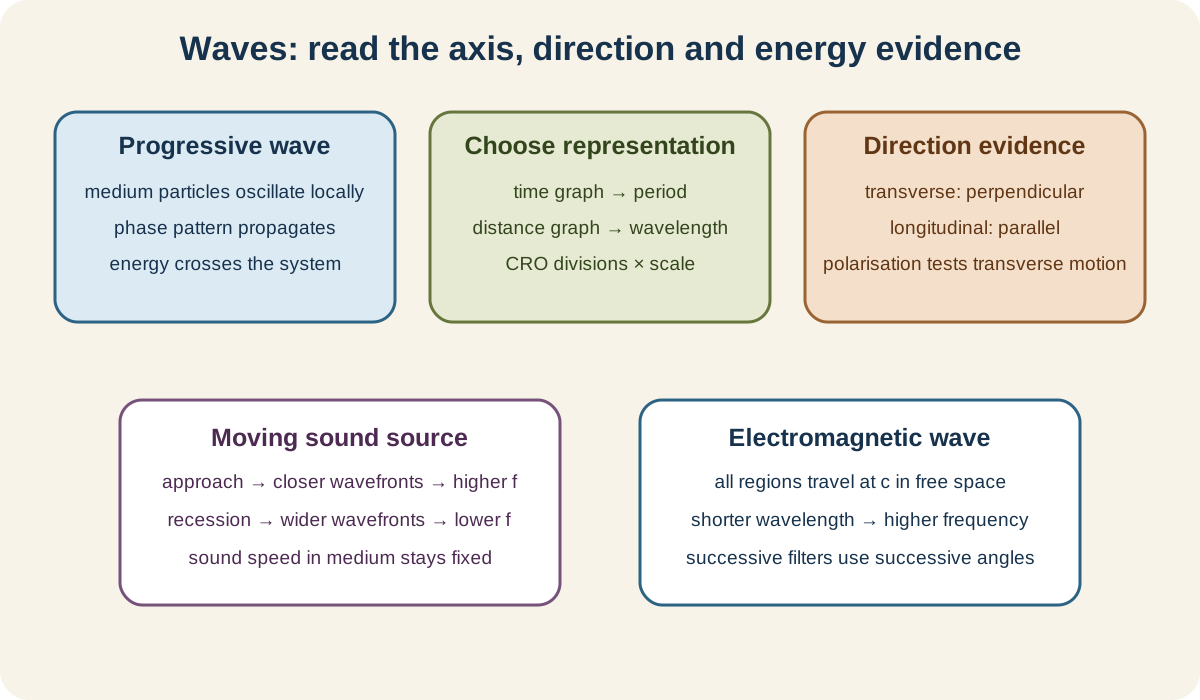
A progressive wave is a travelling disturbance that transfers energy from one place to another without a net transfer of matter over many cycles.
In a rope, particles of the rope oscillate while the disturbance travels along it. In a spring, coils oscillate about equilibrium. In a ripple tank, water particles oscillate while wavefronts propagate across the surface.
The wave pattern travels; an individual medium particle does not travel with the pattern. Its displacement changes about a fixed equilibrium position.
Mechanical waves require a medium. Electromagnetic waves can travel through free space.
Displacement, amplitude and phase
Displacement is the instantaneous distance and direction of an oscillating particle from equilibrium.
Amplitude is the maximum magnitude of displacement. It is non-negative and must not be confused with peak-to-peak displacement, which is twice the amplitude.
Phase identifies a point within a cycle. Phase difference compares two oscillations or two points on a wave:
Δϕ=2πTΔt=2πλΔx
Check this topic from memory
Attempt the matching topic bank before reopening the notes. Use each missed idea to decide what to review next.
in radians when the relevant time or position relationship applies.
Points separated by one wavelength are in phase. Points separated by half a wavelength are in antiphase, with phase difference π radians.
Equal displacement does not always mean equal phase because the particles may be moving in opposite directions.
Period, frequency and wavelength
Period T is time for one complete oscillation. Frequency f is the number of complete oscillations per unit time:
f=T1.
Frequency is measured in hertz and is set by the source. When a wave enters another medium, frequency remains fixed while speed and wavelength can change.
Wavelength λ is the shortest distance between neighbouring points at the same phase. It can be measured crest to crest, compression to compression, or between any matching phase points.
Wave speed is the speed at which a fixed phase point, such as a crest, travels through the medium.
Deriving the wave equation
In one period, a progressive wave travels one wavelength. Therefore:
v=Tλ=fλ.
Use mutually consistent SI units. If wavelength is in metres and frequency in hertz, speed is in metres per second.
The equation does not state that medium particles move at wave speed. It describes propagation of the phase pattern.
For a fixed wave speed, higher frequency means shorter wavelength.
Time and distance graphs
A displacement-time graph shows one particle's oscillation over time. Horizontal separation of matching phase points gives period.
A displacement-distance graph is a snapshot of many particles at one instant. Horizontal separation of matching phase points gives wavelength.
Both graphs can look sinusoidal, but their horizontal axes and physical meanings differ. Do not read wavelength from a time graph or period from a distance graph.
The gradient of a displacement-distance graph is not particle velocity. Particle velocity comes from how one particle's displacement changes with time.
Using a cathode-ray oscilloscope
On a CRO display, y-gain states voltage per vertical division and time-base states time per horizontal division.
Signal amplitude is vertical divisions from the centre line to a peak multiplied by y-gain. Peak-to-peak voltage uses the full vertical separation and must then be halved if amplitude is requested.
Period is horizontal divisions for one complete cycle multiplied by time-base. Frequency is 1/T.
Measure several cycles and divide by their number to reduce fractional reading uncertainty.
Check any probe or gain multiplier and use the trace's centre line rather than the screen edge.
Intensity and amplitude
Intensity is power transmitted per unit area normal to wave propagation:
I=AP.
Its SI unit is W⋅m−2.
For a progressive wave under unchanged medium and frequency conditions:
I∝A2,
where A here denotes wave amplitude, not area. Doubling amplitude makes intensity four times as large.
If power spreads uniformly from a point source, the same power crosses spherical area 4πr2, giving inverse-square intensity when absorption is negligible.
Intensity describes energy transfer rate per area, not displacement size alone.
7.2 Transverse and longitudinal waves
Transverse waves
In a transverse wave, particle displacement is perpendicular to the direction of energy propagation.
Examples include waves on a stretched string and electromagnetic waves. A drawn sine curve can represent transverse displacement directly when its vertical axis is particle displacement.
Crests and troughs describe transverse displacement extremes.
Transverse waves can be polarised because oscillation direction can be restricted within the plane perpendicular to propagation.
Longitudinal waves
In a longitudinal wave, particle displacement is parallel to the direction of energy propagation.
Sound in air and compression waves along a spring are longitudinal. They consist of compressions, where particles or pressure are closer or higher, and rarefactions, where they are farther apart or pressure is lower.
A sinusoidal graph of a longitudinal wave usually plots displacement, pressure or density against distance. It is not a picture of the particles moving in a transverse path.
For a displacement-distance representation, pressure maxima occur near positions where displacement changes most rapidly in the compressive sense. Pressure and particle displacement are not generally in phase.
Interpreting representations
Always read axis labels before naming amplitude, phase or wavelength.
Arrows showing particle motion must be compared with the propagation arrow. Perpendicular arrows indicate transverse motion; parallel arrows indicate longitudinal motion.
For a particle-displacement snapshot, points at the same vertical coordinate may have different phase or motion direction.
One wavelength separates adjacent identical states, such as compression centre to compression centre.
7.3 Doppler effect for sound waves
Moving source and stationary observer
The syllabus model concerns a sound source moving relative to a stationary observer. The moving source changes the spacing of successive wavefronts in the stationary medium.
In front of an approaching source, wavefronts are closer, wavelength is smaller and observed frequency is higher. Behind a receding source, wavefronts are farther apart and observed frequency is lower.
The sound speed relative to the stationary medium remains v. The source does not make sound travel faster in front.
The stationary-source, moving-observer formula is outside this stated boundary.
Source Doppler equation
For source frequency fs, sound speed v and source speed vs:
fo=fsv∓vsv.
Use v−vs for approach, giving a higher observed frequency. Use v+vs for recession, giving a lower observed frequency.
The model assumes source speed is less than sound speed and source motion is along the line joining source and observer.
Choose the sign by checking the physical result, not by memorising a symbol alone.
7.4 Electromagnetic spectrum
Shared electromagnetic properties
All electromagnetic waves are transverse and travel at the same speed c in free space:
c≈3.00⋅108m⋅s−1.
They differ by frequency and wavelength, linked by c=fλ. Higher frequency means shorter free-space wavelength.
All can travel through vacuum. Their speed can be lower in material media.
Approximate wavelength regions
Region boundaries are approximate and can overlap by convention. Useful free-space orders are:
radio waves: longer than about 1m
microwaves: about 1m to 1mm
infrared: about 1mm to 700nm
visible light: about 700nm to 400nm
ultraviolet: about 400nm to 10nm
X-rays: about 10nm to 0.01nm
gamma rays: shorter than about 0.01nm
The required visible range is approximately 400 to 700 nm in free space. Violet lies near the shorter-wavelength end and red near the longer-wavelength end.
Memorise the region order and approximate powers of ten rather than treating boundaries as exact physical discontinuities.
7.5 Polarisation
Evidence for transverse waves
Polarisation restricts transverse oscillations to one direction. A longitudinal wave cannot be plane-polarised in this way because its oscillation is already parallel to propagation.
Unpolarised electromagnetic radiation contains transverse electric-field oscillations in many directions perpendicular to travel. A polariser transmits one axis.
An analyser tests the plane of polarisation. Parallel transmission axes give maximum intensity; crossed axes give zero in the ideal model.
Polarisation therefore provides evidence that electromagnetic waves are transverse.
Malus's law
For plane-polarised incident intensity I0 and angle θ between the incident polarisation direction and the filter transmission axis:
I=I0cos2θ.
At 0∘, all incident plane-polarised intensity is transmitted ideally. At 90∘, none is.
For a series of polarisers, apply Malus's law sequentially. After each filter, the transmitted wave is polarised along that filter's axis, so the next angle is measured between successive axes.
The calculation of intensity loss when an unpolarised wave first meets a polariser is explicitly outside the syllabus requirement. Problems using Malus's law should supply or establish a plane-polarised incident intensity.
Worked application: combining source motion and polarisation
A stationary observer hears a 900Hz source approach at 20m⋅s−1 while sound speed is 340m⋅s−1. The observed frequency is 900(340)/(340−20)=956Hz, higher as required physically. Separately, plane-polarised light of intensity 80W⋅m−2 passes through filters whose axes are 30 degrees and then 70 degrees from the initial direction. First intensity is 80cos230∘=60W⋅m−2. The second angle is 40∘, so final intensity is 60cos240∘=35.2W⋅m−2.
Common misconceptions and corrections
Saying particles travel with a progressive wave. They oscillate about equilibrium.
Calling amplitude peak-to-peak displacement. Amplitude is half that value.
Using equal displacement as proof of equal phase. Motion direction also matters.
Reading wavelength from a displacement-time graph. Its horizontal repeat gives period.
Reading period from a displacement-distance graph. Its horizontal repeat gives wavelength.
Saying frequency changes when a wave enters a new medium. Source frequency remains.
Calling wave speed particle speed. They describe different motion.
Using inconsistent units in v=fλ. Convert first.
Reading CRO amplitude from full peak-to-peak height. Halve when amplitude is requested.
Ignoring time-base or y-gain multipliers. Apply scale per division.
Calling intensity total power. It is power per normal area.
Saying intensity is proportional to amplitude. It follows amplitude squared.
Using the same symbol meaning for wave amplitude and area without context. Identify each quantity.
Drawing a longitudinal wave as particles following a sine path. The graph represents a field quantity.
Calling compressions crests. Use longitudinal terminology.
Saying sound in air is transverse. Particle motion is parallel to propagation.
Saying transverse waves must be electromagnetic. Strings also support them.
Claiming sound speed rises in front of a moving source. Wavefront spacing changes.
Using the moving-observer formula. The stated boundary is a moving source.
Choosing the Doppler sign without checking direction. Approach must raise frequency.
Using the source formula when vs≥v. Its ordinary wavefront model no longer applies.
Saying electromagnetic waves have different free-space speeds. They share c.
Putting gamma rays at the long-wavelength end. They are shortest.
Treating spectrum boundaries as exact. They are approximate regions.
Reversing red and violet wavelengths. Red is longer.
Saying polarisation proves a wave is longitudinal. It is associated with transverse waves.
Measuring analyser angle from a fixed original axis every time. Use successive polarisation axes.
Using cosθ instead of cos2θ. Malus's law concerns intensity.
Applying Malus's law directly to unspecified unpolarised intensity. That first-filter calculation is excluded.
Saying crossed filters always transmit some ideal intensity. Two ideal crossed axes give zero.
Assuming a third intermediate polariser cannot change transmission. Sequential projections can produce non-zero output.
Giving phase difference without radians, degrees or cycle fraction. State the measure.
Assessment guidance
Identify whether a graph varies with time at one point or distance at one instant before measuring period, wavelength or phase. On CRO questions, count divisions across several cycles and apply time-base and y-gain explicitly. In intensity questions, separate total power, area and wave amplitude, then square amplitude ratios. For longitudinal representations, use the plotted quantity rather than treating every sinusoid as a transverse shape. In Doppler problems, state that the observer is stationary, choose the denominator sign from approach or recession and check whether the frequency moves in the expected direction. For the electromagnetic spectrum, give approximate free-space ranges. Apply Malus's law successively and reset the polarisation direction after each filter.
Retrieval practice
Define every progressive-wave quantity and derive v=fλ. Distinguish time and distance graphs, calculate CRO amplitude and frequency, and apply intensity ratios. Compare transverse and longitudinal representations. Solve approaching and receding moving-source Doppler cases, reconstruct the electromagnetic spectrum with approximate wavelength boundaries, then calculate transmission through two- and three-filter polariser sequences using successive axis differences.