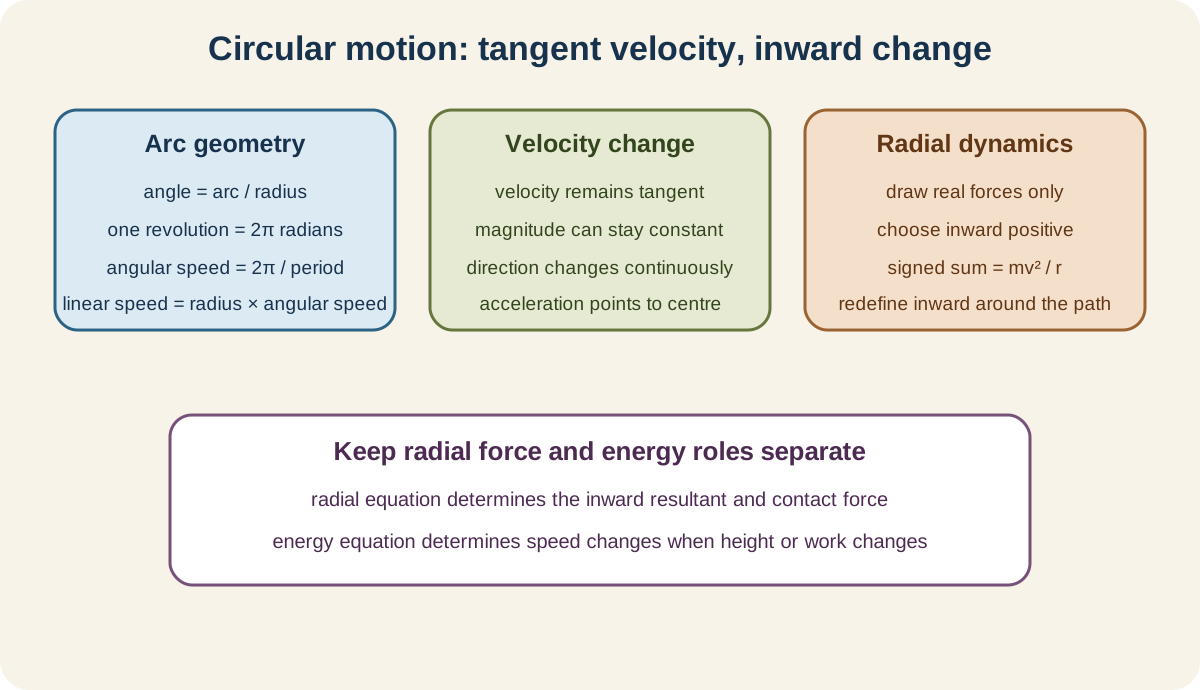
Motion in a circle is Topic 12 of the Cambridge International AS and A Level Physics 9702 additional A Level content. Section 12.1 connects radian angle, angular speed and tangential speed. Section 12.2 explains why a velocity of constant magnitude still requires inward acceleration and resultant force.
12.1 Kinematics of uniform circular motion
The radian
One radian is the angle subtended at the centre of a circle by an arc equal in length to the radius.
For arc length s, radius r and angular displacement θ:
θ=rs.
Check this topic from memory
Attempt the matching topic bank before reopening the notes. Use each missed idea to decide what to review next.
This equation requires θ in radians. Angle is dimensionless because it is a ratio of two lengths, although rad is retained as a helpful label.
A full revolution has arc length 2πr, so it contains 2π radians:
360∘=2πrad.
Convert degrees to radians with θrad=θdegπ/180.
Do not use degree values directly in formulas derived from s=rθ.
Angular speed
Angular speed is rate of change of angular displacement:
ω=ΔtΔθ.
Its unit is radians per second. In uniform circular motion, ω is constant.
Period T is time for one revolution. Since angular displacement per revolution is 2π:
ω=T2π.
Frequency f=1/T, so ω=2πf.
Every point on one rigidly rotating body has the same angular speed, but points at larger radius have greater linear speed.
Angular speed is a scalar magnitude in this syllabus context. If rotation sense is needed, state clockwise or anticlockwise separately.
Tangential speed
Differentiate or divide s=rθ by time for fixed radius:
v=rω.
The instantaneous velocity is tangential to the circular path and perpendicular to the radius.
In uniform circular motion, speed is constant but velocity changes continuously because its direction changes.
For one revolution, distance 2πr divided by period gives
v=T2πr,
consistent with v=rω.
The centre of rotation has r=0 and therefore zero linear speed even though the rotating body has non-zero angular speed.
Vector change in velocity
At two nearby points on a circle, the velocity vectors have equal magnitude but different directions.
Subtract the initial velocity vector from the final velocity vector. For a small angular change Δθ, the velocity-vector triangle is similar to the position-vector triangle:
v∣Δv∣≈Δθ.
The change in velocity points approximately toward the centre as the interval becomes small. This establishes the inward acceleration direction.
Do not infer zero acceleration from constant speed; acceleration depends on velocity change.
12.2 Centripetal acceleration
Inward acceleration
Centripetal acceleration is directed radially inward, perpendicular to instantaneous velocity.
Because it is perpendicular to velocity in uniform circular motion, it changes velocity direction without changing speed.
Its magnitude is
a=rω2=rv2.
Using v=rω shows the two forms are equivalent.
For fixed speed, smaller radius requires greater acceleration. For fixed radius, doubling speed makes acceleration four times as large.
The word centripetal describes direction toward the centre, not a new kind of interaction.
Resultant centripetal force
Newton's second law gives the required inward resultant force:
Fresultant=mrω2=rmv2.
This is not an additional force to draw beside tension, friction, gravity or normal contact. Those real forces combine to provide the inward resultant.
Begin every problem with a free-body diagram. Choose inward as positive and write
∑Finward=rmv2.
An outward sensation in a turning vehicle reflects the body's inertia in a rotating frame. In an inertial-frame force diagram, no outward force is needed unless a real interaction acts outward.
Horizontal circles
For an object on a horizontal turntable, static friction may supply centripetal force:
Ffriction=rmv2.
If required force exceeds available friction, the object cannot follow the circle and moves away from the intended path tangentially at the instant contact control is lost.
For a conical pendulum, horizontal tension component provides centripetal force while vertical tension component balances weight:
Tsinθ=rmv2,Tcosθ=mg
when θ is measured from the vertical.
Resolve forces according to the stated angle rather than memorising sine and cosine positions.
Vertical circles
In a vertical circle, speed and force contributions may vary with position because gravitational potential energy changes.
At the bottom, both tension or normal force and weight must be signed relative to inward, which is upward:
T−mg=rmv2.
At the top, inward is downward, so for a string:
T+mg=rmv2.
Do not use the same unsigned force equation at top and bottom.
For a string to remain taut, tension cannot be negative. At the minimum-speed limiting case at the top, T=0, so gravity alone provides the required centripetal force.
Work and energy in uniform circular motion
The inward resultant is perpendicular to instantaneous displacement, so it does no work in ideal uniform circular motion.
It changes direction of momentum but not kinetic energy. A separate tangential force is required to change speed.
In a non-uniform vertical circle, gravity can have a tangential component and transfer energy, so speed changes even though the radial component still determines centripetal acceleration.
Separate radial force equations from energy equations. They answer different parts of the motion.
Circular motion is not force balance
An inward resultant is non-zero. The object is accelerating even if radius and speed are constant.
Equal outward and inward forces would give zero resultant and therefore no centripetal acceleration in an inertial frame.
At each instant, the object tends to continue along its tangent if the inward interaction is removed.
A circular path therefore provides direct evidence that some inward resultant acts.
Worked application: force ownership at the top and bottom
A 0.50kg mass moves in a vertical circle of radius 0.80m. At the bottom its speed is 6.0m⋅s−1. Inward is upward, so T−mg=mv2/r. Hence T=0.50(6.02/0.80)+0.50(9.81)=27.4N. At the top with speed 4.0m⋅s−1, inward is downward and T+mg=mv2/r, giving T=5.10N. The centripetal force is the resultant, not an extra force added to tension and weight.
Common misconceptions and corrections
Defining one radian as one full turn. A full turn is 2π radians.
Using degrees in s=rθ. Convert to radians.
Giving radians physical dimensions. Angle is a length ratio.
Calling angular speed linear speed. They differ by radius.
Saying every point on a rotating disc has the same linear speed. They share angular speed.
Using ω=2πT. Divide by period.
Using frequency where period belongs without inversion.f=1/T.
Drawing velocity radially inward. Velocity is tangent.
Saying constant speed means constant velocity. Direction changes.
Saying constant speed means zero acceleration. Centripetal acceleration is non-zero.
Drawing centripetal acceleration tangentially. It points inward.
Using a=v2r. Radius is in the denominator.
Saying larger radius always means larger acceleration. State what is held constant.
Adding centripetal force as a separate arrow. It is the inward resultant.
Calling centripetal force a new interaction. Identify tension, friction, gravity or contact.
Drawing an outward force to balance the inward force. That would remove acceleration.
Saying an object released from a circle moves radially outward. It initially follows the tangent.
Using mass in the centripetal acceleration formula. Mass enters force, not acceleration.
Ignoring vertical force balance in a conical pendulum. The vertical component balances weight.
Swapping sine and cosine without checking the angle reference. Resolve from the diagram.
Writing friction equals weight on a horizontal turn. Friction supplies radial acceleration.
Using the same inward direction everywhere on a vertical circle. It rotates with position.
Subtracting weight at the top automatically. Both tension and weight can point inward there.
Adding weight at the bottom automatically. Weight points outward relative to upward inward direction.
Allowing negative string tension. The string would go slack.
Setting tension to zero at every top point. That is only a limiting case.
Saying inward force increases kinetic energy. It is perpendicular in uniform motion.
Using radial force equations alone to find changing speed in a vertical circle. Include energy.
Using energy conservation to find the radial resultant without a force equation. Both may be needed.
Calling circular motion equilibrium. It has a non-zero resultant.
Assessment guidance
Convert angles to radians before using arc or angular-motion formulas. Draw radius, tangential velocity and inward acceleration as mutually defined directions. Select ω=2π/T, v=rω and the appropriate acceleration form from known quantities, then check proportional changes. In dynamics questions, draw only real forces and write their signed inward resultant equal to mv2/r. Re-define inward at every position in a vertical circle and use a separate energy equation when speed changes with height. If a calculated tension or contact force is negative, interpret loss of contact rather than accepting an impossible pulling or pushing direction.
Retrieval practice
Derive the radian from arc length and convert between degrees, radians, period, frequency, angular speed and tangential speed. Use velocity-vector triangles to explain inward acceleration. Solve horizontal turntable and conical-pendulum problems with free-body diagrams, then analyse top, side and bottom positions in a vertical circle using separate radial and energy equations. For each case, name the real interaction supplying the centripetal resultant.