Cambridge International AS and A Level Physics 13: Gravitational fields
Cambridge International AS and A Level Physics 13: Gravitational fields
Study guide/
Cambridge Physics 9702 A Level notes on gravitational fields, Newtonian force, circular and geostationary orbits, field strength, potential and potential energy.
Gravitational fields is Topic 13 of the Cambridge International AS and A Level Physics 9702 additional A Level content. Sections 13.1 to 13.4 connect force per unit mass, Newton's inverse-square law, satellite motion, field strength, potential and potential energy. Escape speed is not an explicit outcome in this syllabus boundary.
13.1 Gravitational field
A field of force
A gravitational field is a region in which a mass experiences a gravitational force. It is an example of a field of force because interaction can be described at every point without requiring the test mass to be present first.
Gravitational field strength at a point is gravitational force per unit mass on a small test mass placed at that point:
g=mF.
Its unit is N⋅kg−1
Check this topic from memory
Attempt the matching topic bank before reopening the notes. Use each missed idea to decide what to review next.
. Field strength is a vector. Its direction is the direction of force on a positive test mass, which is toward the attracting source mass.
The test mass must be small enough not to alter the source distribution significantly. Dividing by test mass removes the chosen probe from the field description.
Near Earth's surface, g commonly denotes both gravitational field strength and free-fall acceleration. The meanings agree when gravity is the only force, but one is a property of the field and the other describes an object's motion.
Field-line representation
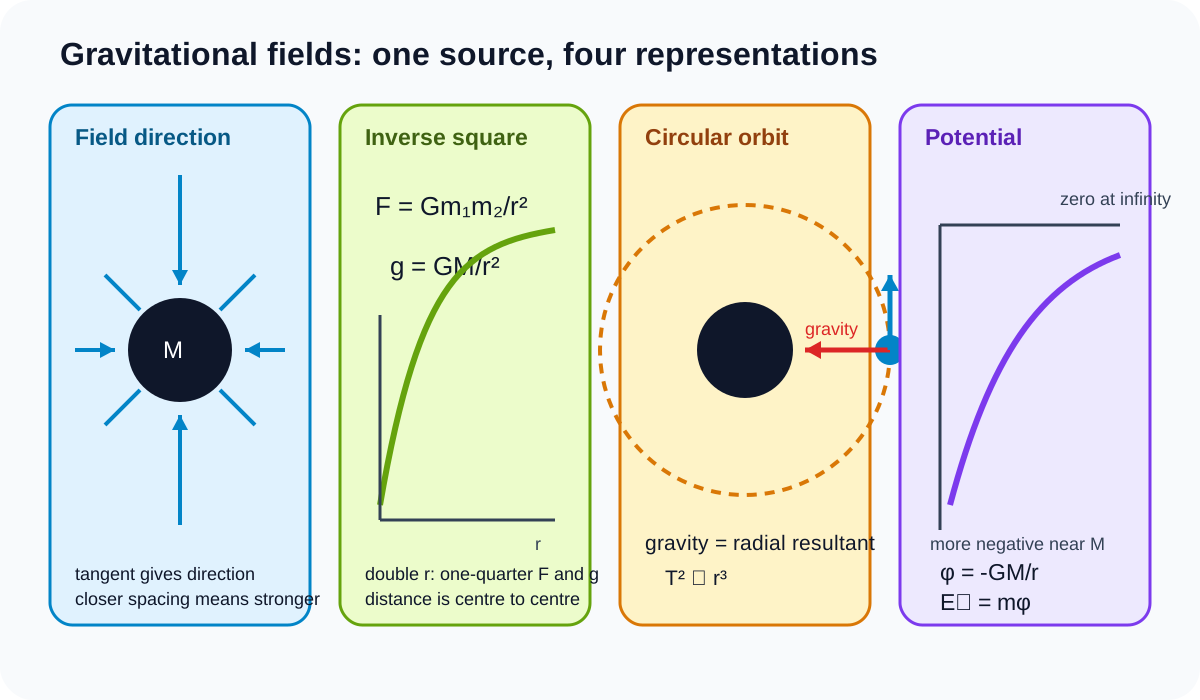
Gravitational field lines show the direction of field strength through their tangent. Arrows point toward an isolated spherical mass because gravity is attractive.
Closer line spacing represents greater field strength. Lines do not cross because a field at one point cannot have two directions.
For an isolated spherical mass, lines are radial and become more widely spaced with distance. Over a small region close to Earth's surface, nearly parallel, equally spaced downward lines model an approximately uniform field.
Field lines are a representation, not physical threads or object trajectories. A moving mass can cross field lines if its velocity is not parallel to the field.
Superposed fields add as vectors. Between two source masses, the resultant direction depends on both individual fields; it is not necessarily toward the nearer source if the masses differ.
13.2 Gravitational force between point masses
Point-mass and uniform-sphere models
A point mass has all its mass treated as concentrated at one position. For a point outside a uniform sphere, the sphere's gravitational effect is the same as if all its mass were concentrated at its centre.
Therefore, distance r in the gravitational formulas is measured centre to centre, not from a sphere's surface. The result applies outside a uniform sphere. It must not be extended unchanged inside the material.
An orbiting satellite can normally be treated as a point mass when its size is negligible compared with orbital radius.
Newton's law of gravitation
The magnitude of force between two point masses is
F=r2Gm1m2,
where G is the gravitational constant and r is their separation. The forces on the two masses are equal in magnitude and opposite in direction, in accordance with Newton's third law.
The law is inverse square. Doubling separation reduces force to one quarter; tripling it reduces force to one ninth. Doubling either mass doubles force.
Do not confuse G, a universal constant, with g, a field strength that varies with position and source mass.
Circular gravitational orbits
For a satellite of mass m in a circular orbit of radius r around a much larger mass M, gravity supplies the entire centripetal resultant:
r2GMm=rmv2.
The satellite mass cancels, giving
v=rGM.
This means a larger circular orbit has a lower orbital speed. The result assumes a circular orbit dominated by the central mass.
Using v=2πr/T gives
T2=GM4π2r3.
Thus T2 is proportional to r3 for circular orbits about the same central mass. Orbital radius is measured from the central mass's centre, so altitude alone cannot replace r.
An orbiting satellite is continuously falling toward the central body while its tangential motion makes it keep missing the surface. There is no need to add a separate centripetal force to gravity.
Geostationary orbit
A geostationary satellite remains above the same point on Earth's surface. Four conditions work together:
its orbit is circular;
it lies directly above the Equator;
it travels from west to east, matching Earth's rotation;
its orbital period is 24 hours.
A polar satellite may have a 24-hour period but is not geostationary. A satellite above the Equator with the wrong direction or period also drifts relative to the ground.
The orbital radius associated with the required period follows from the circular-orbit relationship. The satellite does not hover because thrust balances gravity; gravity supplies its centripetal acceleration.
13.3 Gravitational field of a point mass
Deriving field strength
Place a small test mass m at distance r from source mass M. Newton's law gives
F=r2GMm.
Divide by test mass using g=F/m:
g=r2GM.
The magnitude is positive in this scalar form; the field vector points toward M. The test mass cancels because field strength characterises the source and location.
A graph of g against r outside a sphere falls non-linearly toward zero. A graph of g against 1/r2 is a straight line through the origin with gradient GM, within the point-mass model.
Why near-Earth g is approximately constant
At Earth's surface radius R, field strength is GM/R2. At small height h, it is GM/(R+h)2.
When h≪R, the fractional change in radius is small, so the fractional change in g is also small. This justifies an approximately uniform field and the earlier ΔEP=mgΔh result over modest height changes.
Approximately constant does not mean exactly constant. At changes in height comparable with planetary radius, use the inverse-square expression.
13.4 Gravitational potential
Definition and zero reference
Gravitational potential ϕ at a point is the work done per unit mass in bringing a small test mass from infinity to that point.
For a point mass,
ϕ=−rGM.
Its unit is J⋅kg−1. Potential is a scalar, so contributions from several masses add algebraically rather than as vectors.
The conventional zero is at infinity. Since gravity attracts, the field does positive work as a test mass moves inward. An external agent moving it inward quasistatically does negative work, so potential closer to the source is negative.
Potential approaches zero from below as distance tends to infinity. A more negative value is lower potential, not larger potential.
Potential difference and field direction
Moving a mass from initial point A to final point B changes potential by
Δϕ=ϕB−ϕA.
The corresponding potential-energy change is mass multiplied by potential change. A released mass accelerates toward lower gravitational potential.
Field strength relates to the spatial gradient of potential. In one radial dimension, g=−dϕ/dr. The negative sign indicates that field points in the direction of decreasing potential. The syllabus requires use of the potential formula, so this gradient statement is best used as interpretation rather than as an assumed starting rule unless a question supplies it.
Potential graphs and field-strength graphs therefore have different shapes and units. Potential varies as −1/r, while field-strength magnitude varies as 1/r2.
Gravitational potential energy
For masses M and m separated by r, potential energy is
EP=mϕ=−rGMm.
This is energy of the two-mass system, not energy stored in either mass alone. Its zero is also at infinite separation.
For a move from r1 to r2:
ΔEP=GMm(r11−r21).
Moving outward increases potential energy toward zero; moving inward decreases it and can increase kinetic energy if mechanical energy is conserved.
Near Earth's surface, substituting a small height change into the inverse-distance relationship leads approximately to ΔEP=mgΔh. The uniform-field formula is therefore a local approximation, while −GMm/r covers large radial changes outside the sphere.
Worked application: orbit and potential from one radius
A satellite circles Earth at radius r=7.0⋅106m, with GM=3.99⋅1014m3⋅s−2. Equating gravity to the centripetal resultant gives v=GM/r=7.55⋅103m⋅s−1. Its period is T=2πr/v=5.83⋅103s, not 24 hours, so it is not geostationary. The field strength is g=GM/r2=8.14N⋅kg−1, whereas potential is ϕ=−GM/r=−5.70⋅107J⋅kg−1. The different powers of r show why field and potential must not be interchanged.
Common misconceptions and corrections
Defining a field as force rather than force per unit mass. Divide the test force by test mass.
Treating field strength as scalar. It has direction.
Drawing gravitational field arrows away from a mass. Gravity is attractive.
Saying field lines are particle paths. They show field direction.
Allowing field lines to cross. A point has one resultant field direction.
Using line length to show field strength. Use line density.
Measuring r from a planet's surface. Measure centre to centre.
Using the external uniform-sphere model inside the sphere. Its stated boundary is outside.
Using Newton's law with radius rather than separation. Identify the two mass centres.
Confusing G with g. One is universal; one depends on field position.
Saying gravitational forces on two masses differ because their masses differ. The third-law pair is equal and opposite.
Adding a centripetal-force arrow beside gravity. Gravity is the radial resultant.
Keeping orbital speed constant when radius changes. For circular orbits, v∝r−1/2.
Using altitude as orbital radius. Add planetary radius.
Leaving satellite mass in the final circular-orbit speed. It cancels.
Saying an orbit has zero acceleration. Velocity direction changes continuously.
Calling every 24-hour satellite geostationary. Equatorial plane, direction and circularity also matter.
Putting a geostationary satellite above any latitude. It must be above the Equator.
Giving a westward geostationary orbit. It travels west to east.
Deriving g without dividing by test mass. Use the definition explicitly.
Saying g is exactly constant near Earth. It is an approximation for small height changes.
Using mgΔh for planetary-scale moves. Use potential energy from −GMm/r.
Defining potential as work rather than work per unit mass. Potential has unit joules per kilogram.
Defining potential from the point to infinity. The official definition brings unit mass from infinity to the point.
Omitting the negative sign in ϕ=−GM/r. Infinity is the zero reference.
Saying negative potential means no energy. It indicates a bound reference below zero.
Treating potential as a vector. Add potentials algebraically.
Using 1/r2 for potential. Potential varies as −1/r.
Using 1/r for field strength. Field magnitude varies as 1/r2.
Calling EP a property of one mass alone. It belongs to the interacting system.
Saying outward motion lowers gravitational potential energy. It raises it toward zero.
Assessment guidance
State definitions with their divisor and reference: field strength is force per unit mass, while potential is work done per unit mass from infinity. Mark vectors and scalars correctly. For spherical sources, convert altitude to centre-to-centre radius before substituting. In orbit questions, identify gravity as the centripetal resultant and cancel satellite mass only after writing both sides. Test every geostationary condition rather than relying on period alone. Keep g=GM/r2, ϕ=−GM/r and EP=−GMm/r distinct through units, sign and radial power. For energy changes, calculate final minus initial and interpret whether the system moves toward or away from zero.
Retrieval practice
Define field strength and potential exactly, then sketch radial field lines and matched graphs of g and ϕ against radius. Derive g=GM/r2 and the circular-orbit period relation from Newton's law. Explain all four geostationary conditions. Calculate force, field, potential and potential energy at one radius, then compare small near-surface changes with planetary-scale changes.