Cambridge International AS and A Level Physics 14: Temperature
Cambridge International AS and A Level Physics 14: Temperature
Study guide/
Cambridge Physics 9702 A Level notes on thermal equilibrium, thermometric properties, kelvin temperature, specific heat capacity and specific latent heat.
Temperature is Topic 14 of the Cambridge International AS and A Level Physics 9702 additional A Level content. Sections 14.1 to 14.3 connect the direction of thermal-energy transfer to temperature measurement, the thermodynamic scale, sensible heating and phase changes.
14.1 Thermal equilibrium
Temperature and transfer direction
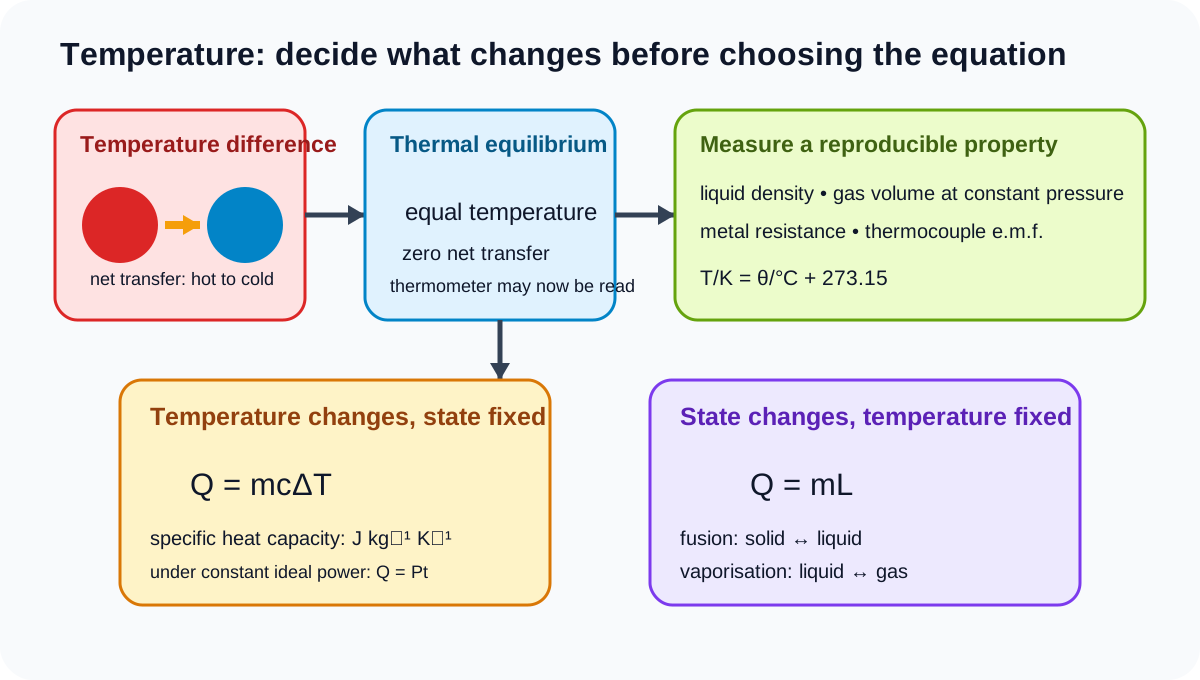
Thermal energy transfers spontaneously from a region of higher temperature to a region of lower temperature. Temperature determines the direction of net transfer, not the total thermal energy stored in an object.
A large cool object can contain more internal energy than a small hot object, yet when the two are in thermal contact, the net transfer direction is still from the hotter object to the cooler one.
Transfer can occur by conduction, convection or radiation, but Topic 14 focuses on the temperature condition rather than detailed transfer mechanisms.
When two regions have equal temperature, there is no net thermal-energy transfer between them. They are in thermal equilibrium.
Microscopic energy exchanges can continue in equilibrium; equal transfer rates in opposite directions produce zero net transfer. Equilibrium therefore does not mean particles stop moving.
Reaching equilibrium
Place a thermometer in thermal contact with an object. Energy transfers between them until thermometer and object have equal temperature. Only then should the thermometer reading represent the object's temperature.
A useful thermometer should have a small thermal capacity so it changes temperature quickly, sufficient contact with the object, and a response that does not significantly alter the object's temperature.
If object A is separately in thermal equilibrium with object C, and object B is also in thermal equilibrium with C under equivalent conditions, A and B have the same temperature. This comparison makes temperature a measurable state property.
Temperature equality is transitive, but thermal energy content is not. Equal-temperature objects need not contain equal internal energy.
14.2 Temperature scales
Thermometric properties
A thermometric property is a physical property that changes with temperature and can therefore indicate temperature after calibration.
The official examples are:
density of a liquid;
volume of a gas at constant pressure;
resistance of a metal;
e.m.f. of a thermocouple.
The property must change reproducibly and measurably. A calibration assigns temperatures to property values using defined reference points or comparison with a standard.
Check this topic from memory
Attempt the matching topic bank before reopening the notes. Use each missed idea to decide what to review next.
For a property X that is assumed to vary linearly between two calibration points, interpolation has the form
θ=θ1+X2−X1X−X1(θ2−θ1).
This is a calibration model, not proof that the property is linear at all temperatures. Different thermometric properties may give slightly different intermediate readings if their response is not perfectly linear.
Liquid density can change because the liquid expands. Gas volume at constant pressure increases with temperature. A metal's resistance generally increases with temperature. Thermocouple e.m.f. depends on the temperature difference between its junctions, so the reference junction matters.
Thermodynamic temperature
The thermodynamic temperature scale does not depend on the property of any particular substance. It provides a universal temperature scale rather than inheriting irregularities from one liquid, gas, metal or thermocouple.
Thermodynamic temperature is measured in kelvin, symbol K. The kelvin is not written with a degree sign.
Convert between thermodynamic temperature T and Celsius temperature theta using
T=θ+273.15.
In numerical practice, this means add 273.15 to a Celsius value to obtain kelvin, and subtract 273.15 from a kelvin value to obtain degrees Celsius.
A temperature interval has the same numerical size in kelvin and Celsius. A change of 15 K is a change of 15 degrees Celsius. The zero points differ, not the step size.
Ratios such as one temperature being twice another are physically meaningful only on an absolute scale. For example, 600 K is twice 300 K, but 20 degrees Celsius is not twice 10 degrees Celsius in a thermodynamic sense.
Absolute zero
The lowest possible temperature on the thermodynamic scale is zero kelvin, known as absolute zero.
Zero kelvin corresponds to minus 273.15 degrees Celsius. Temperatures below zero degrees Celsius are common; temperatures below zero kelvin are outside this syllabus model.
Absolute zero is not the point at which all statements about microscopic motion can be replaced by a simple claim that every particle is completely stationary. The syllabus requirement is the thermodynamic lower limit and its name.
14.3 Specific heat capacity and specific latent heat
Specific heat capacity
Specific heat capacity c is the thermal energy required per unit mass to raise the temperature of a substance by one kelvin, without a change of state.
c=mΔTQ,
or
Q=mcΔT.
Its unit is joules per kilogram per kelvin. Since Celsius and kelvin intervals have the same numerical size, a temperature change may be calculated from either scale. An absolute temperature used in an ideal-gas relationship must still be in kelvin.
Specific heat capacity is a material property. Heat capacity C belongs to a particular sample and equals mc. Doubling sample mass doubles heat capacity but does not change the material's specific heat capacity.
When a heater of constant power P supplies energy for time t, ideal transferred energy is
Q=Pt.
Combining relationships gives Pt = mc delta T if all supplied electrical energy becomes internal energy of the chosen sample. In a real experiment, the container, heater and surroundings also receive energy. Ignoring these routes often makes a calculated specific heat capacity too large because the full electrical input is wrongly assigned to the sample.
On a temperature-time graph under constant power and negligible losses, gradient is P divided by mc. A shallower gradient can indicate larger mass, larger specific heat capacity or additional energy losses. State what is controlled before interpreting it.
Specific latent heat
Specific latent heat L is the thermal energy required per unit mass to change the state of a substance without changing its temperature.
L=mQ,
or
Q=mL.
Its unit is joules per kilogram.
Specific latent heat of fusion is associated with solid-liquid change. Specific latent heat of vaporisation is associated with liquid-gas change. They are different material properties and must not be interchanged.
During melting or boiling at constant pressure for a pure substance, supplied energy changes particle arrangement and potential energy rather than raising temperature. A flat section on a heating curve can therefore represent energy transfer with no temperature rise.
Condensation and freezing release energy of the same magnitude per unit mass as the reverse changes under the same conditions. Use signs consistently if writing an energy balance, or state transferred-energy magnitudes and directions in words.
Multi-stage energy accounting
A process can include several sensible-heating and latent-change stages. Treat each stage separately:
use mc delta T while one phase changes temperature;
use mL during a phase change at constant temperature;
use the new phase's specific heat capacity after the change is complete;
add stage energies for the total.
Do not use one specific heat capacity through a phase change. Do not insert a temperature change into the latent-heat equation.
For mixing in an insulated container, energy lost by warmer components equals energy gained by cooler components and any phase changes. The final equilibrium temperature must be physically possible and consistent with whether all of a phase has melted or boiled.
Theory and practical ownership
This theory note covers definitions, relationships, graph interpretation and loss analysis. A practical investigation covers apparatus choice, thermometer and sensor placement, heater contact, insulation, mass measurement, steady-power evidence, graph processing, uncertainty and evaluation.
The two hubs remain separate while sharing concepts: theory explains why a correction is needed; practical work demonstrates how to measure or estimate it.
Worked application: heating followed by melting
A 0.20kg solid has specific heat capacity 900J⋅kg−1⋅K−1 and fusion temperature 50 degrees Celsius. Heating it from 20 to 50 degrees Celsius needs Q1=mcΔT=0.20(900)(30)=5.4⋅103J. If its specific latent heat of fusion is 1.8⋅105J⋅kg−1, complete melting then needs Q2=mL=3.6⋅104J. Total energy is 4.14⋅104J. The temperature stays at 50 degrees Celsius during the second stage even though most of the energy is transferred there.
Common misconceptions and corrections
Saying energy transfers from the object with more energy. Net direction follows temperature difference.
Calling temperature the amount of thermal energy. It is not an energy total.
Saying equal temperatures imply equal internal energies. Material and mass also matter.
Saying equilibrium means no microscopic transfer. It means no net transfer.
Reading a thermometer immediately. Allow thermal equilibrium.
Ignoring thermometer disturbance. The probe can change a small object's temperature.
Calling any changing property thermometric. It must vary reproducibly and measurably with temperature.
Assuming every thermometric property is perfectly linear. Calibration may only approximate linearity.
Using gas volume without holding pressure constant. State the required condition.
Ignoring the thermocouple reference junction. E.m.f. depends on junction temperature difference.
Saying thermodynamic temperature depends on mercury. It is substance independent.
Writing degrees kelvin. Use kelvin or K without a degree sign.
Adding 273 rather than 273.15 when precision matters. Use the stated conversion.
Adding 273.15 to a temperature change. Interval sizes are already equal.
Using Celsius in an absolute temperature ratio. Convert to kelvin.
Saying zero degrees Celsius is absolute zero. Absolute zero is zero kelvin.
Treating negative Celsius values as impossible. Only the kelvin lower limit is zero.
Defining specific heat capacity without per unit mass. Both mass and temperature interval belong in the definition.
Using Q=mcT with absolute temperature. Use temperature change.
Confusing heat capacity with specific heat capacity. One belongs to a sample; one to a material.
Changing c when sample mass changes. Specific heat capacity is mass normalised.
Assuming all heater energy reaches the sample. Include container and environmental transfers.
Using Celsius rather than kelvin for a temperature change. Either gives the same numerical interval.
Defining latent heat with a temperature rise. Latent change occurs without temperature change.
Confusing fusion with vaporisation. They name different state changes.
Using Q=mcΔT across a phase-change plateau. Use mL there.
Using one L value for every phase change. Fusion and vaporisation differ.
Saying a flat heating curve means the heater is off. Energy can change state.
Saying temperature rises throughout melting. It stays constant for a pure substance at fixed pressure.
Ignoring energy released during freezing or condensation. Reverse changes transfer energy out.
Combining a multi-stage process into one formula. Calculate and sum each stage.
Accepting an impossible mixing temperature. Check phase and boundary conditions.
Assessment guidance
Use the direction of net thermal transfer to justify equilibrium, and separate temperature from total internal energy. Name both the thermometric property and any controlled condition. Convert absolute temperatures with 273.15 and keep temperature intervals unchanged. In energy calculations, identify whether each stage changes temperature or state before choosing mc delta T or mL. Write units that distinguish specific heat capacity from latent heat. For electrical heating, compare Pt with energy gained by every relevant component and state how losses bias the requested result. On heating curves, interpret slope and plateau only after confirming power, mass and material controls.
Retrieval practice
Explain how a thermometer reaches thermal equilibrium, then compare the four official thermometric properties. Convert values and intervals between Celsius and kelvin and state the meaning of absolute zero. Define specific heat capacity and both forms of specific latent heat with units. Build and solve a three-stage heating curve, then predict how ignored environmental transfer affects an experimental value.