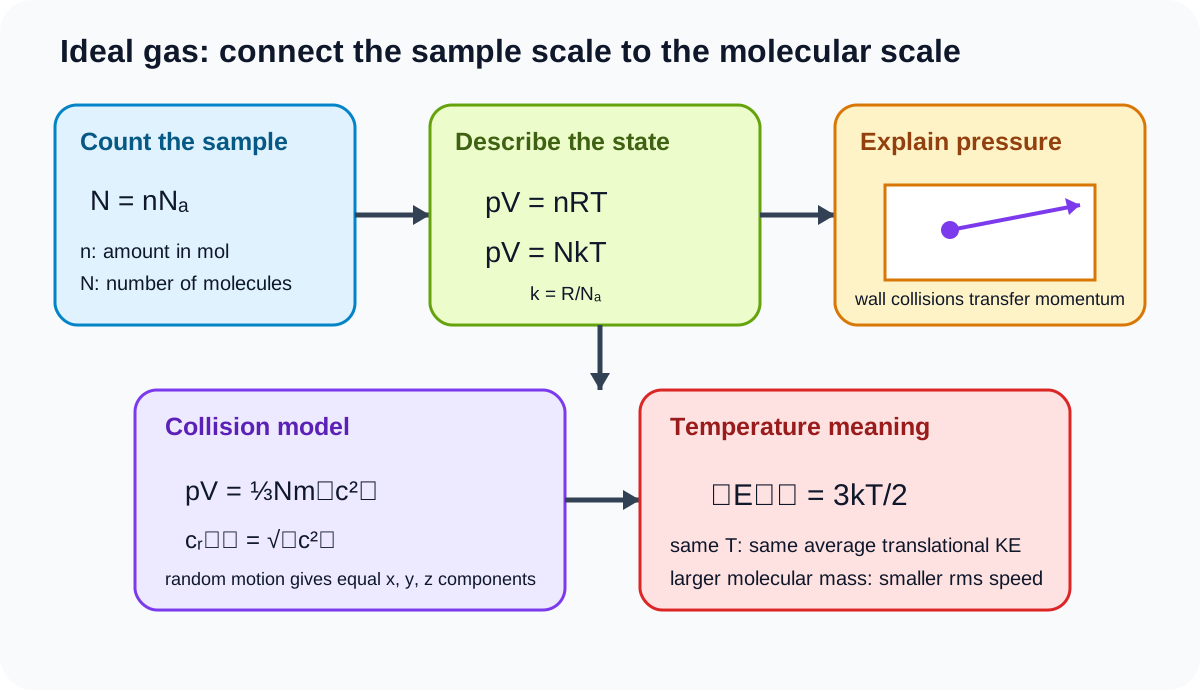
Ideal gases is Topic 15 of the Cambridge International AS and A Level Physics 9702 additional A Level content. Sections 15.1 to 15.3 connect the mole and particle count to the macroscopic equation of state, then derive gas pressure from molecular collisions and link thermodynamic temperature to average translational kinetic energy.
15.1 The mole
Amount of substance
Amount of substance is an SI base quantity. Its base unit is the mole, symbol mol.
One mole of any specified substance contains a number of particles equal to the Avogadro constant, denoted by NA. The particles must be identified: atoms, molecules, ions or another stated entity.
For amount n and particle number N:
N=nNA.
Check this topic from memory
Attempt the matching topic bank before reopening the notes. Use each missed idea to decide what to review next.
The relationship does not say that one mole of every substance has the same mass. Molar mass determines the mass of one mole.
If sample mass m_sample and molar mass M_molar use compatible units:
n=Mmolarmsample.
Do not confuse the symbol M for molar mass with a source mass or molecular mass in another context. Define symbols locally.
Microscopic gas equations use mass of one molecule, while molar calculations use mass per mole. They relate through molar mass divided by the Avogadro constant.
15.2 Equation of state
Ideal-gas model
A gas that obeys pV proportional to T, where T is thermodynamic temperature, is an ideal gas.
The model equation in molar form is
pV=nRT,
where p is absolute pressure, V is volume, n is amount in moles, R is the molar gas constant and T is thermodynamic temperature in kelvin.
The particle-count form is
pV=NkT,
where N is number of molecules and k is the Boltzmann constant.
Since N equals n times the Avogadro constant, comparing the two equations gives
k=NAR.
The two forms describe the same state. Choose pV = nRT when amount is given in moles and pV = NkT when molecule count is given. Do not insert number of molecules into the symbol n.
State variables and units
Pressure must be in pascals, volume in cubic metres and temperature in kelvin when using SI values of R or k.
Convert litres to cubic metres and kilopascals to pascals before substitution. Celsius is unsuitable because zero Celsius is not zero molecular thermal scale.
For a fixed amount of ideal gas, two equilibrium states obey
T1p1V1=T2p2V2.
This combined relationship is derived from the equation of state and applies only when the amount of gas is unchanged.
At constant temperature, pV is constant. At constant volume, pressure is proportional to thermodynamic temperature. At constant pressure, volume is proportional to thermodynamic temperature.
A p against V graph at fixed temperature is a reciprocal curve, while a p against 1/V graph is linear through the origin for a fixed amount. State every controlled variable when interpreting proportionality.
An ideal gas is a model. Real gases approach ideal behaviour most closely when molecular interactions and molecular volume have small effects, but detailed real-gas corrections are not required by this topic.
15.3 Kinetic theory of gases
Basic assumptions
The simple kinetic theory model assumes that:
a gas contains a very large number of molecules in continuous random motion;
molecules can be treated as point particles with negligible volume compared with container volume;
molecules exert no intermolecular forces except during collisions;
collisions between molecules and with the container walls are perfectly elastic;
collision duration is negligible compared with time between collisions;
molecules obey Newtonian mechanics and their motion is isotropic, with no preferred direction.
Each assumption has a role. Negligible molecular volume makes available volume approximately container volume. Negligible forces make motion between collisions uniform. Elastic collisions conserve kinetic energy. Random isotropic motion allows equal mean-square components in three perpendicular directions.
The model does not claim molecules have identical speeds or never collide with one another.
How molecular motion produces pressure
Consider a cubical container of side L and one molecule of mass m with x-component of velocity c_x.
At a wall perpendicular to the x-axis, an elastic collision reverses c_x while leaving its magnitude unchanged. The molecule's x-momentum changes from mc_x to minus mc_x, so the magnitude of momentum transferred to the wall is
Δpx=2mcx.
The time between successive collisions of this molecule with the same wall is distance 2L divided by speed component c_x:
Δt=cx2L.
Its average force contribution is momentum transfer rate:
Fx=2L/cx2mcx=Lmcx2.
For N molecules, sum the squared x-components:
F=LNm⟨cx2⟩.
Wall area is L squared and container volume is L cubed, so pressure F/A becomes
p=VNm⟨cx2⟩.
Random motion has equal mean-square components:
⟨cx2⟩=⟨cy2⟩=⟨cz2⟩=31⟨c2⟩.
Therefore,
pV=31Nm⟨c2⟩.
Pressure is thus the collective result of repeated molecular momentum transfer to the walls. Individual impulses fluctuate, but an enormous number of collisions produces a stable macroscopic average.
Root-mean-square speed
Root-mean-square speed is
cr.m.s.=⟨c2⟩.
The order of operations matters: square every molecular speed, take their mean, then take the square root. It is not generally the same as mean speed, and it is not the square root of mean velocity. Mean velocity in a stationary gas is zero because directions cancel, while root-mean-square speed is positive.
The pressure equation can be written
pV=31Nmcr.m.s.2.
At fixed molecule number and volume, larger mean-square speed produces larger pressure because wall collisions transfer momentum more frequently and strongly.
Molecular kinetic energy and temperature
Compare the kinetic-theory result with pV = NkT:
31Nm⟨c2⟩=NkT.
Cancel N and multiply by three halves:
21m⟨c2⟩=23kT.
The left side is average translational kinetic energy per molecule. Therefore,
⟨EK⟩=23kT.
Average translational kinetic energy depends only on thermodynamic temperature, not molecular species. At the same temperature, heavier molecules have the same average translational kinetic energy but smaller root-mean-square speed.
Combining the result gives
cr.m.s.=m3kT.
For a fixed species, root-mean-square speed is proportional to the square root of thermodynamic temperature. Doubling T increases the speed by a factor of square root two, not two.
This relationship concerns an average distribution. It does not say every molecule has exactly the root-mean-square speed.
Worked application: moving between molecular and molar views
A 0.50mol ideal gas occupies 0.012m3 at 300K. Its pressure is p=nRT/V=1.04⋅105Pa. The molecule count is N=nNA=3.01⋅1023, giving the same pressure through pV = NkT. Average translational kinetic energy per molecule is 3kT/2=6.21⋅10−21J. If each molecule has mass 4.65⋅10−26kg, then cr.m.s.=3kT/m=517m⋅s−1. Pressure is macroscopic, but its value is consistent with molecular momentum transfer.
Common misconceptions and corrections
Calling the mole a particle count rather than an SI base unit for amount. One mole contains the Avogadro number of specified entities.
Saying one mole of every substance has the same mass. Molar masses differ.
Failing to name the counted entity. State atoms, molecules or ions.
Using N for amount in moles. N is molecule count; n is amount.
Using molecular mass as molar mass. They differ by the Avogadro constant.
Defining an ideal gas using Celsius temperature. Use thermodynamic temperature.
Substituting litres directly into SI gas equations. Convert to cubic metres.
Substituting kilopascals as pascals. Convert the pressure.
Using Celsius in pV = nRT. Convert to kelvin.
Using pV = NkT with moles for N. N counts molecules.
Using pV = nRT with molecule count for n. n is measured in moles.
Saying k equals R times the Avogadro constant. Divide R by it.
Applying a two-state gas law while gas leaks. Amount must remain constant.
Calling p proportional to V at fixed temperature. It is inversely proportional.
Omitting controlled variables from a gas proportionality. Name amount and the relevant state variable.
Saying an ideal-gas molecule has no mass. Its volume and intermolecular forces are neglected, not its mass.
Saying molecules do not collide. Collisions occur and are modelled as elastic.
Saying molecules move only along one axis. The derivation begins in one dimension then uses three-dimensional randomness.
Using inelastic wall collisions in the derivation. The velocity component reverses with equal magnitude.
Forgetting the factor two in momentum change. Velocity reverses sign.
Using L rather than 2L between same-wall collisions. The molecule travels to the opposite wall and back.
Adding speeds rather than squared components. Pressure depends on mean-square motion.
Omitting division by wall area. Pressure is force per area.
Saying pressure is caused by molecules resting on walls. It comes from momentum transfer in collisions.
Assuming one collision gives steady pressure. The macroscopic average comes from many collisions.
Using mean velocity for root-mean-square speed. Mean velocity can be zero.
Taking the mean after the square root. Square, mean, then root.
Saying every molecule travels at c_r.m.s. It characterises a distribution.
Omitting translational from the kinetic-energy statement. The result is average translational kinetic energy.
Saying heavier molecules have greater average kinetic energy at equal T. The average is the same.
Saying heavier molecules have the same root-mean-square speed at equal T. They move more slowly on average.
Saying root-mean-square speed is proportional to T. It is proportional to square root T for a fixed species.
Assessment guidance
Choose the molar or molecular equation from the quantity supplied, convert every state variable to SI units and use kelvin. State the fixed amount before applying a two-state relationship. In the pressure derivation, show momentum reversal, same-wall collision time, force as momentum-transfer rate, division by wall area and the one-third isotropic component step. Define root-mean-square speed by its operation order. When comparing gases, use average translational kinetic energy to establish what equal temperature fixes, then use molecular mass to infer speed. Check whether an answer concerns one molecule, one mole or the whole sample before assigning a constant or unit.
Retrieval practice
Convert between moles, molecules and sample mass. Use both forms of the ideal-gas equation on the same state and prove their equivalence through k = R divided by the Avogadro constant. Rebuild the pressure derivation without notes, annotating each kinetic-theory assumption. Distinguish mean velocity, mean speed, mean-square speed and root-mean-square speed, then compare two molecular species at equal temperature.