Cambridge International AS and A Level Physics 16: Thermodynamics
Cambridge International AS and A Level Physics 16: Thermodynamics
Study guide/
Cambridge Physics 9702 A Level notes on internal energy, molecular kinetic and potential energy, constant-pressure work and the first law sign convention.
Thermodynamics is Topic 16 of the Cambridge International AS and A Level Physics 9702 additional A Level content. Sections 16.1 and 16.2 define internal energy as a state property and account for its change through heating and work done on a system.
16.1 Internal energy
A property determined by state
Internal energy U is determined by the state of a system. It can be expressed as the sum of the random kinetic energies and potential energies associated with the system's molecules.
Random molecular kinetic energy includes translational motion and, where relevant to the model, other disordered molecular motion. Potential energy arises from molecular interactions and relative arrangement.
Internal energy excludes the kinetic energy of the whole system's ordered motion and the gravitational potential energy of the whole system in an external field. A moving container may have macroscopic kinetic energy in addition to the internal energy of its contents.
Because internal energy is a state property, its change depends on the initial and final equilibrium states, not on the route used between them. Heating and work are transfer pathways, not quantities stored inside a system.
The absolute value of internal energy usually needs a reference model. Thermodynamic calculations focus on change:
ΔU=Ufinal−Uinitial.
Check this topic from memory
Attempt the matching topic bank before reopening the notes. Use each missed idea to decide what to review next.
A positive change means the system's internal energy increases.
Temperature and internal energy
A rise in an object's temperature is related to an increase in its internal energy. Increasing temperature raises the average random kinetic energy of its molecules.
For an ideal gas, the kinetic-theory result makes this link especially direct: average translational kinetic energy per molecule is proportional to thermodynamic temperature. In real substances, intermolecular potential energy can also contribute to internal-energy changes.
Temperature alone does not determine total internal energy for every system. Mass, material, phase and state also matter. Two bodies at the same temperature can have different internal energies.
During a phase change at constant temperature, internal energy can increase even though average molecular kinetic energy does not rise. Supplied energy changes molecular arrangement and potential energy. This connects Topic 16 to the latent-heat distinction in Topic 14.
Cooling generally reduces internal energy. It does not imply that internal energy becomes zero at zero degrees Celsius.
Define the system boundary
Before applying an energy equation, identify the system. It may be the gas only, a liquid plus container, or a larger insulated assembly.
Energy crossing the chosen boundary by heating or mechanical work changes the system account. Energy transfer between components inside the boundary does not cross it.
A consistent boundary prevents double counting. For example, friction between two components inside a closed system can convert ordered kinetic energy to internal energy without energy crossing the external boundary.
16.2 The first law of thermodynamics
Work at constant pressure
Consider a gas in a cylinder with piston area A. If the gas expands through piston displacement x, its volume increase is
ΔV=Ax.
At constant pressure p, the gas exerts force pA. Work done by the gas is therefore
Wby=Fx=pAx=pΔV.
For expansion, volume change is positive and work done by the gas is positive. Work done on the gas is the opposite:
Won=−pΔV.
For compression, volume change is negative, so work done on the gas is positive. The surroundings transfer energy mechanically into the system.
The formula p delta V in this syllabus outcome is for constant pressure. On a pressure-volume graph, work done by a gas is the area under the path. For a constant-pressure process, that area is the rectangle p delta V. Do not assume the same simple product if pressure varies unless an appropriate average or area is supplied.
Pressure must be in pascals and volume change in cubic metres to obtain work in joules.
Cambridge first-law convention
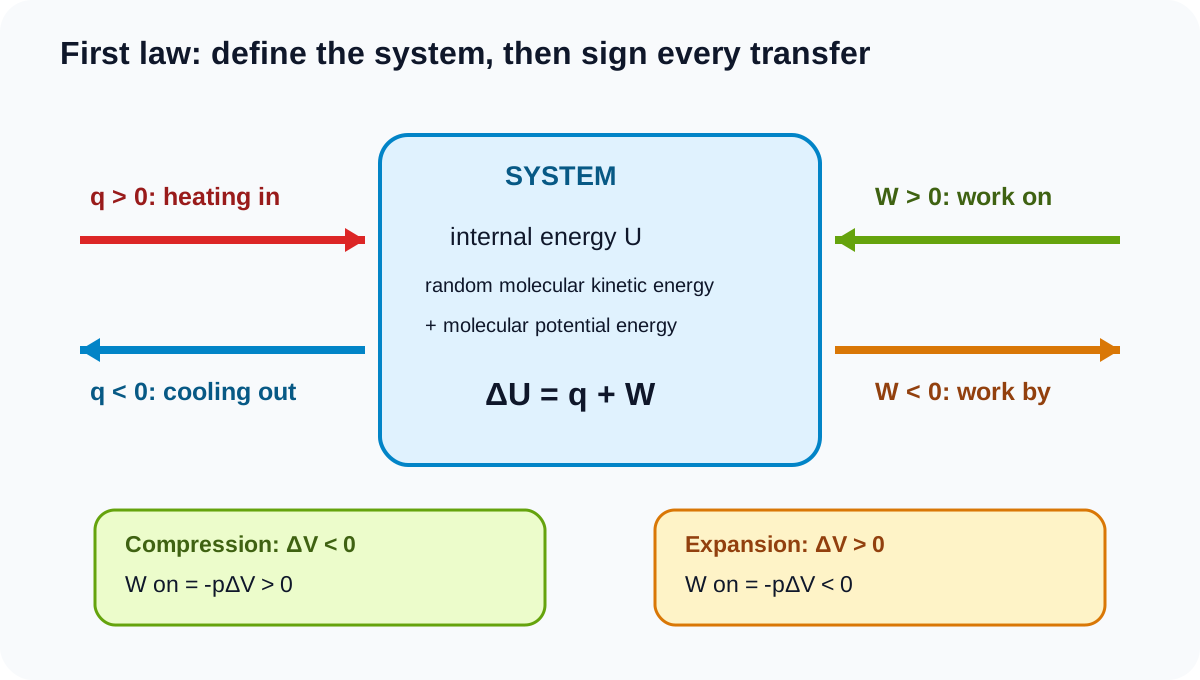
The syllabus writes the first law as
ΔU=q+W,
where:
delta U is the increase in internal energy of the system;
q is energy transferred to the system by heating;
W is work done on the system.
Under this convention, q is positive when the system is heated and negative when it transfers energy out by cooling. W is positive for work done on the system and negative for work done by the system.
For a constant-pressure volume change, substitute
W=−pΔV
when delta V is defined as final volume minus initial volume.
Some sources use a first law with work done by the system. That convention writes a minus sign before work. Both can be consistent, but never combine the equation from one convention with the sign definition from the other. In Cambridge questions, anchor the solution to delta U = q + W with W as work done on the system.
Expansion and compression cases
During expansion, the gas does work on the surroundings, so W is negative. If no heating occurs, internal energy decreases.
During compression, the surroundings do work on the gas, so W is positive. If no energy leaves by heating, internal energy increases.
Heating and expansion can occur together. Internal energy rises only if positive q exceeds the magnitude of negative W. If the gas transfers out as much work as it receives by heating, internal energy is unchanged.
Cooling and compression can also occur together. Their effects oppose: negative q reduces internal energy, while positive W increases it.
Build a signed energy ledger rather than guessing from one process label.
Special process interpretations
If volume is constant, delta V is zero, so constant-pressure boundary work p delta V is zero. Any internal-energy change in the simple account comes from q.
If q is zero, the process is adiabatic in the energy-transfer sense used here. Delta U then equals work done on the system.
If delta U is zero, energy transferred into the system by heating is balanced by energy transferred out as work, or another signed combination sums to zero. Zero internal-energy change does not imply no energy transfers occurred.
For a complete cycle returning to the initial state, total delta U is zero because internal energy is a state property. Net heating over the cycle is then opposite to net work done on the system.
Detailed named gas processes and heat-engine efficiencies are outside this Topic 16 boundary unless a question provides the necessary information.
Linking macroscopic and molecular explanations
Heating can increase random molecular kinetic energy and, depending on state, molecular potential energy. Compression transfers energy mechanically and can increase collision rate and molecular kinetic energy.
Expansion lets the gas transfer energy mechanically to its surroundings. Without compensating heating, molecular energy and temperature can fall.
The first law is an accounting principle. It does not specify the microscopic distribution by itself; the state model supplies that interpretation.
Theory and practical ownership
This theory note covers the internal-energy definition, state-function reasoning, constant-pressure work derivation, signs and first-law calculations.
Practical work may measure pressure, volume, temperature, electrical input or thermal loss. It covers sensor calibration, apparatus leakage, piston friction, pressure constancy, uncertainty and evaluation. A real piston experiment can deviate from the ideal work model because pressure is not constant or friction transfers additional energy.
Worked application: heating during expansion
A gas expands at constant pressure 2.0⋅105Pa from 3.0⋅10−3m3 to 5.5⋅10−3m3 while receiving 900J by heating. Volume change is 2.5⋅10−3m3, so the gas does pΔV=500J of work. Work done on the gas is therefore W=−500J. Cambridge's convention gives ΔU=q+W=900−500=400J. Expansion alone does not determine the sign of internal-energy change; the positive heating transfer is larger than the outward mechanical work transfer.
Common misconceptions and corrections
Defining internal energy as heat stored in a body. Heating is a transfer pathway, not stored heat.
Including whole-body kinetic energy in internal energy. Internal energy concerns random molecular energies.
Including external gravitational potential energy automatically. Keep macroscopic energy separate.
Omitting molecular potential energy. Internal energy includes random kinetic and interaction potential energies.
Saying internal energy depends on the route. Its change is fixed by initial and final states.
Saying heating and work are state properties. They describe transfers across a boundary.
Saying equal temperature means equal internal energy. Mass, material and phase matter.
Saying constant temperature means constant internal energy in every process. Phase change can alter potential energy.
Saying a temperature rise leaves internal energy unchanged. It is related to an increase.
Using zero degrees Celsius as zero internal energy. Celsius zero is not an energy reference.
Starting without defining the system. Boundary choice controls the transfer ledger.
Using total volume instead of volume change in p delta V. Use final minus initial.
Using p delta V when pressure varies without justification. Use pressure-volume area.
Forgetting that p delta V is work done by the gas for expansion. Cambridge W is work done on the gas.
Giving work done on and by the gas the same sign. They are opposites.
Calling expansion work on the gas positive. Expansion gives negative W in this convention.
Calling compression work on the gas negative. Compression gives positive W.
Using litres with pascals in the work formula. Convert volume to cubic metres.
Writing delta U = q minus W while defining W as work done on. That mixes conventions.
Treating q as always positive. Cooling gives negative q.
Treating W as always positive. Work done by the system gives negative W.
Saying compression always raises internal energy. Sufficient cooling can outweigh work input.
Adding unsigned energy magnitudes. Use a signed ledger.
Saying zero work means zero energy transfer. Heating may still occur.
Saying zero heating means constant internal energy. Work may change it.
Saying zero delta U means no transfers. Opposing transfers can cancel.
Saying an adiabatic expansion cannot cool. Negative work-on can reduce internal energy.
Forgetting that internal energy returns after a complete cycle. It is a state property.
Using molecular explanations without the first-law account. State both transfer and energy consequence.
Assessment guidance
Define the system and write final minus initial for every state change. Label q as heating into the system and W as work done on the system before assigning signs. At constant pressure, calculate work done by the gas as p delta V, then reverse its sign for Cambridge's W. Convert pressure and volume to SI units. Use delta U = q + W only after the sign ledger is explicit. Explain a temperature change through random molecular kinetic energy while retaining potential energy for phase or interaction changes. For pressure-volume paths, use rectangular p delta V only when pressure is constant and use graph area when pressure varies.
Retrieval practice
Define internal energy and distinguish it from whole-body kinetic and potential energy. Classify internal energy, heating and work as state or transfer quantities. Derive p delta V from piston force and displacement. Complete sign tables for expansion, compression, heating and cooling, then solve mixed cases with Cambridge's first-law convention. Explain how a phase change can alter internal energy at constant temperature.