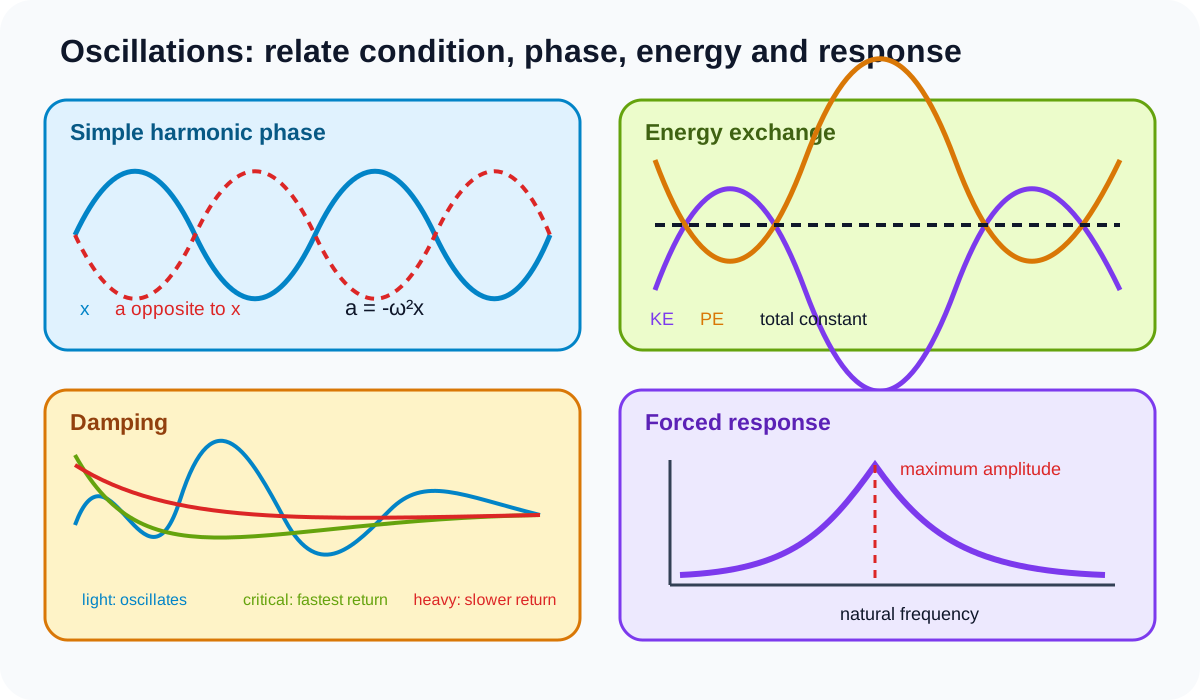
Oscillations is Topic 17 of the Cambridge International AS and A Level Physics 9702 additional A Level content. Sections 17.1 to 17.3 connect the defining acceleration condition of simple harmonic motion to kinematics and energy, then distinguish damping regimes, forced oscillation and resonance.
17.1 Simple harmonic oscillations
Oscillation language
An oscillation is repeated motion about an equilibrium position.
Displacement x is the signed distance from equilibrium. Amplitude x0 is the maximum magnitude of displacement. Period T is time for one complete oscillation, and frequency f is oscillations per unit time.
T=f1.
Angular frequency omega measures phase progression in radians per second:
ω=2πf=T2π.
Check this topic from memory
Attempt the matching topic bank before reopening the notes. Use each missed idea to decide what to review next.
Do not confuse angular frequency of an oscillation with angular speed of a body travelling in a physical circle. The mathematics connects them through the reference-circle model, but the oscillating object moves along its stated path.
Phase identifies the stage of a cycle. Phase difference compares the stages of two oscillations or two quantities. One complete cycle is 2 pi radians. A quarter cycle is pi over two radians and a half cycle is pi radians.
Two oscillations can have the same frequency but different phase. Phase difference is meaningful only with a shared frequency or clearly defined comparison.
Defining simple harmonic motion
Simple harmonic motion occurs when acceleration is proportional to displacement from a fixed point and opposite in direction:
a=−ω2x.
The minus sign is essential. If displacement is positive, acceleration is negative; if displacement is negative, acceleration is positive. Acceleration always points toward equilibrium.
This condition is the definition, not merely the fact that motion repeats or has a sine-shaped graph.
At equilibrium, x is zero and acceleration is zero. At either extreme, displacement magnitude and acceleration magnitude are maximum.
For a spring-mass system obeying Hooke's law, F = -kx and F = ma give acceleration proportional to minus displacement. This is one route to simple harmonic motion, but the syllabus equations apply to any system meeting the condition.
Displacement solution
One solution of the defining equation is
x=x0sinωt.
This form chooses time zero at equilibrium moving in the positive direction. A different initial condition may require a phase constant or an equivalent cosine form.
The maximum displacement is x0. The argument omega t is phase in radians. Replacing t by t + T reproduces the same displacement because omega T equals 2 pi.
Do not assume every question begins at x = 0. Read the stated initial displacement and direction.
Velocity
Differentiating displacement gives
v=v0cosωt,
where maximum speed is
v0=ωx0.
Eliminating time using sine-squared plus cosine-squared equals one gives
v=±ωx02−x2.
The plus or minus sign records direction. Position alone does not determine velocity direction because the oscillator passes most positions twice per cycle.
Speed is maximum at equilibrium and zero at the extremes. Velocity leads displacement by a quarter cycle for the stated sine displacement convention.
Acceleration and graphs
Differentiate velocity or apply the definition:
a=−ω2x=−ω2x0sinωt.
Acceleration is exactly opposite in phase to displacement. Velocity differs by a quarter cycle from both.
On a displacement-time graph, gradient gives velocity. Turning points have zero gradient and therefore zero velocity. The steepest crossings of equilibrium have maximum speed.
On a velocity-time graph, gradient gives acceleration. On an acceleration-time graph, acceleration is an inverted, scaled copy of displacement.
An acceleration-displacement graph for simple harmonic motion is a straight line through the origin with negative gradient:
gradient=−ω2.
This graph provides direct evidence for the defining condition and can be used to find angular frequency.
17.2 Energy in simple harmonic motion
Total energy
For an undamped simple harmonic oscillator of mass m and amplitude x0, total energy is
E=21mω2x02.
Total energy is constant when no resistive transfer occurs. It is proportional to amplitude squared and angular frequency squared.
For a spring oscillator with k = m omega squared, elastic potential energy is
EP=21mω2x2.
Kinetic energy is total minus potential:
EK=21mω2(x02−x2).
At equilibrium, potential energy is minimum in this reference and kinetic energy is maximum. At either extreme, kinetic energy is zero and potential energy equals total energy.
Potential and kinetic energy exchange continuously. Each energy varies twice per oscillation because energy depends on squared displacement or squared speed. Total energy remains a horizontal line for an undamped oscillator.
Energy alone does not give direction of motion. The same kinetic energy occurs on inward and outward passes at the same displacement magnitude.
17.3 Damped and forced oscillations, resonance
Damping
A resistive force acting on an oscillating system causes damping. Mechanical energy transfers from the oscillator to its surroundings, so amplitude decreases.
Light damping produces several oscillations with an envelope that decays gradually toward equilibrium. The system crosses equilibrium repeatedly.
Critical damping returns the system to equilibrium in the shortest time without oscillating. It is the boundary between oscillatory and non-oscillatory return.
Heavy damping also returns without oscillating, but more slowly than critical damping. Greater resistance does not always mean faster settling.
On displacement-time sketches:
light damping crosses the equilibrium line with progressively smaller peaks;
critical damping approaches equilibrium quickly from one side without crossing repeatedly;
heavy damping approaches equilibrium more slowly without oscillation.
Damping reduces mechanical energy and amplitude. The natural frequency can also be affected, but detailed damping equations are outside the stated boundary.
Forced oscillations
A forced oscillator receives a periodic driving force. After transient motion decays, it oscillates at the driving frequency, not automatically at its natural frequency.
The natural frequency is the frequency at which the system oscillates freely after displacement and release, under the model conditions.
The driver transfers energy to the oscillator. The steady amplitude depends on driving frequency, damping and driving strength.
Resonance
Resonance involves maximum amplitude of forced oscillations. It occurs when an oscillating system is forced at its natural frequency.
At resonance, the driver supplies energy most effectively from cycle to cycle because its phase relationship supports the motion.
A graph of steady amplitude against driving frequency has a peak at the natural frequency in the syllabus model. Damping lowers and broadens the peak. Light damping permits a larger, sharper resonance response; greater damping limits amplitude and spreads the response across frequencies.
Resonance is not merely any large oscillation, and it does not mean the driving frequency becomes equal to the amplitude. Frequency and amplitude are different quantities.
Useful resonance may amplify musical or sensing systems. Unwanted resonance can produce damaging structural motion. Damping controls excessive response by transferring energy away.
Theory and practical ownership
This theory note covers the SHM condition, equations, phase and graph relationships, energy interchange and conceptual damping and resonance response.
A practical investigation covers timing over repeated cycles, displacement sensing, decay-envelope measurement, driver-frequency control, resonance-curve sampling, uncertainty and safety. A measured resonance curve tests the theory but does not belong in the theory hub as an apparatus protocol.
Worked application: reading one oscillator state
A 0.40kg oscillator has amplitude 0.12m and period 1.6s. Its angular frequency is 2π/T=3.93rad⋅s−1. At displacement 0.050m, acceleration is −ω2x=−0.771m⋅s−2, directed toward equilibrium. Speed magnitude is ωx02−x2=0.429m⋅s−1, but direction needs extra information. Total energy is mω2x02/2=0.0444J. The state combines signed kinematics with direction-independent energy; neither representation replaces the other.
Common misconceptions and corrections
Measuring displacement from an extreme. Measure from equilibrium.
Calling amplitude peak-to-peak displacement. Amplitude is maximum magnitude from equilibrium.
Using period as oscillations per second. That is frequency.
Using omega equal to one over T. Omega equals 2 pi over T.
Confusing oscillation angular frequency with physical circular speed. Check the motion described.
Saying equal frequency guarantees equal phase. Phase difference can remain.
Calling every periodic motion SHM. Acceleration must equal minus a constant times displacement.
Omitting the minus sign in acceleration. It encodes restoration toward equilibrium.
Saying acceleration is maximum at equilibrium. It is zero there.
Saying speed is zero at equilibrium. Its magnitude is maximum.
Saying acceleration is zero at extremes. Its magnitude is maximum.
Assuming the sine solution starts at an extreme. It starts at equilibrium for zero phase.
Using maximum velocity as omega divided by amplitude. It is omega times amplitude.
Dropping the plus-minus sign from the position-speed equation. Position does not fix direction.
Taking square root of a negative value without checking amplitude. Displacement magnitude cannot exceed amplitude.
Saying velocity and displacement are in phase. They differ by a quarter cycle.
Saying acceleration and displacement are in phase. They are opposite in phase.
Reading graph height as velocity on an x-time graph. Velocity is its gradient.
Using a positive acceleration-displacement gradient for SHM. The gradient is negative.
Finding omega directly from the negative gradient. Omega is square root of its magnitude.
Saying total energy varies during undamped SHM. Kinetic and potential exchange while total stays constant.
Saying energy is proportional to amplitude. Total energy is proportional to amplitude squared.
Saying kinetic energy is maximum at extremes. It is zero there.
Saying energy determines direction. Squared quantities lose direction.
Defining damping as lower frequency only. It is caused by a resistive force and reduces energy and amplitude.
Drawing light damping with constant peaks. The envelope decays.
Drawing critical damping crossing equilibrium repeatedly. It returns without oscillating.
Saying heavy damping returns fastest. Critical damping is fastest without oscillation.
Saying a forced oscillator always moves at natural frequency. Steady motion follows driving frequency.
Calling any large amplitude resonance. Maximum forced amplitude occurs at natural frequency.
Confusing resonance frequency with amplitude. They have different dimensions.
Saying more damping makes the resonance peak taller. It lowers and broadens the response.
Assessment guidance
Start by testing the defining relation between acceleration and signed displacement. Convert period, frequency and angular frequency before using the sinusoidal equations. Track phase through graph gradients: displacement gradient gives velocity and velocity gradient gives acceleration. Preserve the direction sign in velocity questions. In energy questions, distinguish total, kinetic and potential energy and use amplitude rather than current displacement in total energy. Sketch damping regimes against one equilibrium line and show crossings only for light damping. For forced motion, separate natural and driving frequencies and state that maximum steady amplitude occurs when they match.
Retrieval practice
Define every oscillation term and convert between T, f and omega. From one sine displacement function, generate velocity and acceleration functions and align their graphs. Derive the position-speed relationship and energy partition. Sketch light, critical and heavy damping from identical initial displacement. Draw an amplitude-frequency resonance curve and explain how damping changes its peak.