Cambridge International AS and A Level Physics 18: Electric fields
Cambridge International AS and A Level Physics 18: Electric fields
Study guide/
Cambridge Physics 9702 A Level notes on electric field strength, uniform fields, charged-particle motion, Coulomb force, point-charge fields, potential and potential energy.
Electric fields is Topic 18 of the Cambridge International AS and A Level Physics 9702 additional A Level content. Sections 18.1 to 18.5 connect force per unit positive charge, parallel-plate motion, Coulomb's law, point-charge field strength, potential gradient and two-charge potential energy.
18.1 Electric fields and field lines
Field strength
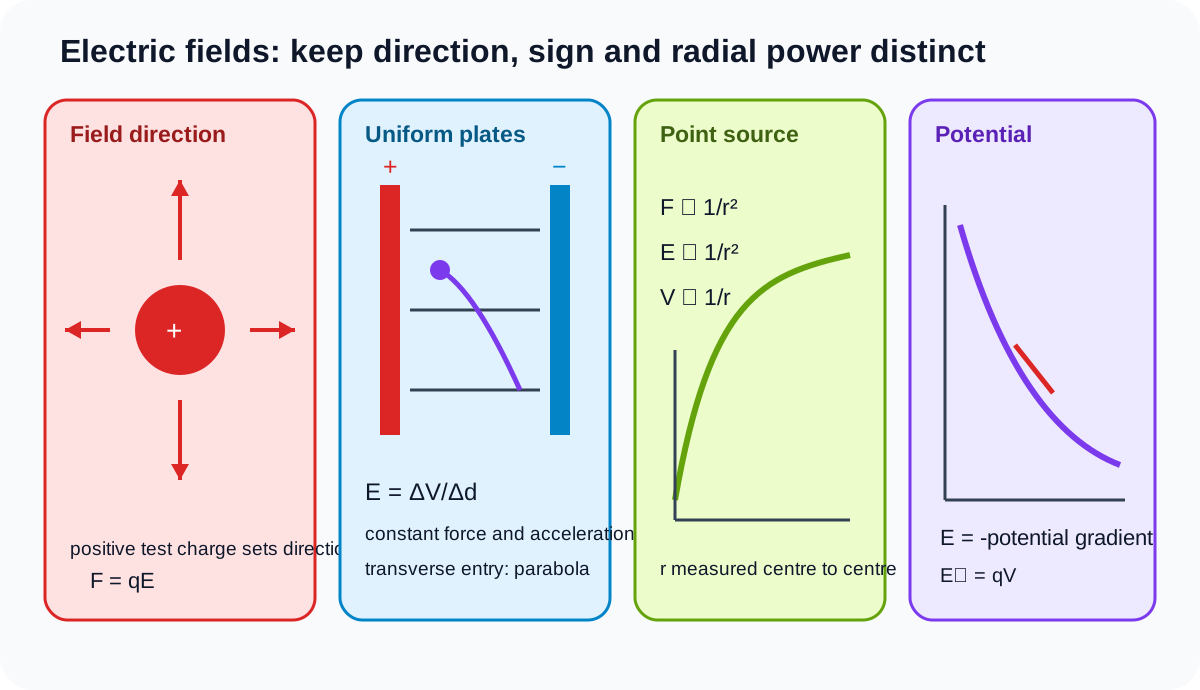
An electric field is a region in which an electric charge experiences a force. Electric field strength E at a point is force per unit positive charge on a small test charge placed at that point:
E=qF.
Its unit is newtons per coulomb. Field strength is a vector. Its direction is the direction of force on a positive test charge.
The test charge must be small enough not to disturb the source distribution significantly. The word positive in the definition fixes field direction independent of whichever particle later enters the field.
For a charge q in an electric field:
Check this topic from memory
Attempt the matching topic bank before reopening the notes. Use each missed idea to decide what to review next.
A positive charge experiences force along the field. A negative charge experiences force opposite to the field because q carries a negative sign. Force magnitude is the absolute value of q times E.
Field lines
The tangent to an electric field line gives field direction. Arrows point away from positive source charge and toward negative source charge.
Closer line spacing represents greater field strength. Field lines do not cross because the resultant field at one point has one direction.
Between oppositely charged parallel plates, lines in the central region are straight, parallel and equally spaced, representing an approximately uniform field. Near plate edges they curve, showing fringing; the simple uniform model applies away from edges.
Field lines are representations, not material paths. A charged particle with an initial sideways velocity can cross field lines.
When several charges produce a field, add their field vectors. Potentials add as scalars, but field strengths require direction.
18.2 Uniform electric fields
Field strength between parallel plates
For a uniform field between charged parallel plates:
E=ΔdΔV,
where potential difference is across perpendicular plate separation. Its equivalent unit is volts per metre.
Use the magnitude form when calculating field strength. The field direction is from the positive plate toward the negative plate, which is the direction of decreasing electric potential.
Doubling potential difference at fixed separation doubles field strength. Doubling separation at fixed potential difference halves it, provided the uniform-field approximation remains valid.
Charged-particle motion
In a uniform field, force qE is constant. For a particle of mass m, acceleration is
a=mqE.
A positive particle released from rest accelerates along the field; a negative particle accelerates opposite to it.
If initial velocity is parallel to the field, motion is one-dimensional with constant acceleration. If initial velocity is perpendicular to the field, the component parallel to the plates remains uniform while the field-direction component accelerates. The trajectory is parabolic under the ideal uniform-field model, analogous to projectile motion with electric rather than gravitational acceleration.
Do not bend the path in the field direction regardless of sign. Determine force first from qE.
Energy transferred when charge q moves through potential difference delta V is
ΔEP=qΔV.
If only the electric force acts, a decrease in electric potential energy becomes an equal increase in kinetic energy.
18.3 Electric force between point charges
Spherical-conductor model
For a point outside a spherical conductor, its charge may be considered concentrated as a point charge at its centre. Distance r is therefore centre to centre, not surface gap.
The stated result is external. The field inside a conductor in electrostatic equilibrium has separate behaviour and must not be inferred by extending the external point-charge equation through the material.
Coulomb's law
For two point charges in free space, force magnitude is
F=4πε0r2Q1Q2.
For magnitude calculations, use absolute charge product. Like charges repel and unlike charges attract. The forces form an equal-and-opposite Newton third-law pair even if charge magnitudes differ.
The law is inverse square. Doubling separation makes force one quarter. Doubling either charge doubles force.
The free-space permittivity is epsilon zero. Do not replace it with gravitational G or omit the factor 4 pi.
With more than two charges, calculate each Coulomb force on the chosen charge and add vectors. A scalar sum of magnitudes is valid only if all contributions have the same direction.
18.4 Electric field of a point charge
Place a small positive test charge q at distance r from source charge Q. Coulomb's law gives F, and dividing by q gives
E=4πε0r2Q.
In a magnitude equation use absolute Q. Direction is radially outward for positive Q and inward for negative Q.
The test charge cancels because the field describes source and position. The force on a later charge still depends on that charge through F = qE.
Field magnitude against radius falls as inverse square. A graph of E against 1/r squared is linear through the origin for a fixed positive point charge if signed direction is handled separately.
For several point charges, each field contribution uses distance and direction from its own source. Superpose components at the observation point.
18.5 Electric potential
Definition and sign
Electric potential V at a point is the work done per unit positive charge in bringing a small test charge from infinity to that point.
Potential is scalar and measured in joules per coulomb, equivalent to volts. The conventional zero for an isolated point charge is at infinity.
For a point charge in free space:
V=4πε0rQ.
Potential is positive around a positive source charge and negative around a negative source charge. Unlike field magnitude, it varies as inverse distance rather than inverse square.
Potentials from several source charges add algebraically. A zero-potential point can still have non-zero field because scalar potentials may cancel while vector gradients do not.
Potential gradient
Electric field equals the negative potential gradient:
E=−drdV
in a one-dimensional radial description. More generally, field points in the direction of greatest decrease of potential.
On a potential-distance graph, the negative gradient gives the field component. A steep potential graph means a strong field. Zero potential is not automatically zero gradient.
For a uniform field, constant gradient gives the magnitude relationship E = delta V divided by delta d.
Potential energy of two charges
Potential energy of point charges Q and q separated by r is
EP=qV=4πε0rQq.
This is energy of the two-charge system. Like-charge pairs have positive potential energy relative to infinite separation; unlike-charge pairs have negative potential energy.
Bringing like charges closer requires external work and increases system potential energy. Allowing unlike charges to move closer decreases potential energy and can increase kinetic energy.
For movement between points, calculate final minus initial potential energy. Do not use force times distance when force changes with inverse-square separation unless an integral or potential method justifies it.
Electric and gravitational comparisons
Both point-source fields are inverse square and both point-source potentials vary as inverse distance. Electric source and test quantities can be positive or negative, so force may attract or repel and potential may have either sign. Gravitational mass is positive in this syllabus model, so isolated gravitational potential with zero at infinity is negative and gravity attracts.
The comparison helps organise equations but does not make electric and gravitational constants interchangeable.
Theory and practical ownership
This theory note covers definitions, vector directions, uniform and point-source equations, charged-particle motion, potential gradients and energy relationships.
Practical work covers plate alignment, voltage and separation measurement, field mapping probes, beam deflection, calibration, uncertainty and high-voltage safety. The hubs remain separate even when practical evidence tests the theory.
Worked application: force, acceleration and energy direction
Parallel plates have potential difference 1.8⋅103V and separation 0.030m, giving E=6.0⋅104V⋅m−1. An electron experiences force magnitude eE=9.61⋅10−15N opposite to the field and acceleration magnitude F/m=1.06⋅1016m⋅s−2. Moving through 250V toward higher potential decreases the electron's potential energy by 4.00⋅10−17J because its charge is negative, so its kinetic energy increases by that amount. Field direction alone is insufficient; charge sign controls both force and energy change.
Common misconceptions and corrections
Defining electric field as force rather than force per unit positive charge. Include the divisor and sign convention.
Using a negative test charge to define field direction. Direction follows positive test charge force.
Forcing every charge along the field. Negative charges accelerate opposite to it.
Drawing lines into positive charge. They point away from positive and toward negative.
Treating line paths as particle trajectories. Initial velocity can cross them.
Allowing field lines to cross. A point has one resultant direction.
Using line length as field magnitude. Use line density.
Calling the plate-edge field uniform. Fringing occurs there.
Using plate length instead of perpendicular separation. Delta d lies along the field.
Using volts per metre and newtons per coulomb as different quantities. They are equivalent field units.
Bending every charged-particle path the same way. Determine qE direction.
Saying perpendicular injection gives circular motion. Constant transverse force gives a parabola.
Using surface gap for spherical charges. Use centre separation.
Applying the external sphere model inside a conductor. Its stated boundary is outside.
Using signed Coulomb force as a magnitude without direction analysis. Determine attraction or repulsion separately.
Saying third-law forces differ when charge magnitudes differ. They are equal and opposite.
Using inverse distance for Coulomb force. Force varies as inverse square.
Omitting free-space permittivity or 4 pi. Both belong in the formula.
Adding force magnitudes without resolving directions. Superposition is vector addition.
Leaving the test charge in the point-field expression. It cancels from E.
Saying a negative source has negative field magnitude. Magnitude is positive; direction is inward.
Using inverse distance for point-charge field strength. It varies as inverse square.
Defining potential as work rather than work per unit positive charge. Potential is energy per charge.
Defining potential from the point to infinity. The test charge is brought from infinity.
Treating potential as vector. Add it algebraically.
Using inverse square for potential. It varies as inverse distance.
Saying zero potential means zero field. The potential gradient can be non-zero.
Omitting the negative sign from the gradient relation. Field points toward decreasing potential.
Calling positive potential energy attraction. Like-charge system energy is positive.
Assigning potential energy to one charge alone. It belongs to the interacting system.
Using field strength and potential interchangeably. Their units, signs and radial powers differ.
Using gravitational sign rules for electric charges. Electric source and test charges may be negative.
Assessment guidance
State field and potential definitions with positive test charge and infinity reference. Separate magnitude calculations from vector directions. Between plates, identify field direction, calculate E from perpendicular potential gradient, then apply charge sign before predicting acceleration. For point sources, measure centre-to-centre radius and distinguish inverse-square force and field from inverse-distance potential. Add fields as vectors and potentials as scalars. Use negative potential gradient to interpret graphs. For energy, calculate q delta V or the two-charge system expression and use final minus initial before inferring kinetic-energy transfer.
Retrieval practice
Draw field lines for isolated positive and negative charges, unlike and like pairs, and central parallel plates. Predict positive and negative particle paths for parallel and perpendicular injection. Derive point-charge field from Coulomb's law, then compare its radial dependence with potential. Build a table separating force, field, potential and potential energy by definition, unit, sign and superposition rule.
Cambridge International, AS and A Level Physics 9702 syllabus for examinations in 2025, 2026 and 2027, additional A Level Topic 18 sections 18.1 Electric fields and field lines, 18.2 Uniform electric fields, 18.3 Electric force between point charges, 18.4 Electric field of a point charge and 18.5 Electric potential.