Cambridge International AS and A Level Physics 20: Magnetic fields
Cambridge International AS and A Level Physics 20: Magnetic fields
Study guide/
Cambridge Physics 9702 A Level notes on magnetic fields, forces on currents and charges, Hall voltage, velocity selection, current-produced fields, flux and induction.
Magnetic fields is Topic 20 of the Cambridge International AS and A Level Physics 9702 additional A Level content. Sections 20.1 to 20.5 connect field sources and patterns, forces on currents and charges, Hall voltage, circular particle motion, velocity selection, current-produced fields, magnetic flux and electromagnetic induction.
20.1 Concept of a magnetic field
A magnetic field is a region in which a magnetic force can act. It is produced by moving charges or permanent magnets.
Magnetic field lines show direction through their tangent. Outside a permanent magnet they point from north to south. Closer spacing represents greater field strength, and lines do not cross.
A uniform magnetic field is represented by parallel, equally spaced lines. A cross represents a direction into the page, like the tail of an arrow; a dot represents out of the page, like its point.
Field lines are representations rather than physical wires. The path of a charged particle depends on its velocity and charge as well as the field.
20.2 Force on a current-carrying conductor
Magnitude and direction
A current-carrying conductor in a magnetic field may experience force because moving charge carriers interact with the field.
For straight conductor length L carrying current I at angle theta to flux density B:
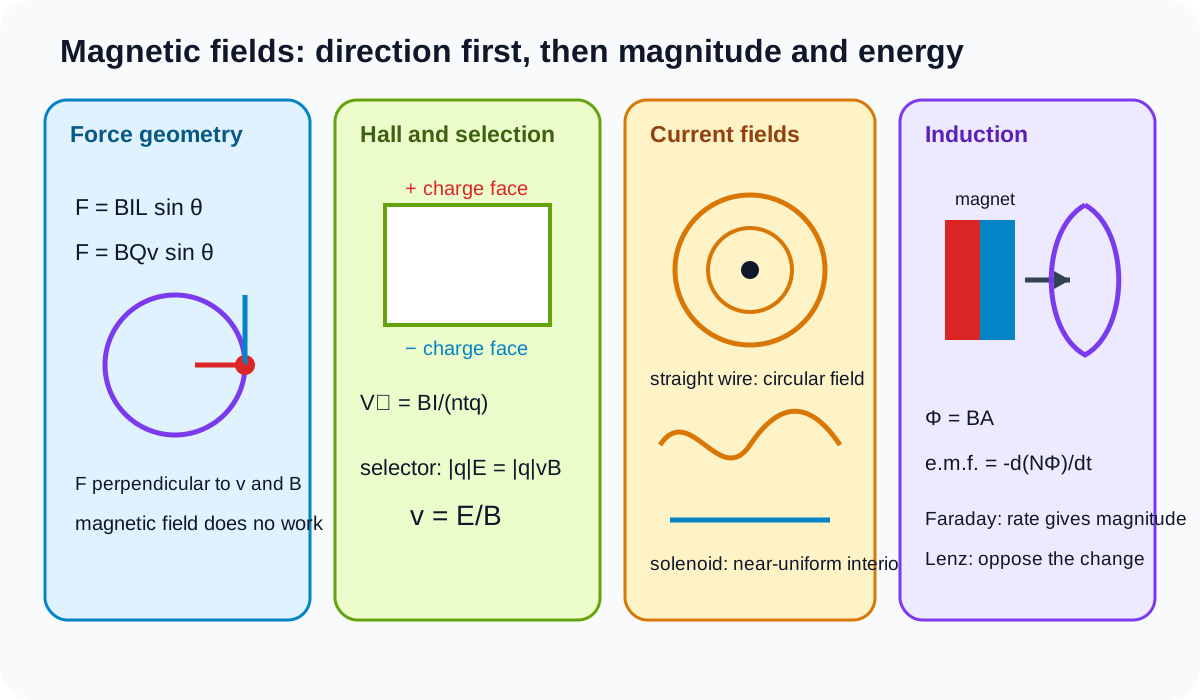
F=BILsinθ.
Only the length within the field and the current component perpendicular to B contribute. Force is maximum at 90 degrees and zero when conductor and field are parallel.
Check this topic from memory
Attempt the matching topic bank before reopening the notes. Use each missed idea to decide what to review next.
Fleming's left-hand rule gives conventional-current force direction: first finger field, second finger conventional current, thumb force. Electron drift is opposite conventional current, but use the stated current direction in the conductor rule.
The force is perpendicular to both current and field. Reversing either current or field reverses force; reversing both leaves force direction unchanged.
Magnetic flux density
Magnetic flux density B is force per unit current per unit length on a wire placed at right angles to the field:
B=ILF.
Its unit is tesla. This definition requires the right-angle condition; otherwise the sine factor remains.
20.3 Force on a moving charge
Single-particle force
For charge Q moving at speed v at angle theta to a magnetic field:
F=BQvsinθ.
Use absolute charge for magnitude. For a positive charge, the force direction follows the conventional-current left-hand rule; for a negative charge, reverse it.
Force is perpendicular to velocity, so a magnetic field alone does no work. It changes velocity direction but not speed or kinetic energy.
Circular motion
If velocity is perpendicular to a uniform magnetic field, magnetic force supplies centripetal force:
B∣Q∣v=rmv2.
Hence
r=B∣Q∣mv.
The path is circular at constant speed. Larger momentum gives larger radius; larger charge magnitude or flux density gives smaller radius. Opposite charge signs curve in opposite directions.
If velocity has a component parallel to the field, that component is unchanged while the perpendicular component circles, producing a helix. The explicit outcome asks for perpendicular entry, but component reasoning explains why the circular condition matters.
Hall voltage
In a current-carrying slab placed in a perpendicular magnetic field, charge carriers experience sideways magnetic force. Charge accumulates on opposite faces until the electric force from the transverse Hall field balances magnetic force:
qEH=qvB.
Thus Hall field magnitude is vB. If slab width is w, Hall voltage is E_H w. Current is
I=nqvwt,
where n is carrier number density and t is slab thickness in the field-normal dimension stated by the formula. Eliminating v and w gives
VH=ntqBI.
Hall-voltage polarity reveals carrier sign. Magnitude increases with B and I, and decreases with carrier density, thickness and charge magnitude.
A Hall probe uses a calibrated Hall voltage to measure magnetic flux density. Orientation matters because only the perpendicular field component produces the full response; zeroing, calibration and finite probe size belong to practical execution.
Velocity selection
Crossed electric and magnetic fields can select particles of one speed. Arrange electric and magnetic forces oppositely. An undeflected particle satisfies
∣Q∣E=∣Q∣vB,
so
v=BE.
Charge magnitude and mass cancel. Particles of other speeds deflect because the two forces do not balance. Field directions must be chosen for opposition for the charge sign used.
20.4 Magnetic fields due to currents
Required patterns
A long straight current produces concentric circular field lines. The right-hand grip rule gives direction: thumb conventional current, curled fingers field.
A flat circular coil produces a bar-magnet-like pattern through its centre. Field direction reverses when current reverses. Multiple turns strengthen the central field.
A long solenoid has a strong, approximately uniform internal field represented by parallel lines, with a weaker return pattern outside. A ferrous core increases the solenoid field.
Do not use Fleming's left hand for field around a current; use the grip rule. Fleming's rule predicts force when a current is already in an external field.
Forces between conductors
Each long parallel conductor produces a magnetic field at the other. The second conductor's current then experiences BIL force.
Parallel currents in the same direction attract. Parallel currents in opposite directions repel. The forces are equal and opposite.
Explain the interaction in two stages: current 1 produces field at wire 2; field acts on current 2. Repeating roles gives the third-law partner.
20.5 Electromagnetic induction
Flux and flux linkage
Magnetic flux Phi is magnetic flux density multiplied by cross-sectional area perpendicular to the field:
Φ=BA.
Its unit is weber. If a flat area has normal at angle theta to B, the perpendicular projected area gives BA cos theta. The official definition covers the perpendicular-area case.
For a coil of N turns, magnetic flux linkage is
NΦ.
Flux can change by changing B, effective area, orientation or how much of a circuit lies in the field.
Faraday's law
A changing magnetic flux linkage induces an e.m.f.:
E=−dtd(NΦ).
Magnitude equals rate of change of flux linkage. A faster change, stronger field, larger effective area or more turns increases induced e.m.f.
Moving a magnet toward or away from a coil, moving the coil, rotating a coil, or changing current in a nearby coil can demonstrate induction. A stationary magnet and stationary coil with constant flux produce no sustained induced e.m.f., even if flux itself is non-zero.
Lenz's law
The induced e.m.f. acts in a direction that opposes the change producing it. This is Lenz's law and gives the negative sign in Faraday's law.
Opposition is to change in flux, not necessarily to the original field. If inward flux is increasing, induced current produces outward field. If inward flux is decreasing, induced current produces inward field to oppose the decrease.
Use a three-step method:
identify the direction of external flux through the circuit;
decide whether that flux is increasing or decreasing;
choose an induced field that opposes the change, then use the grip rule for current.
Lenz's law expresses energy conservation. An induced response that reinforced the initiating change without external work would create energy.
Experimental evidence and practical ownership
A centre-zero galvanometer connected to a coil deflects only while flux changes. Faster relative motion gives larger deflection; reversing motion reverses deflection; more turns or a stronger magnet increases magnitude.
The theory note covers field and force relationships, Hall derivation, ideal particle paths, current-field patterns, flux, Faraday magnitude and Lenz direction.
The practical hub covers apparatus alignment, probe calibration, galvanometer sensitivity, coil turns, motion control, uncertainty, induced-signal timing and electrical safety.
Worked application: magnetic radius and velocity selection
A positive ion of mass 3.3⋅10−27kg and charge 1.60⋅10−19C passes undeflected through crossed fields E=2.4⋅104V⋅m−1 and B=0.080T, so v=E/B=3.0⋅105m⋅s−1. It then enters the magnetic field alone perpendicularly. Its radius is r=mv/(Bq)=0.077m. Magnetic force changes direction but not speed. A negative ion of equal mass and charge magnitude at the selected speed follows the same-radius circle in the opposite direction. The selector fixes speed while the second region reveals momentum-to-charge ratio.
Common misconceptions and corrections
Saying only permanent magnets produce magnetic fields. Moving charges also do.
Drawing field lines crossing. A point has one resultant direction.
Reversing dot and cross notation. Dot is out; cross is in.
Using BIL without the sine factor for an angled wire. Use the perpendicular component.
Saying force is maximum for a parallel wire. It is zero there.
Using total wire length when only part lies in the field. Use active length.
Using electron flow in Fleming's conductor rule. Use conventional current.
Defining B without the right-angle condition. The definition assumes perpendicular wire.
Giving tesla as force alone. It is force per current per length under the condition.
Forgetting to reverse force for a negative particle. Charge sign reverses direction.
Saying magnetic force changes particle speed. It does no work.
Drawing circular motion when velocity is parallel to B. Force is then zero.
Adding centripetal force to magnetic force. Magnetic force is the resultant.
Leaving particle speed in the denominator of radius. Radius increases with momentum.
Saying opposite charges curve the same way. Their force directions reverse.
Explaining Hall voltage as resistance along the sample. It is transverse charge separation.
Omitting carrier density or thickness from Hall voltage. Both affect magnitude.
Using carrier sign only as a magnitude. Polarity reveals sign.
Saying a Hall probe measures current rather than B. Calibration relates Hall voltage to flux density.
Adding electric and magnetic selector forces in the same direction. Undeflected motion requires opposition.
Leaving charge in the selected-speed result. It cancels.
Using Fleming's left hand for field around a wire. Use the grip rule.
Drawing straight-wire field as radial. It is concentric circular.
Drawing a solenoid's strong field outside. The long-solenoid interior is strong and nearly uniform.
Saying a ferrous core reduces field. It increases it.
Saying same-direction parallel currents repel. They attract.
Claiming wires act directly without fields. Each current's field acts on the other current.
Defining flux as B times any area. Use area perpendicular to B.
Confusing flux with flux linkage. Multiply by turn number for linkage.
Saying constant non-zero flux induces e.m.f. Flux linkage must change.
Saying induced current opposes the original field. It opposes the change.
Choosing Lenz direction before identifying increase or decrease. Determine the change first.
Omitting rate from Faraday's law. E.m.f. depends on change per time.
Draw field, current or velocity and force as three mutually perpendicular directions before applying a hand rule. Use charge magnitude for force calculations and charge sign for direction. In circular motion, equate magnetic force to the centripetal resultant and state constant speed. Derive Hall voltage from transverse force balance and current density rather than recalling disconnected symbols. For current-produced fields, name the grip rule and explain conductor forces in two stages. In induction, distinguish flux from flux linkage, identify exactly what changes, use rate for magnitude, and apply Lenz's law to the change before choosing current direction.
Retrieval practice
Sketch all three required current-produced field patterns and practise force directions for wires and both charge signs. Derive magnetic circular radius, Hall voltage and selector speed. For several magnet-coil motions, predict galvanometer magnitude and direction. Rebuild Faraday and Lenz reasoning from flux direction, increase or decrease, induced field and current.
Cambridge International, AS and A Level Physics 9702 syllabus for examinations in 2025, 2026 and 2027, additional A Level Topic 20 sections 20.1 Concept of a magnetic field, 20.2 Force on a current-carrying conductor, 20.3 Force on a moving charge, 20.4 Magnetic fields due to currents and 20.5 Electromagnetic induction.