Cambridge International AS and A Level Physics 22: Quantum physics
Cambridge International AS and A Level Physics 22: Quantum physics
Study guide/
Cambridge Physics 9702 A Level notes on photon energy and momentum, electronvolts, photoelectric emission, wave-particle duality, de Broglie wavelength, atomic energy levels and...
Quantum physics is Topic 22 of the Cambridge International AS and A Level Physics 9702 additional A Level content. Sections 22.1 to 22.4 connect photon quanta and momentum to photoelectric evidence, electron diffraction and de Broglie wavelength, then use discrete atomic energy levels to explain emission and absorption line spectra.
22.1 Energy and momentum of a photon
Photon model
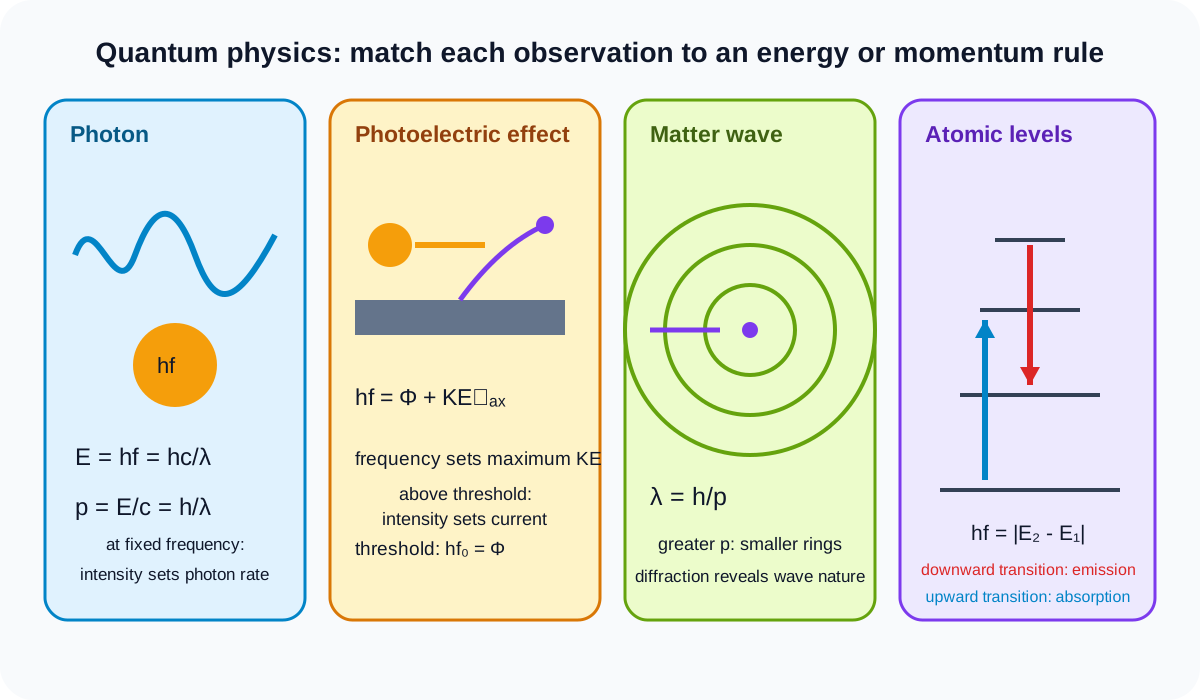
Electromagnetic radiation has a particulate nature as well as wave behaviour. A photon is one quantum, or discrete packet, of electromagnetic energy.
Photon energy is
E=hf,
where h is the Planck constant and f is radiation frequency. Since c = f lambda in vacuum:
E=λhc.
Check this topic from memory
Attempt the matching topic bank before reopening the notes. Use each missed idea to decide what to review next.
Higher frequency means greater energy per photon. Greater intensity at fixed frequency means more photon energy arrives per unit area per unit time, normally through a greater photon arrival rate, not greater energy per photon.
A photon also has momentum:
p=cE=λh.
Photons have momentum even though they have no rest mass in this model. Do not apply the non-relativistic massive-particle formula p = mv to a photon.
Electronvolt
The electronvolt is a unit of energy. One electronvolt is the energy transferred when a charge of magnitude e moves through a potential difference of one volt:
1eV=eJ.
To convert eV to joules, multiply the numerical eV value by elementary charge in coulombs. To convert joules to eV, divide by it.
Electronvolt is not a unit of voltage and not restricted to electrons. Kiloelectronvolt and megaelectronvolt are convenient for atomic and nuclear energy scales.
22.2 Photoelectric effect
Observations and terms
Photoelectrons may be emitted from a metal surface when electromagnetic radiation illuminates it.
Threshold frequency f0 is the minimum radiation frequency that can cause photoelectric emission from a given surface. Threshold wavelength lambda0 is the corresponding maximum wavelength:
λ0=f0c.
Radiation below threshold frequency cannot emit electrons regardless of intensity in the photon model. Radiation at or above threshold may do so.
Work function Phi is the minimum energy required to remove an electron from the metal surface. At threshold:
Φ=hf0=λ0hc.
Einstein photoelectric equation
One photon transfers its energy to one electron. Part of the energy overcomes the work function; the remainder can become maximum electron kinetic energy:
hf=Φ+21mvmax2.
Equivalently,
EK,max=hf−Φ.
The maximum label matters because electrons originate at different depths and can lose different amounts of energy before leaving.
For a graph of maximum kinetic energy against frequency, gradient is h, the frequency-axis intercept is f0 and the energy-axis intercept extrapolates to minus Phi.
Frequency and intensity effects
Increasing frequency above threshold raises energy per photon and therefore raises maximum photoelectron kinetic energy.
Increasing intensity at fixed frequency raises photon arrival rate. More photons can release more electrons per unit time, so photoelectric current increases, provided collection conditions are comparable.
Maximum kinetic energy remains independent of intensity because each emitted electron absorbs one photon whose energy hf has not changed.
Below threshold, a larger arrival rate of individually inadequate photons still does not provide emission in this one-photon interaction model.
The lack of a classically expected energy-accumulation delay and the frequency threshold support the particulate model of radiation.
22.3 Wave-particle duality
Evidence depends on experiment
The photoelectric effect provides evidence for the particulate nature of electromagnetic radiation. Interference and diffraction provide evidence for its wave nature.
This is wave-particle duality: one simple classical picture does not predict every observation. The experimental arrangement determines which behaviour is revealed.
Do not say radiation changes physically from a wave into a particle. Wave and particle models describe complementary observed properties.
Electron diffraction
Electrons directed at a thin crystalline material produce a diffraction pattern of rings or spots. A regular crystal lattice provides atomic-scale spacings comparable with electron wavelength, so scattered electron waves interfere.
Changing electron momentum changes the diffraction pattern. Greater accelerating potential gives greater momentum and a smaller associated wavelength, so diffraction angles or ring diameters decrease under otherwise fixed geometry.
The pattern is qualitative evidence that particles have wave behaviour. Individual localized detections build a statistical diffraction pattern, linking particle-like arrival with wave-like probability distribution.
De Broglie wavelength
A moving particle of momentum p has associated de Broglie wavelength
λ=ph.
For a non-relativistic particle p = mv:
λ=mvh.
Greater momentum gives shorter wavelength. For macroscopic objects, h is so small relative to momentum that wavelength is unobservably tiny in ordinary conditions.
For a particle accelerated from rest through potential difference V, electrical energy qV becomes kinetic energy:
qV=2mp2,
so momentum and de Broglie wavelength can be found without first calculating speed. This derivation assumes non-relativistic motion.
22.4 Energy levels in atoms and line spectra
Discrete levels
Electrons in an isolated atom occupy discrete energy levels rather than a continuous range. Each element has its own allowed level structure.
An electron can change level only by an energy difference matching the transition. It does not occupy energies between allowed stationary levels in this model.
Ground state is the lowest allowed energy. Higher levels are excited states. Energy values are often negative when zero is assigned to a free electron at infinity; a less negative level is higher.
Emission spectra
When an electron falls from higher level E1 to lower level E2, the atom emits a photon:
hf=E1−E2.
Only particular differences occur, so only particular frequencies and wavelengths appear. An emission spectrum consists of bright lines on a dark background.
A larger energy drop produces a higher-frequency, shorter-wavelength photon. The photon energy equals the level difference, not either level value alone.
Several possible transitions can produce multiple lines. Different transitions can occasionally have equal energy differences, so line count need not equal transition count without inspecting the levels.
Absorption spectra
An atom can absorb a photon when its energy exactly matches an allowed upward transition from an occupied lower level. The transmitted continuous spectrum then contains dark lines at absorbed wavelengths.
Absorption lines do not include every possible pair of levels if the necessary lower state is unoccupied. In a cool gas, many atoms begin in the ground state, so upward transitions from that state dominate.
After excitation, atoms may return through one or several downward steps, emitting photons whose energies match those steps.
Emission and absorption lines from the same element correspond to the same energy-level differences, though their appearance and population conditions differ.
Connecting spectra to evidence
Line spectra are evidence for quantized atomic energy levels because a continuous range of electron energies would allow a continuous range of photon frequencies.
Use an energy-level diagram with horizontal lines, upward arrows for absorption and downward arrows for emission. Arrow length represents energy difference, not time or physical distance travelled by the electron.
Theory and practical ownership
This theory note covers photon equations, photoelectric evidence, de Broglie reasoning, discrete levels and spectral transitions.
Practical work covers illumination control, stopping-potential circuits if supplied, diffraction apparatus, accelerating-voltage measurement, spectrometer calibration, uncertainty and safety. Those execution details remain in the practical hub rather than being folded into theory.
Worked application: photoelectric threshold and electron wavelength
A metal has work function 2.2eV and is illuminated by photons of energy 3.6eV. Maximum photoelectron kinetic energy is 1.4eV, or 2.24⋅10−19J, giving speed v=2EK/m=7.02⋅105m⋅s−1. Its de Broglie wavelength is h/(mv)=1.04⋅10−9m. Increasing light intensity releases more electrons per second but leaves this maximum energy unchanged. Increasing photon frequency would instead increase both maximum momentum and the corresponding photoelectron energy while decreasing de Broglie wavelength.
Common misconceptions and corrections
Calling a photon a continuous wave packet with arbitrary energy. Its energy is hf.
Saying greater intensity means greater photon energy. Frequency sets energy per photon.
Using wavelength proportional to photon energy. Energy is inversely proportional to wavelength.
Using p = mv for a photon. Use E/c or h/lambda.
Calling electronvolt a voltage. It is an energy unit.
Dividing by e when converting eV to joules. Multiply.
Saying photoelectric emission occurs at every frequency if intensity is high enough. A threshold exists.
Calling threshold wavelength the minimum wavelength. It is the maximum that can emit.
Defining work function as total electron energy. It is minimum removal energy.
Using intensity in Einstein's energy equation. One-photon energy depends on frequency.
Omitting maximum from kinetic energy. Electrons can lose energy before escape.
Saying intensity raises maximum kinetic energy. It raises current at fixed frequency.
Saying frequency only raises current. It raises maximum kinetic energy above threshold.
Adding photon energies from repeated sub-threshold photons in the simple model. One photon interacts with one electron.
Saying the photoelectric effect proves wave behaviour. It supports particulate behaviour.
Saying diffraction proves particles have no localized detections. Individual arrivals still occur.
Calling wave-particle duality a literal shape change. It concerns complementary experimental behaviour.
Saying electron diffraction is caused by electron collisions only. Interference of matter waves produces the pattern.
Saying greater electron momentum gives greater wavelength. Wavelength is h/p.
Using de Broglie wavelength for a stationary particle by dividing by zero. The relation concerns moving-particle momentum.
Using p = mv at relativistic speeds without checking. That form is non-relativistic.
Saying atomic electron energies form a continuum. Isolated atoms have discrete levels.
Calling the least negative energy the ground state. Ground is the lowest level.
Using one level energy instead of a difference for photon energy. Transitions use E1 minus E2.
Drawing emission arrows upward. Emission is a downward transition.
Drawing absorption arrows downward. Absorption raises electron energy.
Saying every incoming photon is absorbed. Its energy must match an allowed transition.
Calling emission spectra dark lines on a bright continuum. Those describe absorption.
Saying larger energy drop gives longer wavelength. It gives shorter wavelength.
Assuming every pair of levels appears in absorption. Initial-state population matters.
Saying line width represents electron travel time. Diagram spacing represents energy.
Calling spectral lines evidence for continuous levels. Their discreteness supports quantization.
Assessment guidance
Identify whether the question concerns one photon, a photon rate, one electron or an atomic transition. Convert electronvolts and joules before mixing constants. In photoelectric problems, compare hf with work function first, then calculate maximum kinetic energy; discuss intensity through photon count and current rather than electron energy. For matter waves, calculate momentum before wavelength and state non-relativistic assumptions when using mv. On energy-level diagrams, preserve signed level order but use a positive energy difference for photon magnitude. Match arrow direction to absorption or emission and convert between energy, frequency and wavelength consistently.
Retrieval practice
Convert photon frequency, wavelength, energy and momentum in one chain. Explain every photoelectric observation with the one-photon model and sketch maximum kinetic energy against frequency. Predict how electron diffraction changes with accelerating potential. Build an atomic energy-level diagram, enumerate allowed emission and absorption transitions, and calculate each line wavelength from its energy difference.