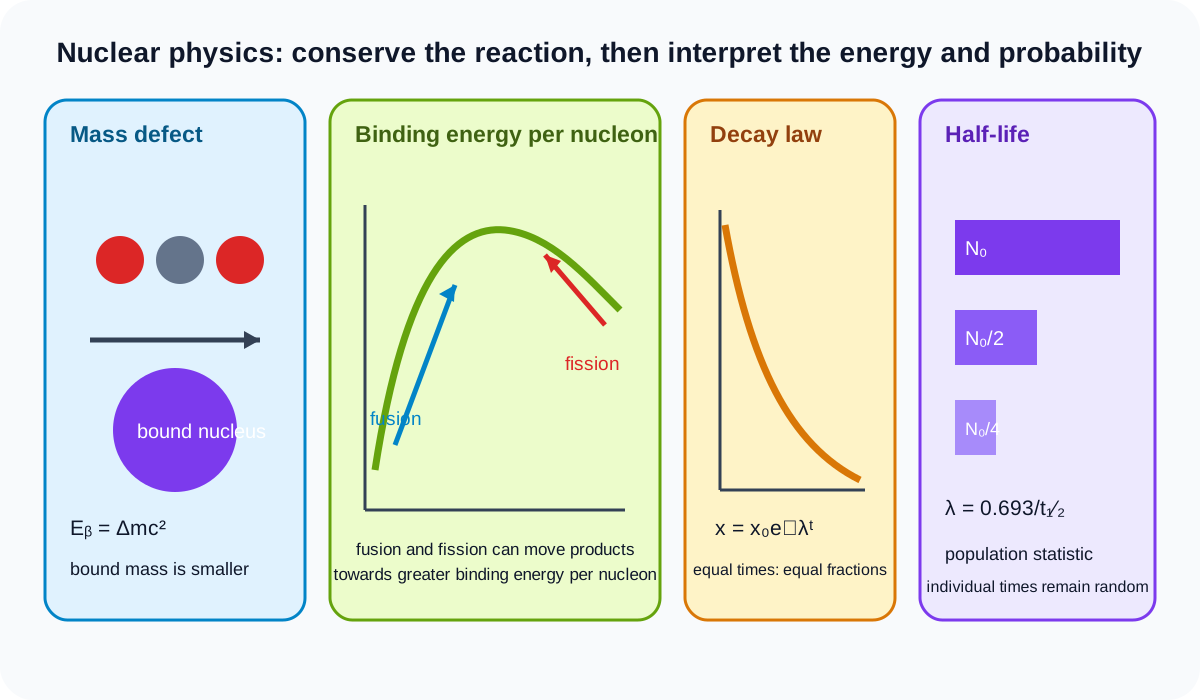
Nuclear physics is Topic 23 of the Cambridge International AS and A Level Physics 9702 additional A Level content. Sections 23.1 and 23.2 connect mass-energy equivalence and binding energy to fission and fusion, then develop spontaneous random decay through activity, decay constant, half-life and exponential graphs.
23.1 Mass defect and nuclear binding energy
Mass-energy equivalence
Mass and energy are equivalent. A change in rest mass delta m corresponds to energy change
E=Δmc2.
Because c squared is very large, a small mass difference can correspond to substantial energy.
Use kilograms with metres per second to obtain joules. If masses are supplied in unified atomic mass units, convert the mass difference consistently before applying c squared or use a valid supplied energy equivalent.
Do not interpret mass as disappearing without an energy account. Total mass-energy is conserved even when measured rest mass of products differs from that of reactants.
Nuclear equations
A simple nuclear equation must conserve nucleon number and charge number. Write nuclides with nucleon number as upper left and proton number as lower left.
For a reaction
ZAX+zaY→CBW+dbR,
Check this topic from memory
Attempt the matching topic bank before reopening the notes. Use each missed idea to decide what to review next.
These balances identify missing particles but do not by themselves prove energy, momentum or lepton bookkeeping. Apply every conservation law relevant to the stated process.
Atomic masses can be used in many balanced reactions when electron counts cancel, but do not mix atomic and bare nuclear masses without accounting for electrons.
Mass defect
Mass defect of a nucleus is the difference between the total mass of its separate constituent nucleons and the mass of the bound nucleus:
Δm=Zmp+(A−Z)mn−mnucleus.
The bound nucleus has smaller mass than its separated nucleons. The corresponding binding energy is
EB=Δmc2.
Binding energy is the minimum energy required to separate a nucleus completely into its nucleons. The same magnitude is released when separated nucleons form the nucleus under an energy-conserving process.
Mass defect is not missing measurement error. It represents system binding energy through mass-energy equivalence.
Binding energy per nucleon
Binding energy per nucleon is total binding energy divided by nucleon number A:
AEB.
It indicates average binding and is useful for comparing nuclear stability. A larger value generally means more energy per nucleon is required to separate the nucleus.
The graph rises steeply for light nuclei, reaches a broad maximum near medium nucleon numbers around iron, then falls gradually for very heavy nuclei.
Do not sketch binding energy per nucleon as total binding energy. Total binding energy can continue to grow for larger nuclei even while the average per nucleon declines.
Fusion
Nuclear fusion joins light nuclei to form a heavier nucleus. If products lie higher on the binding-energy-per-nucleon curve, total binding energy increases and rest mass decreases. The mass difference is released as energy.
Fusion of light nuclei can release energy because the product nucleons are more strongly bound on average. Charge repulsion creates an approach barrier; the binding-energy explanation covers energy release, not the detailed reaction-rate conditions.
Fission
Nuclear fission splits a heavy nucleus into two or more lighter nuclei, often with neutrons. If fragments lie higher on the binding-energy-per-nucleon graph than the original heavy nucleus, total binding energy increases and energy is released.
Conserve nucleon and charge numbers in every fission equation. Neutrons can initiate and emerge from fission, enabling further reactions, but reactor engineering is outside this topic boundary.
Reaction energy
For any nuclear reaction, calculate initial total rest mass and final total rest mass:
Δm=minitial−mfinal.
If delta m is positive, released energy is delta m c squared. If final rest mass is greater, the process requires net energy input of the corresponding magnitude.
Binding-energy reasoning and direct mass-difference calculation must agree. A move toward greater total binding corresponds to lower rest mass.
23.2 Radioactive decay
Spontaneous and random decay
Radioactive decay is spontaneous: it occurs without being triggered by ordinary external conditions. It is random: the exact time at which any particular unstable nucleus decays cannot be predicted.
Random does not mean the population has no predictable pattern. A large number of nuclei shows statistically stable exponential behaviour.
Repeated count measurements fluctuate even when source-detector geometry and averaging interval are unchanged. These fluctuations are evidence of random decay. A longer counting interval usually reduces fractional statistical fluctuation, although the count remains random.
Background radiation also fluctuates. When estimating source count rate, measure background over a suitable interval and subtract its mean rate from the measured total rate.
Activity and decay constant
Activity A is rate of decay, the number of nuclear decays per unit time. Its unit is the becquerel, one decay per second.
For N undecayed nuclei:
A=λN,
where decay constant lambda is probability per unit time that an individual nucleus decays. Its unit is inverse seconds if time is in seconds.
A larger decay constant means a greater decay probability per unit time and therefore a shorter half-life.
Received count rate is not generally equal to source activity because a detector captures only a fraction of emissions and may have incomplete efficiency. It follows the same decay factor if geometry, efficiency and background correction remain constant.
Exponential decay
Number of undecayed nuclei follows
N=N0e−λt.
Since A = lambda N, activity follows the same form:
A=A0e−λt.
Background-corrected received count rate can likewise be represented as
x=x0e−λt.
The graph starts at x0, falls most steeply initially and approaches zero asymptotically. Equal time intervals produce equal fractional decreases, not equal absolute decreases.
The instantaneous gradient satisfies
dtdx=−λx.
Taking natural logarithms gives
lnx=lnx0−λt.
A graph of ln x against t is straight with gradient minus lambda. Use positive background-corrected magnitudes; noisy late data can make logarithmic treatment unreliable if subtraction produces zero or negative estimates.
Half-life
Half-life is time for activity or number of undecayed nuclei to fall to half its initial value.
Set x/x0 equal to one half in the exponential relationship:
t1/2=λln2=λ0.693.
Equivalently,
λ=t1/20.693.
After n half-lives, fraction remaining is
(21)n.
Half-life is a population statistic. It is not the lifetime of every nucleus and does not mean all nuclei have decayed after two half-lives.
Choosing a decay method
Use repeated halving when time is an exact number of half-lives. Use the exponential for arbitrary time. Use a logarithmic graph when estimating decay constant from multiple data points.
If a question provides measured count rate, correct for background before applying a half-life ratio unless it explicitly states that the values are already corrected.
Theory and practical ownership
This theory note covers binding definitions, reaction accounting, decay probability, activity, exponential relationships and graph interpretation.
Practical work covers source handling, distance and shielding controls, detector dead time if supplied, background measurement, counting intervals, repeated measurements, uncertainty and radiation safety. The practical hub carries execution detail.
Worked application: reaction energy and decay ledger
A reaction has initial mass 4.0319u and final mass 4.0026u, so mass decrease is 0.0293u. Using 1u=1.6605⋅10−27kg, released energy is Δmc2=4.38⋅10−12J, or about 27.3MeV. A product has half-life 6.0 h, so after 15 h the remaining fraction is 2−15/6=0.177. Its decay constant is 0.693/6.0=0.1155h−1. Mass-energy release and exponential population change are separate calculations joined only by the stated reaction and isotope.
Common misconceptions and corrections
Using E = mc squared with total mass instead of mass change. Reaction energy uses delta m.
Saying mass disappears. Mass-energy is conserved.
Mixing kilograms and atomic mass units in one substitution. Convert consistently.
Balancing only nucleon number. Charge number must also balance.
Treating a balanced nuclear equation as proof of all conservation laws. Check energy and momentum too.
Mixing atomic and nuclear masses without electron accounting. Use a consistent mass type.
Defining mass defect as nucleus mass minus nucleon mass. Use separated nucleons minus bound nucleus.
Calling mass defect measurement error. It corresponds to binding energy.
Defining binding energy as energy released by any reaction. It is minimum separation energy for a nucleus.
Using total binding energy to compare average stability. Use binding energy per nucleon.
Sketching binding energy per nucleon rising forever. It peaks then declines gradually.
Putting the peak at the heaviest nuclei. It is near medium nucleon number.
Saying fusion splits heavy nuclei. It joins light nuclei.
Saying fission joins light nuclei. It splits a heavy nucleus.
Explaining release only by lost nucleons. Nucleons are conserved while binding changes.
Saying every fusion or fission reaction releases energy. Check total binding or mass difference.
Using final minus initial mass for released energy without sign interpretation. Released energy uses mass decrease.
Calling radioactive decay predictable for each nucleus. Individual decay time is random.
Saying random decay has no population law. Large populations decay exponentially.
Saying spontaneous means instantaneous. It means untriggered by ordinary external control.
Treating count fluctuations as apparatus failure automatically. They are expected statistical evidence.
Ignoring background count rate. Subtract its mean when estimating source rate.
Defining activity as number of nuclei. It is decays per time.
Calling becquerel a count rather than per second. One Bq is one decay each second.
Saying decay constant is fraction already decayed. It is probability per unit time.
Saying larger lambda means longer half-life. The relationship is inverse.
Equating detector count rate exactly with activity. Efficiency and geometry matter.
Drawing exponential decay reaching zero at finite time. It approaches asymptotically.
Subtracting equal amounts in equal time intervals. Equal fractions are lost.
Using 0.693 times half-life for lambda. Divide 0.693 by half-life.
Saying every nucleus lasts one half-life. Half-life describes a population.
Applying logarithms to a negative background-corrected count. Use valid positive magnitudes.
Assessment guidance
Balance nucleon and charge numbers before calculating reaction mass. State whether masses are atomic or nuclear and convert units consistently. Define mass defect with separated nucleons as the larger reference, then connect a positive mass decrease to released energy. Use binding energy per nucleon, not total binding, to explain fusion and fission trends. In decay questions, separate source activity from received count rate, correct background when needed and select halving, exponential or logarithmic methods from the time information. Keep lambda units reciprocal to the chosen time unit and interpret half-life statistically.
Retrieval practice
Balance several reaction equations and calculate mass defect, binding energy and energy release. Sketch and annotate binding energy per nucleon, explaining both fusion and fission on the same graph. From one noisy count-rate data set, subtract background, estimate half-life, calculate decay constant, linearise the exponential and explain why individual events remain unpredictable.