Cambridge International AS and A Level Physics 25: Astronomy and cosmology
Cambridge International AS and A Level Physics 25: Astronomy and cosmology
Study guide/
Cambridge Physics 9702 A Level notes on luminosity and standard candles, stellar temperature and radius, spectral redshift, Hubble's law, expansion and the Big Bang theory.
Astronomy and cosmology is Topic 25 of the Cambridge International AS and A Level Physics 9702 additional A Level content. Sections 25.1 to 25.3 connect observed radiant flux and spectra to stellar distance, temperature and radius, then use redshift and Hubble's law as evidence for an expanding Universe and the Big Bang model.
25.1 Standard candles
Luminosity and radiant flux intensity
Luminosity L is the total power of radiation emitted by a star. Its unit is watt.
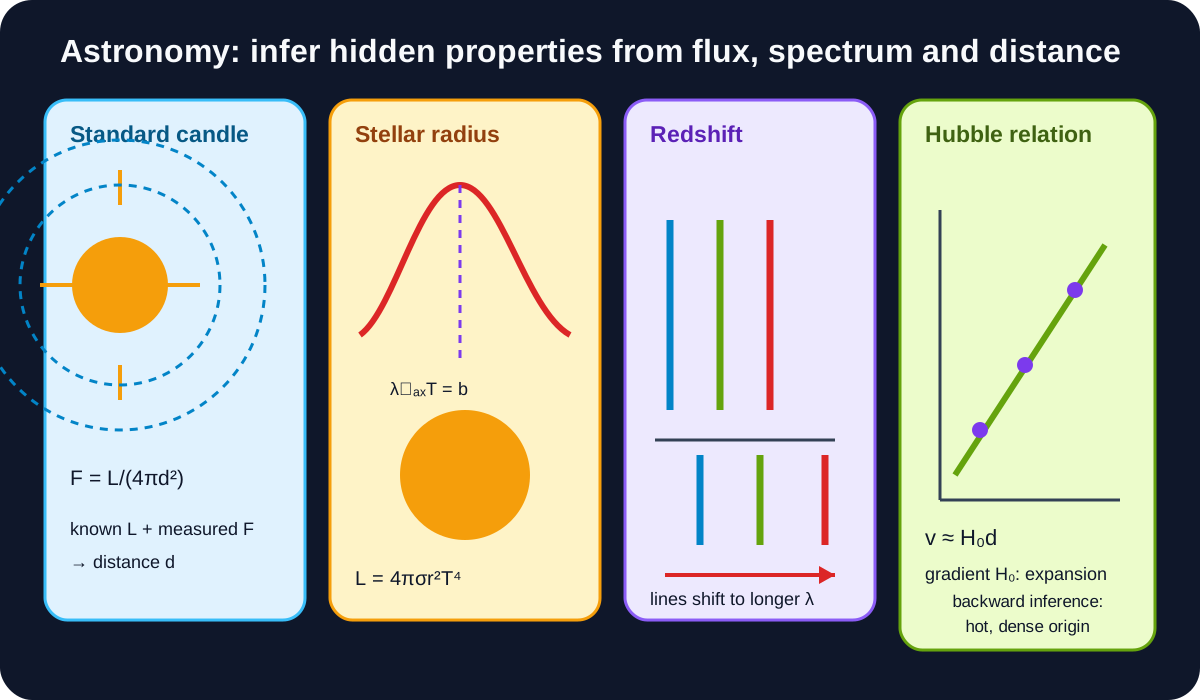
Radiant flux intensity F at distance d is received power per unit area. If a source radiates equally in all directions, its power is spread over a sphere of area 4 pi d squared:
F=4πd2L.
Check this topic from memory
Attempt the matching topic bank before reopening the notes. Use each missed idea to decide what to review next.
Its unit is watts per square metre. Luminosity belongs to the source; radiant flux intensity depends on source luminosity and observer distance.
Rearranging gives
d=4πFL.
Doubling distance reduces received intensity to one quarter. A star can appear faint because it has low luminosity, is far away, or both.
The inverse-square model assumes isotropic emission and no additional absorption or lensing correction unless the question supplies one.
Standard candles
A standard candle is an object of known luminosity. Compare its known L with measured radiant flux intensity F to determine distance.
The method is a calibrated inference. The object does not have to resemble a literal candle, and known apparent brightness alone is insufficient; luminosity must be known independently.
For a standard candle in another galaxy, calculated d estimates galaxy distance. Uncertainty in luminosity calibration propagates into distance, as does measurement uncertainty in received flux.
Since distance depends on square root of L/F, a fractional error in the ratio produces approximately half as large a fractional error in distance for small uncertainties.
25.2 Stellar radii
Wien's displacement law
A star's spectrum has a peak wavelength related to its surface temperature. Wien's displacement law states
λmaxT=b,
or lambda max proportional to inverse T, where b is Wien's displacement constant.
A shorter peak wavelength indicates a higher surface temperature. Use thermodynamic temperature in kelvin.
The peak belongs to the spectral distribution, not necessarily the wavelength at which one instrument records greatest signal after atmospheric and detector effects. Exam data normally provide or imply the intended peak.
Stefan-Boltzmann law
For a spherical star treated as a black-body radiator:
L=4πσr2T4,
where r is stellar radius and sigma is the Stefan-Boltzmann constant.
The surface area is 4 pi r squared. Luminosity rises with the fourth power of temperature, so modest temperature changes can strongly affect emitted power.
Rearrange for radius:
r=4πσT4L.
At equal temperature, a larger star has greater luminosity in proportion to r squared. At equal radius, doubling temperature multiplies luminosity by sixteen.
Combining the laws
Use observed peak wavelength to estimate T through Wien's law. Use luminosity, perhaps obtained from standard-candle or distance information, with T in Stefan-Boltzmann law to estimate r.
Keep three different quantities distinct:
observed flux intensity F at the detector;
total luminosity L emitted by the star;
surface flux represented implicitly by sigma T to the fourth power.
Substituting observed F directly for L in the stellar-radius equation omits the distance-dependent inverse-square step.
The black-body and spherical assumptions make these estimates models rather than exact descriptions of every star.
25.3 Hubble's law and the Big Bang theory
Spectral redshift
Atoms produce characteristic emission or absorption lines with known laboratory wavelengths. Lines observed from many distant galaxies appear at longer wavelengths than their known values.
This increase is redshift. Define
z=λΔλ.
For speeds small compared with c, the syllabus approximation connects wavelength, frequency and recession speed:
λΔλ≈−fΔf≈cv.
For a receding source, delta lambda is positive and delta f is negative. Use magnitudes if a question states redshift as a positive fraction.
The denominator should be the known rest wavelength or frequency. Do not divide by the shifted value unless a definition explicitly changes.
At high cosmological redshifts the simple low-speed Doppler approximation is incomplete, but the official boundary requires this relationship.
Expansion evidence
Systematic redshift of distant galaxies indicates that they are receding. This leads to the idea that the Universe is expanding.
Expansion does not mean every object locally grows or that galaxies necessarily travel through space away from one central point. The large-scale separation between galaxies increases; local gravitationally bound systems can behave differently.
One redshift alone does not establish the whole expansion relationship. The distance trend supplies the stronger evidence.
Hubble's law
Hubble's law relates recession speed v to distance d:
v≈H0d,
where H0 is the Hubble constant.
A graph of v against d is approximately linear through the origin in the simple model, with gradient H0. The syllabus requires SI units, so use v in metres per second, d in metres and H0 in inverse seconds.
Astronomical Hubble units must be converted before substitution if they appear in supporting data. Do not mix kilometres per second, megaparsecs and SI without conversion.
Greater distance corresponding to greater recession speed supports a uniformly expanding large-scale Universe.
Big Bang inference
If present expansion is extrapolated backward, separations become smaller. This leads to the Big Bang theory: the Universe evolved from a much denser, hotter early state.
The reciprocal of H0 has units of time:
t∼H01.
It provides a simple expansion timescale, not an exact age without considering how expansion rate has changed over cosmic history.
Hubble's law is evidence supporting the Big Bang model through expansion. It is not a direct observation of an explosion at one location.
Evidence chain
Keep the inference sequence explicit:
identify known spectral lines;
measure their wavelength increase;
estimate recession speed with the supplied approximation;
determine distance independently, for example with standard candles;
observe the speed-distance trend;
infer large-scale expansion and backward convergence toward an early dense state.
This separates observation from interpretation and prevents circular reasoning in which redshift is used to obtain both speed and distance without an independent distance scale.
Theory and practical ownership
This theory note covers the inverse-square, Wien, Stefan-Boltzmann, redshift and Hubble relationships and their evidence chain.
Observational practice covers spectral calibration, detector response, standard-candle calibration, background subtraction, uncertainty, model fitting and telescope operation. These remain distinct from the equations explained in this note.
Worked application: from spectrum and flux to radius and expansion
A star has peak wavelength 500nm. With Wien constant 2.90⋅10−3m⋅K, its surface temperature is 5800K. If luminosity is 3.8⋅1026W, Stefan-Boltzmann law gives radius about 6.9⋅108m. A galaxy line shifts from 500.0 nm to 500.5 nm, so z=0.0010 and recession speed is about 3.0⋅105m⋅s−1. With independently measured distance, this point contributes to a v-d graph whose gradient estimates H0. Stellar inference and cosmic expansion require different independently calibrated observations.
Common misconceptions and corrections
Defining luminosity as received brightness. It is total emitted power.
Giving luminosity units per square metre. Those belong to radiant flux intensity.
Using inverse distance rather than inverse square. Emitted power spreads over spherical area.
Using stellar radius as observer distance. The inverse-square d is source-observer separation.
Saying every faint star has low luminosity. It may be distant.
Calling an object of known distance a standard candle. Its defining known quantity is luminosity.
Using apparent flux alone to find distance. Known luminosity is also required.
Forgetting the square root when rearranging distance. d squared appears in the law.
Saying longer peak wavelength means higher temperature. Wien's relation is inverse.
Using Celsius in Wien's law. Use kelvin.
Calling one spectral line the entire black-body peak automatically. Identify the continuum peak.
Using pi r squared for a star's emitting surface. Use 4 pi r squared.
Using T squared in Stefan-Boltzmann law. Luminosity varies as T to the fourth.
Substituting received F for luminosity L. Convert through distance first.
Saying equal luminosity means equal radius. Temperature also matters.
Treating every star as an exact black body. The law is a model estimate.
Calling any line displacement redshift. Redshift is toward longer wavelength.
Using shifted wavelength in the denominator without checking. Use the known rest value.
Giving positive frequency change for a receding source. Frequency decreases.
Omitting the minus sign between fractional wavelength and frequency change. Their changes oppose.
Using the low-speed relation at arbitrary relativistic redshift. Respect its approximation boundary.
Saying redshift alone gives galaxy distance in this topic. It first estimates recession speed.
Saying the Universe expands from a central galaxy. Large-scale separations increase without a required centre in the model.
Saying every local system expands. Bound systems can resist cosmic expansion.
Using v divided by d as distance. It estimates H0.
Using non-SI Hubble units directly when SI is required. Convert both speed and distance.
Calling 1/H0 an exact age. It is a simple expansion timescale.
Describing the Big Bang as an explosion at one point in existing space. It is an early hot, dense state of the expanding Universe.
Using redshift to infer both speed and independent standard-candle distance. Keep the evidence routes separate.
Presenting theory before observation as proof. State the measured spectral and distance evidence first.
Assessment guidance
Label luminosity and received flux with their different units before applying inverse square. Use standard-candle luminosity and measured F to obtain distance. Convert peak wavelength to metres and temperature to kelvin before combining Wien and Stefan-Boltzmann laws, and retain the full stellar surface area. For redshift, identify rest and observed wavelengths, preserve the frequency-change sign and state the low-speed approximation. Convert Hubble data to SI, find H0 from the v-d gradient and describe reciprocal H0 as an approximate timescale. Separate measured observations from expansion and Big Bang inferences.
Retrieval practice
Calculate standard-candle distance from luminosity and flux, then combine Wien and Stefan-Boltzmann laws to infer a stellar radius. Match shifted spectral lines to rest values and estimate redshift and recession speed. Build a Hubble graph in SI units, interpret its gradient and reciprocal, and write the full observation-to-Big-Bang evidence chain without circular distance reasoning.