Loading blog content…
Loading page…
Loading blog content…
Free notes for all 13 SEAB 9476 topics. For calculation mistakes, start with Mole Concept or Chemical Equilibria. For reactions and conditions, choose Organic Chemistry. Follow the explanation and examples, then try a question. Read online or download the complete PDF.
Free to use, with no sign-in required
Last updated: 2026-10-12
This hub is organised around the 13 numbered topics in the SEAB 9476 syllabus. You can download the combined notes PDF or individual topic PDFs, but use the official syllabus learning outcomes as the final scope checklist for your examination year.
Yes - scroll to the topic list and use the “Download PDF” link for each chapter (Atomic Structure → Transition Elements), or use the full bundle PDF at the top.
The hub tracks the SEAB H2 Chemistry 9476 structure across all 13 numbered topics and links exam-format guidance for Papers 1 to 4. The official syllabus remains the final authority on assessable learning outcomes.
Last reviewed: 4 August 2026. SEAB is the final authority on syllabus scope and examination arrangements.
Yes. SEAB lists H2 Chemistry syllabus 9476 for school candidates in both 2026 and 2027. The separate 9729 syllabus has its last examination in 2026, so students should use the syllabus code assigned by their school and examination year.
SEAB provides a Chemistry Data Booklet, including the Periodic Table, for the theory papers. It is a reference booklet rather than a complete list of every equation or fact candidates may need. Use the formula-sheet guide on this page to distinguish provided data from material to learn.
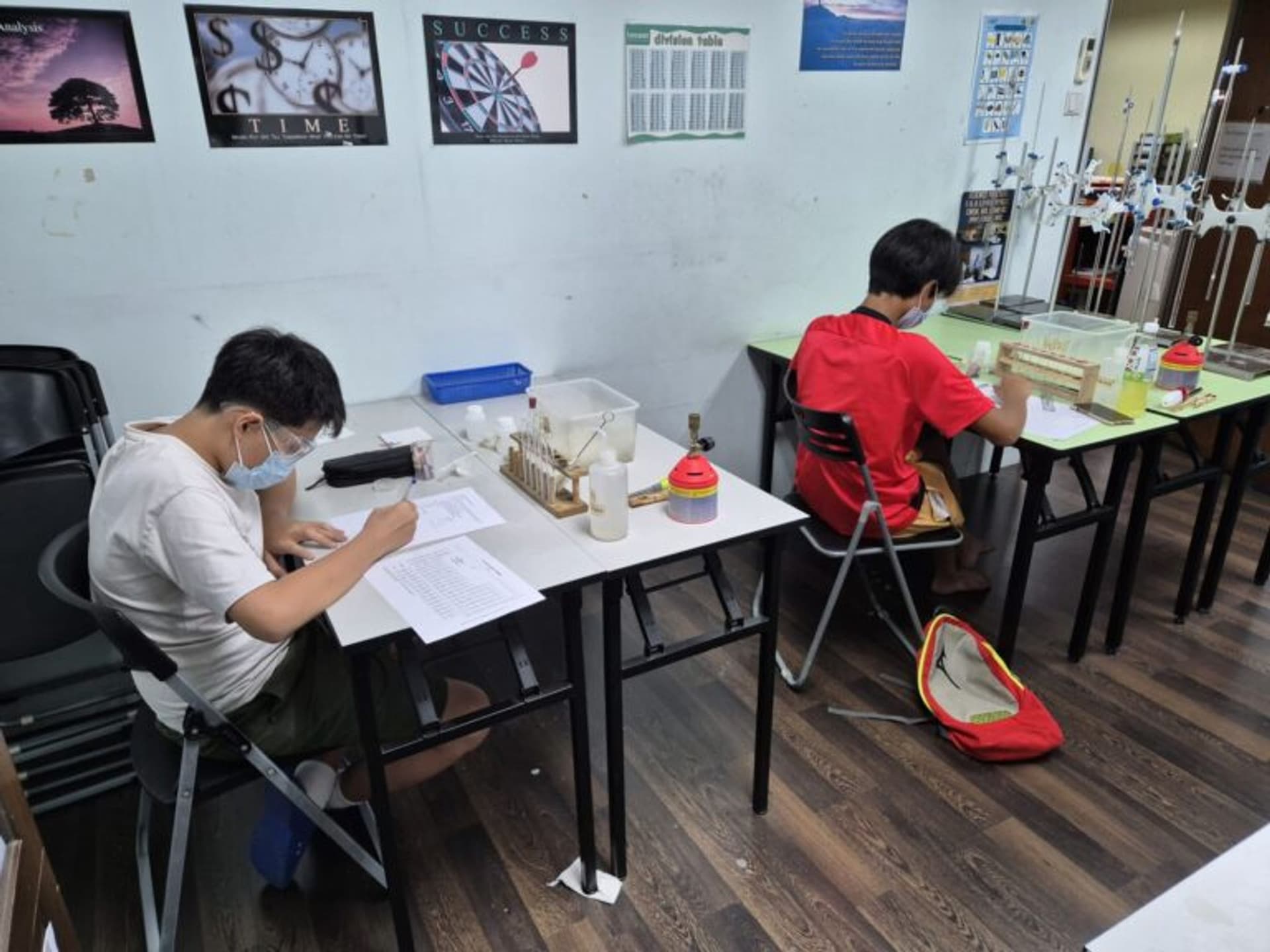
Use the Paper 1 to 4 format guides for pacing and mark breakdowns. For Paper 4, practise planning and the manipulation, measurement, observation, presentation, data handling, analysis, conclusion, and evaluation skills identified in the official syllabus.
The official SEAB Data Booklet shared by H1 Chemistry 8873 and H2 Chemistry 9476 is linked from the data-booklet guide on this hub. SEAB says candidates receive it for the theory papers. The Qualitative Analysis Notes are separately made available for the Paper 4 practical assessment. H3 Chemistry 9813 has a separate data booklet.
The official SEAB H2 Chemistry (9476) syllabus PDF is available for free download from the SEAB A-Level syllabuses page. Our H2 Chemistry Syllabus 2026-27 guide links directly to the official PDF and covers paper format, topic list, specimen papers, and the companion data booklet.
The SEAB Chemistry Data Booklet for 8873 and 9476 includes the Periodic Table and reference data used in the theory papers. The Qualitative Analysis Notes appear in the syllabus appendix and are made available for Paper 4. It is not a complete formula sheet, so check the current official booklet rather than relying on a memorised list of contents.
Yes - the SEAB Chemistry Data Booklet includes a Periodic Table of Elements. Use the Data Booklet guide when you need the official PDF, and use Topic 5 Periodic Table notes when you need to explain trends, Period 3 oxides and chlorides, Group 2, or Group 17.
Yes - all our H2 Chemistry notes are free. Download the full bundle PDF or grab individual topic PDFs from the Topic Outline below. We cover all 13 H2 Chemistry topics (Atomic Structure through Transition Elements), aligned to SEAB 9476.
If Organic Chemistry feels hardest, start with Topic 11 and draw every functional-group conversion before attempting synthesis questions. If calculations break down instead, move to Chemical Equilibria or Electrochemistry and drill the equation setup before timed practice.
The SEAB 9476 syllabus has 13 numbered topics: (1) Atomic Structure, (2) Chemical Bonding, (3) The Gaseous State, (4) Theories of Acids and Bases, (5) The Periodic Table, (6) Mole Concept and Stoichiometry, (7) Chemical Energetics, (8) Reaction Kinetics, (9) Chemical Equilibria, (10) Chemistry of Aqueous Solutions, (11) Organic Chemistry, (12) Electrochemistry, and (13) Chemistry of Transition Elements. SEAB organises Topics 1 to 9 under core ideas and Topics 10 to 13 as extension topics.
For 2026 school candidates, SEAB lists H2 Chemistry 9476 and separately lists 9729 with its last year of examination in 2026. Use the 9476 syllabus guide on this hub for current paper structure, topic routing, data booklet use, and Paper 4 planning.
Start by reading each topic summary to identify your weak areas. Then download the relevant chapter PDF and work through the embedded examples. Cross-reference each chapter with the Data Booklet guide to know which constants and tables are provided. Finish by doing timed practice with the Paper 1 to 4 format guides linked on this page.
H1 and H2 Chemistry have different syllabus breadth and assessment structures. H2 9476 includes four papers, including Paper 3 structured questions and Paper 4 practical assessment. Compare the current official syllabuses, and check each university course's admissions page for the relevant intake year.
Do not use a generic grade target for admissions planning. Check the official admissions page for each course and intake year, because subject prerequisites and grade profiles vary across universities and can change.
Use the Organic Synthesis Flowchart guide to link functional groups with the reactions that convert one to another. Then try writing a mechanism without looking at the solution: draw the curly arrows, label the nucleophile and electrophile, and state the conditions. Compare your answer with the worked example and correct mistakes.
Start active recall and spaced practice early, using the sequence taught by your school. SEAB organises the content as core ideas and extension topics but does not prescribe a universal JC1/JC2 split. Use the study plan on this page as an adaptable revision framework, then move into timed-paper practice when your taught coverage permits.