

Cambridge IGCSE Additional Mathematics Notes 1: Functions
Cambridge IGCSE Additional Mathematics 0606 notes on domains, ranges, inverse and composite functions, modulus graphs and notation.
Cambridge IGCSE Additional Mathematics 0606 Topic 1 treats a function as a mapping with a stated domain and image set. The chapter includes one-one and many-one mappings, inverse and composite functions, modulus output graphs, and the domain restrictions needed for an inverse or composite to exist.
1. Function, domain and range
A function assigns exactly one output to each input in its domain. Different inputs may share an output, so a many-one mapping can still be a function. A relation fails to be a function when one permitted input has more than one output.
The domain is the permitted input set. The range, or image set, contains outputs actually produced. Domain restrictions can arise from:
- denominators, which cannot equal zero;
- even roots, whose real radicands must be non-negative;
- logarithms, whose arguments must be positive;
- a context, such as time or length being non-negative.
Find a range by studying the graph, solving for possible outputs or using a known extremum. State intervals with correct strict or inclusive endpoints.
2. One-one and many-one functions
A one-one function never gives the same output to two different domain inputs. Graphically, every horizontal line meets its graph at most once. A many-one function gives at least one shared output and therefore fails this horizontal-line test.
An inverse function exists only when the original is one-one on its stated domain. A quadratic on all real numbers is many-one, but restricting it to one side of its turning point makes it one-one. Explain the failure in words when asked: two different inputs produce the same output, so reversing the mapping would give one input more than one output.
3. Function notation
Notation such as f(x) means the value produced by f at x. The mapping notation f: x maps to lg x, x > 0 states both rule and domain. The expression f²(x) means f(f(x)) in this syllabus and is not used with trigonometric functions. It does not mean [f(x)]².
Substitute the whole input using brackets. If f(x) = 2x - 3, then f(x + 1) = 2(x + 1) - 3, not 2x + 1 - 3 by an unexplained shortcut.
4. Composite functions
The syllabus uses fg(x) = f(g(x)), so the rightmost function acts first. Composition is normally not commutative: fg and gf can have different rules, domains and ranges.
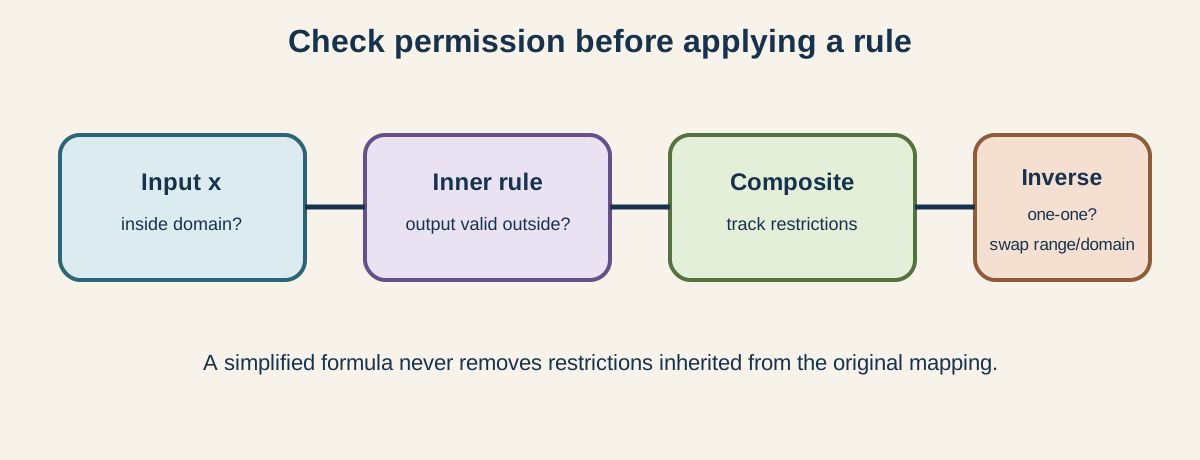
For gf to exist at x, x must lie in the domain of f and f(x) must lie in the domain of g. This is why the domain of gf is a subset of the domain of f and its range is a subset of the range of g. Check the inner output before simplifying an algebraic rule.
Check this topic from memory
Attempt the matching topic bank before reopening the notes. Use each missed idea to decide what to review next.
Start the topic quiz