

Cambridge IGCSE Additional Mathematics Notes 2: Quadratic Functions
Cambridge IGCSE Additional Mathematics notes on completing the square, discriminants, roots, ranges and quadratic inequalities.
Cambridge IGCSE Additional Mathematics 0606 Topic 2 connects algebraic form, turning point, range, roots, intersections and inequalities. Candidates find extrema by completing the square or differentiation, use the discriminant geometrically, and solve real-root equations by factorisation, formula or completing the square.
1. Three useful forms
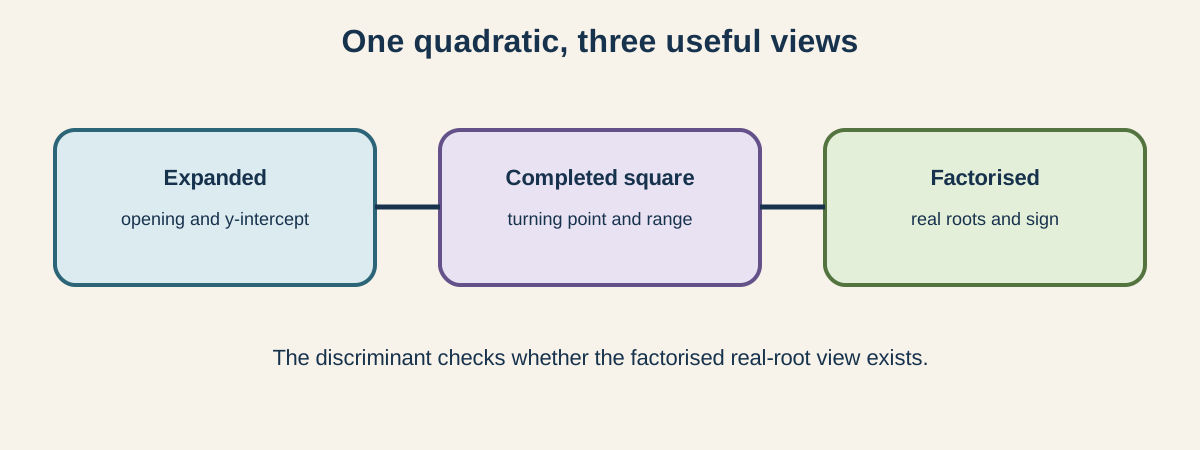
The expanded form ax² + bx + c reveals the leading coefficient and y-intercept. The sign of a determines whether the parabola opens upward or downward.
The completed-square form a(x - h)² + k reveals turning point (h, k), axis of symmetry x = h, and maximum or minimum k. The factorised form a(x - p)(x - q) reveals real roots p and q when they exist.
Choose a form from the required feature rather than expanding everything automatically. Each form represents the same function and should give consistent intercepts and turning point.
2. Completing the square
For x² + bx, add and subtract (b/2)². When the x² coefficient is not 1, factor it from the x terms first or use h = -b/(2a) and substitute for k.
For example, 2x² - 12x + 5 = 2[(x - 3)² - 9] + 5 = 2(x - 3)² - 13. The minimum is -13 at x = 3.
Differentiation provides another allowed route. If f(x) = ax² + bx + c, set f'(x) = 2ax + b to zero, then calculate f at that x. Completing the square usually gives the graph structure more directly.
3. Range for a stated domain
For an unrestricted upward parabola, the range begins at its minimum. For a downward parabola, the range ends at its maximum. A restricted domain may exclude the turning point or include finite endpoints, so evaluate all candidates that can produce an extremum.
Write the result with correct inequalities. If an endpoint is excluded from the domain and no other input produces its output, the corresponding range endpoint may also be excluded.
4. Discriminant and roots
For ax² + bx + c = 0, the discriminant is D = b² - 4ac:
- D > 0 gives two distinct real roots;
- D = 0 gives one repeated real root;
- D < 0 gives no real roots.
This algebra describes graph intersections with the x-axis. It also handles line-curve intersections: substitute the line equation into the curve to form a quadratic in one variable, then apply the discriminant. Two real solutions mean two intersections, zero discriminant means tangency, and a negative discriminant means no real intersection.
The discriminant classifies roots but does not give their values. Use a solution method if coordinates are required.
5. Solving quadratic equations
Check this topic from memory
Attempt the matching topic bank before reopening the notes. Use each missed idea to decide what to review next.
Start the topic quiz