

Cambridge IGCSE Additional Mathematics Notes 3: Factors of Polynomials
Cambridge IGCSE Additional Mathematics notes on factor and remainder theorems, polynomial division and cubic equations.
Cambridge IGCSE Additional Mathematics 0606 Topic 3 uses the remainder and factor theorems to reveal polynomial structure. Candidates find factors, divide a cubic into a linear and quadratic factor, and solve cubic equations completely.
1. Division and remainder structure
When polynomial f(x) is divided by x - a, the result can be written
f(x) = (x - a)q(x) + r,
where q(x) is the quotient and r is a constant remainder. Substituting x = a removes the product term, so f(a) = r. This is the remainder theorem.
The divisor x + a is x - (-a), so its remainder is f(-a). Translate the divisor into x minus root form before substituting to avoid a sign error.
2. Factor theorem
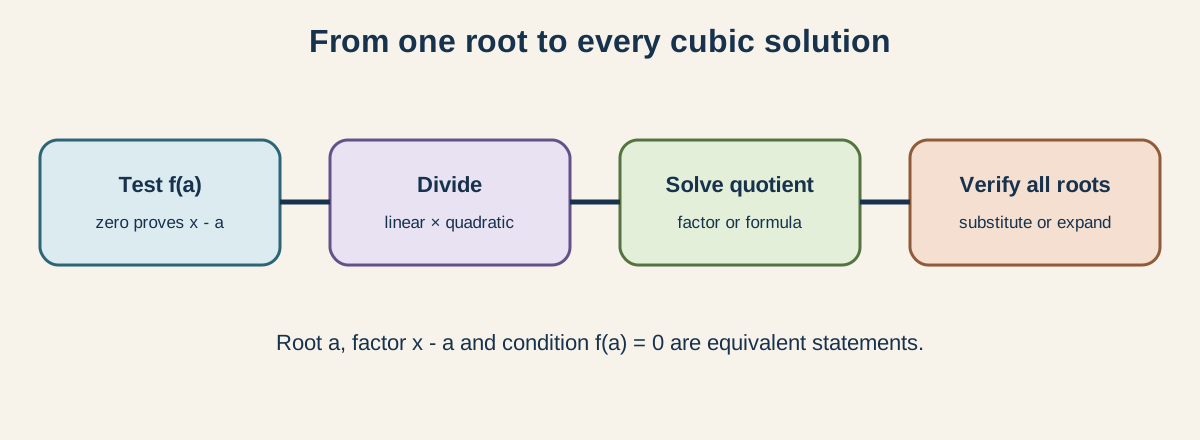
If f(a) = 0, the remainder on division by x - a is zero, so x - a is a factor. Conversely, if x - a is a factor, then a is a root of f(x) = 0.
The three statements are equivalent but use different objects:
- a is a root;
- x - a is a factor;
- f(a) = 0.
A root of -3 corresponds to factor x + 3. Keep this sign relationship visible.
3. Unknown coefficients and stated remainders
If a polynomial contains an unknown coefficient, a stated factor or remainder creates an equation for it. For example, if f(x) = x³ + kx - 5 has remainder 7 on division by x - 2, then f(2) = 7. Thus 8 + 2k - 5 = 7 and k = 2.
Two conditions can determine two unknown coefficients. Convert each condition separately before solving the simultaneous equations. A factor condition gives zero; a non-zero remainder must not be accidentally replaced by zero.
4. Finding a first cubic factor
For an integer-coefficient cubic, possible integer roots are among factors of the constant term divided by factors of the leading coefficient. Test simple candidates efficiently using substitution. A graph or question information may also reveal a root.
Once a root a is found, divide by x - a. Cambridge expects the cubic first to become a linear factor multiplied by a quadratic factor, using observation or algebraic long division.
5. Polynomial long division
Write terms in descending powers and insert zero coefficients for missing powers. Divide the leading term, multiply the divisor by that quotient term, subtract the entire product, then bring down the next term. Repeat until the remainder has lower degree than the divisor.
Check by expanding divisor × quotient + remainder. This reconstruction catches most subtraction and missing-term errors.
Synthetic division can check arithmetic, but long division displays the polynomial structure and works without relying on a memorised shortcut.
Check this topic from memory
Attempt the matching topic bank before reopening the notes. Use each missed idea to decide what to review next.
Start the topic quiz