

Cambridge IGCSE Additional Mathematics Notes 4: Equations, Inequalities and Graphs
Cambridge IGCSE Additional Mathematics notes on modulus equations, inequalities, substitutions and graphical solutions.
Cambridge IGCSE Additional Mathematics 0606 Topic 4 combines modulus equations and inequalities, quadratic substitutions, cubic and modulus sketches, and graphical cubic inequalities. It tests whether algebraic and graphical forms lead to the same valid solution set.
1. Meaning of modulus
The modulus |u| is the non-negative distance of u from zero. Therefore |u| = c has no real solution if c < 0, one breakpoint solution if c = 0, and usually two cases u = c or u = -c when c > 0.
Graphically, y = |f(x)| reflects every negative-output section of y = f(x) in the x-axis. Zeros stay fixed. This image supports equations as intersections and inequalities as regions where one graph lies above or below another.
2. Linear modulus equations
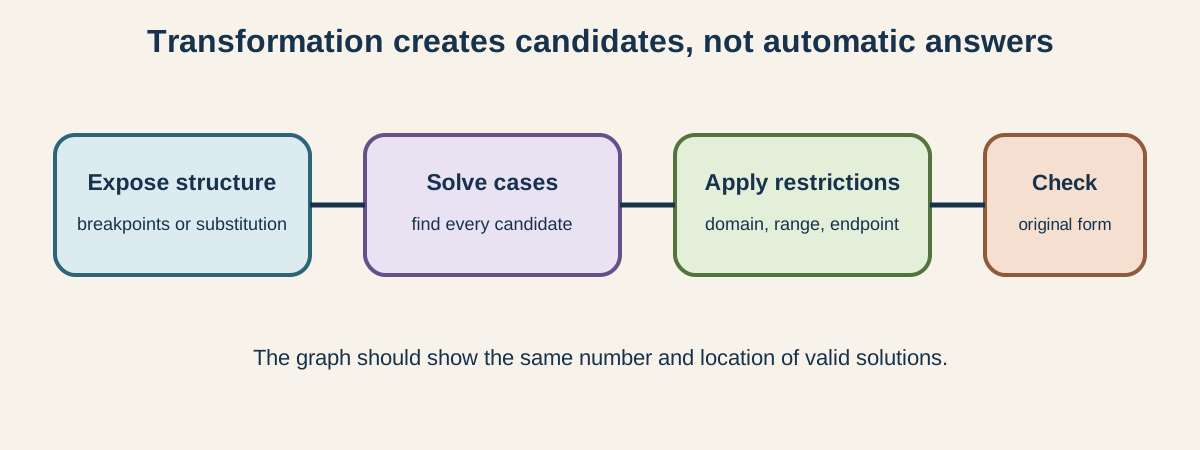
For |ax + b| = c with c ≥ 0, solve ax + b = c and ax + b = -c. For |ax + b| = cx + d, the right side must be non-negative. Solve cases or find intersections of a V-shaped graph and a line, then check every candidate in the original equation.
For |ax + b| = |cx + d|, equality of distances gives ax + b = cx + d or ax + b = -(cx + d). Squaring is also valid but may obscure the simple cases.
3. Modulus inequalities
For c > 0, |u| < c means -c < u < c, while |u| > c means u < -c or u > c. Inclusive signs carry through. These compact rules work when the other side is a positive constant.
When comparing a modulus with a variable expression or another modulus, use breakpoints and intervals, graphs, or careful squaring after checking non-negativity. Breakpoints occur where expressions inside modulus signs change sign and where comparison graphs intersect.
Test one point in each interval. Include equality points only for ≤ or ≥. Present disconnected regions with “or”.
4. Quadratic modulus
Equations such as |ax² + bx + c| = d can be solved through ax² + bx + c = d or = -d, provided d ≥ 0. Graphically, intersect y = |quadratic| with y = d.
For inequalities, first understand the original parabola, reflect its negative part, then compare with the horizontal level. The modulus graph is never below the x-axis, a useful check on the sketch.
5. Substitution to a quadratic
Some non-quadratic equations have a repeated algebraic structure. Define a substitution such as u = x^(2/3), u = ln(5x), or u = eˣ so the equation becomes quadratic in u. Solve that quadratic, then return to the original variable.
Apply restrictions during the back-substitution. An exponential u = eˣ must be positive. A logarithmic expression requires a positive argument. A fractional-power substitution may need separate sign analysis. A root valid for the quadratic in u can still be impossible for x.
Check this topic from memory
Attempt the matching topic bank before reopening the notes. Use each missed idea to decide what to review next.
Start the topic quiz