

Cambridge IGCSE Additional Mathematics Notes 5: Simultaneous Equations
Cambridge IGCSE Additional Mathematics notes on linear and nonlinear simultaneous equations and intersection reasoning.
Cambridge IGCSE Additional Mathematics 0606 Topic 5 requires candidates to solve simultaneous equations in two unknowns by elimination or substitution. The official examples include linear with nonlinear equations, products and rational relationships, so the method must preserve restrictions and recover complete ordered pairs.
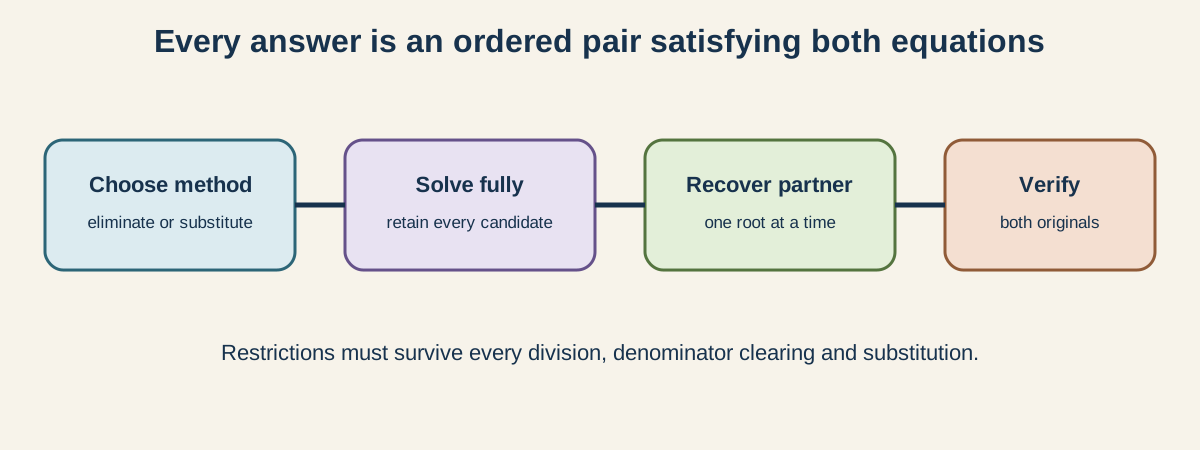
1. What a simultaneous solution means
A simultaneous solution satisfies every original equation at the same time. It is therefore an ordered pair, not two unrelated lists of x-values and y-values. Graphically, each solution is an intersection of the represented curves.
Two straight lines may have one intersection, none if distinct and parallel, or infinitely many if their equations represent the same line. A line and a quadratic curve may intersect at zero, one or two real points. More general nonlinear pairs can generate several candidates, so recover and check each pair systematically.
2. Choosing elimination
Elimination is efficient when one variable occurs in compatible terms. For a linear pair, multiply equations so one variable has opposite coefficients, then add. For nonlinear examples, a shared expression such as xy or xy² may be eliminated without expanding everything.
Treat the repeated expression as a temporary unit. If one equation gives xy = 3 and another contains xy², then xy² = y(xy) = 3y. This may reduce the system immediately.
Valid elimination combines equations without dividing by an expression that could be zero. If division is tempting, handle the zero case separately first.
3. Choosing substitution
Substitution is efficient when one equation isolates a variable or a repeated expression. Rearrange once, substitute into the other equation, solve the resulting one-variable equation, then substitute back.
Use brackets around the entire replacement. If y = x - 2, replace every y with (x - 2), including powers and denominators. Expand only as much as necessary.
The substituted equation may be quadratic or higher-degree. Solve it completely before back-substituting each root. One x-value may produce a unique y through a linear relationship, but do not assume this without checking the original pair.
4. Linear and quadratic intersections
For a line and quadratic curve, substitute the line into the curve. The resulting quadratic's discriminant predicts the number of real intersections. A repeated root means tangency. Two distinct roots give two coordinate pairs.
After solving for x, calculate the corresponding y from the simplest original equation. Pair each x with its own y. Plotting can check the count and approximate position, but exact algebra provides the coordinates requested.
Check this topic from memory
Attempt the matching topic bank before reopening the notes. Use each missed idea to decide what to review next.
Start the topic quiz