

Cambridge IGCSE Additional Mathematics Notes 6: Logarithmic and Exponential Functions
Cambridge IGCSE Additional Mathematics notes on exponential and logarithmic graphs, asymptotes, laws and equations.
Cambridge IGCSE Additional Mathematics 0606 Topic 6 covers simple properties and graphs of exponential and logarithmic functions, their inverse relationship and asymptotes, logarithm laws including change of base, and equations of the form aˣ = b. Transforming experimental relationships into straight-line form belongs to Topic 7 and is not imported here.
1. Exponential functions
For positive base a not equal to 1, y = aˣ is always positive and has domain all real numbers, range y > 0 and horizontal asymptote y = 0. If a > 1, the function increases; if 0 < a < 1, it decreases.
The natural exponential y = eˣ is central. It passes through (0, 1), never crosses the x-axis and changes multiplicatively over equal x-intervals.
The syllabus limits transformed exponential graphs here to y = ke^(nx) + a, where the parameters are integers. The vertical shift changes the horizontal asymptote to y = a. The factor k scales or reflects the graph, while n controls growth or decay and horizontal rate.
2. Logarithmic functions
The logarithm log base a of x is the power to which a must be raised to produce x. Therefore y = aˣ and y = log base a of x are inverse functions.
A logarithmic function has domain x > 0, range all real numbers and vertical asymptote x = 0 before transformations. It passes through (1, 0). The natural logarithm is ln x; common logarithm is base 10 and may be written lg x.
The listed transformed logarithmic graphs have form y = k ln(ax + b), with integer parameters. Their domain requires ax + b > 0, and their vertical asymptote is ax + b = 0. State the asymptote equation, not merely “at the boundary”.
3. Inverse graph relationship
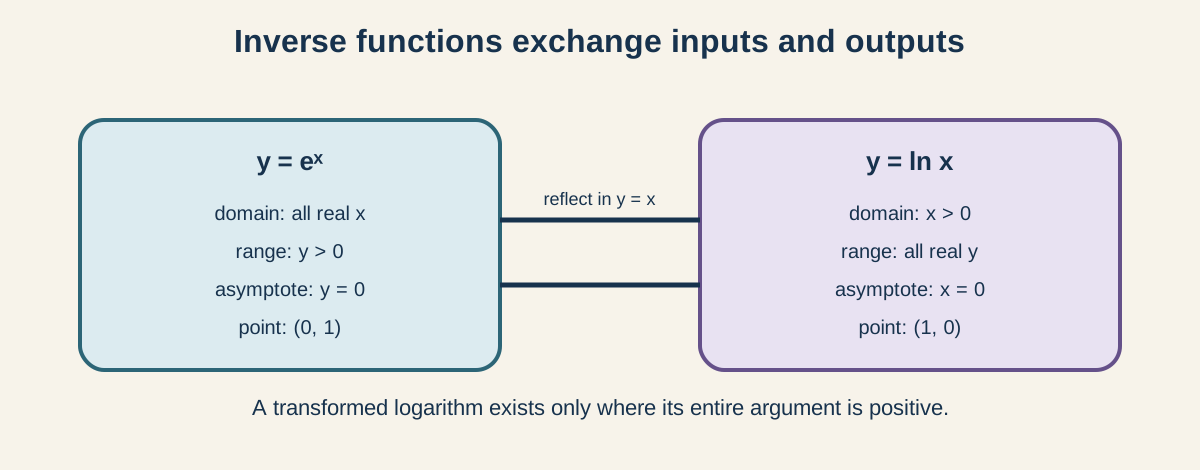
The graphs of y = eˣ and y = ln x reflect in y = x. Their domains and ranges exchange, and the exponential horizontal asymptote y = 0 reflects to the logarithmic vertical asymptote x = 0.
Corresponding points exchange coordinates: (0, 1) on y = eˣ becomes (1, 0) on y = ln x. This reflection explains why ln(eˣ) = x for all real x and e^(ln x) = x only for x > 0.
4. Logarithm laws
For positive M and N:
- log base a of MN = log base a of M + log base a of N;
- log base a of M/N = log base a of M - log base a of N;
- log base a of Mʳ = r log base a of M.
These follow from index laws. There is no law that splits log(M + N) or log(M - N). Every logarithm argument must remain positive, even when an algebraic simplification appears possible.
Constants can be written as logarithms. In base 10, 3 = lg(1000). This allows an expression such as 3 + 2lg p - lg q to combine as lg(1000p²/q), provided p and q are positive.
Check this topic from memory
Attempt the matching topic bank before reopening the notes. Use each missed idea to decide what to review next.
Start the topic quiz