

Cambridge IGCSE Additional Mathematics Notes 8: Coordinate Geometry of the Circle
Cambridge IGCSE Additional Mathematics notes on circle equations, centres, radii, tangents and intersections.
Cambridge IGCSE Additional Mathematics 0606 Topic 8 covers circle equations in centre-radius and expanded forms, line-circle intersections, tangents without calculus, and two-circle intersections including common chords and contact classification.
1. Centre-radius form
A circle with centre (a, b) and radius r has equation
(x - a)² + (y - b)² = r².
The signs inside brackets are opposite the centre coordinates. The right side is radius squared, so take the positive square root to recover r.
A point lies on the circle if substitution makes the equation true. Its distance from the centre is then exactly r. A smaller squared distance places it inside; a larger one places it outside.
2. Expanded form
The syllabus also uses x² + y² + 2gx + 2fy + c = 0. Completing squares gives
(x + g)² + (y + f)² = g² + f² - c.
The centre is (-g, -f) and radius is √(g² + f² - c). The formula is supplied, but completing squares explains it and avoids coefficient-reading errors.
An equation represents a real circle only when r² > 0. A zero value degenerates to one point; a negative value has no real locus.
3. Forming a circle equation
If centre and radius are given, substitute directly. If centre and one point are known, calculate the squared radius from coordinate differences. If endpoints of a diameter are given, find their midpoint for the centre and half their distance for the radius.
An alternative expanded-form method substitutes three non-collinear points into x² + y² + 2gx + 2fy + c = 0 and solves for g, f and c. Three collinear points do not determine a circle.
4. Line-circle intersections
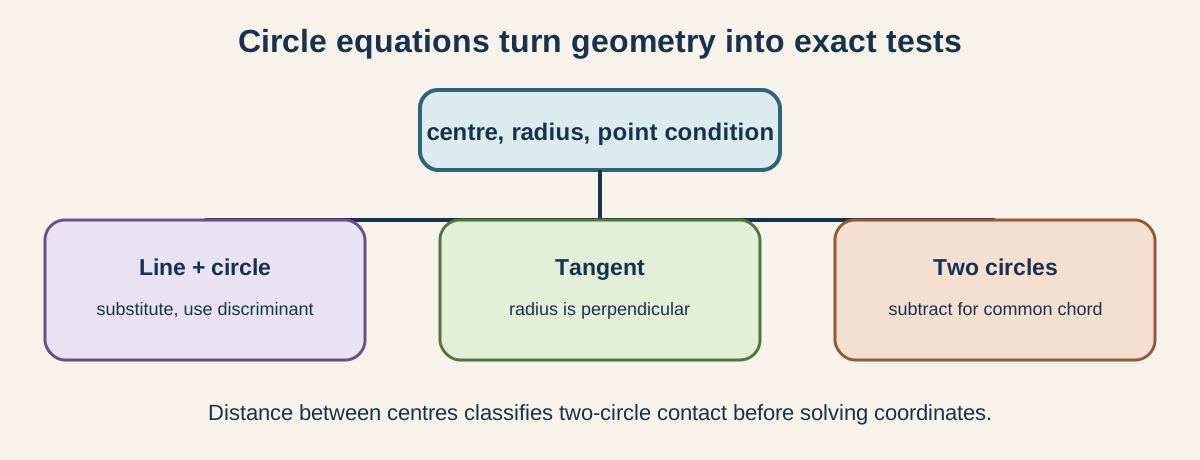
Substitute the line equation into the circle to form a quadratic in one coordinate. Solve it, then recover the partner coordinate from the line. The discriminant classifies the geometry:
- D > 0: the line cuts a chord at two points;
- D = 0: the line is tangent at one point;
- D < 0: the line does not meet the circle.
Report coordinate pairs and verify them in both original equations. A repeated coordinate root corresponds to one contact point.
5. Tangents without calculus
The radius to a tangent point is perpendicular to the tangent. If the centre and contact point are known, find the radius gradient, take its negative reciprocal, and form the tangent through the contact point.
For vertical or horizontal radii, use the corresponding horizontal or vertical tangent directly. The tangent passes through the contact point, not the centre.
Check this topic from memory
Attempt the matching topic bank before reopening the notes. Use each missed idea to decide what to review next.
Start the topic quiz